
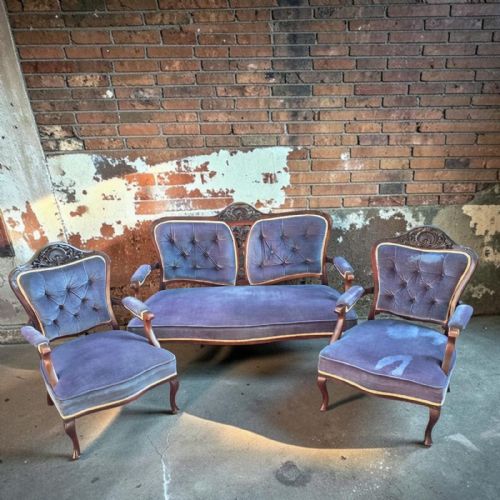


Edwardian Sofa Set
When searching for an edwardian sofa set, collectors find coordinated seating arrangements designed for formal entertaining and comfortable parlour use.
Edwardian Sofa Set
An edwardian sofa set typically comprises a matching settee accompanied by one or more armchairs, often styled as salon, parlour, or boudoir suites. The groupings originate primarily from the early twentieth century, alongside transitional pieces spanning late Victorian periods to nineteen-ten.
Forms vary from tub-shaped settees and twin chairs to larger three-piece suites and expansive five or seven-piece drawing room arrangements. Buyers encounter matching pairs of his and her seats alongside complete curved bergere suites and leather club seating.
How they were made
Construction relies upon solid hardwoods including mahogany, walnut, rosewood, oak, and beech, frequently decorated with delicate marquetry inlay. Frames support traditional upholstery methods, utilising materials such as velvet, damask, leather, and cane panels.
Buyers seeking miniature detail occasionally find Edwardian sofa-shaped pin cushions preserved from nineteen-hundred and two.
What varies in quality
Distinction across the range rests upon the intricacy of the timber work and the integrity of the matching frames. Suites featuring complex marquetry inlay, rosewood construction, or named cabinetmaker attribution stand apart from simpler beech or mahogany framework.
The completeness of the suite dictates desirability, with matched three-piece and multi-piece salon groups commanding greater architectural harmony than assembled single chairs and settees. Preservation of original cane work, leather surfaces, and carved detailing similarly defines the upper tiers.
Howard and Sons·James Shoolbred·J. S. Kinsey
The Edwardian Sofa Set Glossary
- Bergere
- A type of enclosed upholstered armchair or sofa with cane panels on the back and sides. These frames often incorporate polished hardwood structures.
- Salon suite
- A matching collection of seating designed for a formal drawing room or parlour. The grouping typically includes a settee and paired armchairs sharing identical wood and upholstery.
- Marquetry
- Decorative veneer work arranged in pictorial or geometric patterns using various coloured woods. This technique is frequently seen on Edwardian mahogany furniture.
- Tub settee
- A small sofa featuring a continuous curved back and arms that wrap around the seat in a single rounded enclosure. These often stand on tapered wooden legs.
- Damask
- A reversible figured fabric traditionally woven with patterns visible on both sides. It appears frequently as original or replacement upholstery on period seating.
Edwardian Sofa Set: Frequently Asked Questions
What pieces make up a salon suite?
A salon suite typically consists of a matching settee and two matching armchairs designed for formal entertaining. Larger suites may expand to include five or seven coordinated pieces for a drawing room.
These groupings share identical wood types, inlay patterns, and upholstery fabrics to maintain visual harmony across the room.
How do bergere suites differ from upholstered ones?
Bergere suites incorporate woven cane panels into the back and sides of the wooden framework rather than relying entirely on stuffed padding. This style offers a lighter visual presence while maintaining structural support.
Upholstered alternatives use fully covered springs and fabric or leather over the frame without exposed woven cane sections.
Where were these suites placed in the home?
Edwardian sofa sets were positioned in formal public rooms such as drawing rooms, parlours, and salons where guests were received. Smaller boudoir suites were intended for private sitting rooms and bedrooms.
Their coordinated design ensured the seating matched the refined aesthetic expected in turn-of-the-century reception spaces.
How do I identify an Edwardian set?
Edwardian seating generally displays lighter proportions and simpler lines than heavier Victorian precedents, frequently utilising mahogany inlaid with marquetry. Pieces often date from around nineteen-hundred to nineteen-ten, reflecting transitional furniture styles.
Construction details like tapered legs, satinwood banding, and cane panels help distinguish these suites from earlier nineteenth-century furniture.