
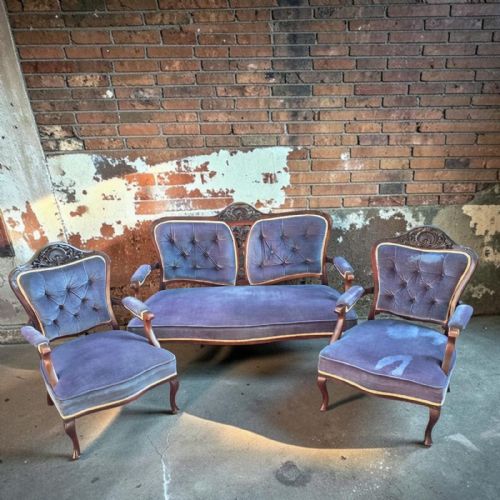


Edwardian Salon Suite
These pieces are an edwardian salon suite, designed to furnish a formal drawing room with matched seating.
What an edwardian salon suite is
An edwardian salon suite comprises matched sets of seating designed for formal entertaining and conversation in the parlour or drawing room. You will most frequently encounter three-piece suites consisting of a settee and two armchairs, alongside larger six-piece or five-piece configurations.
The objects span late Victorian and Edwardian periods, typically dating from around 1890 to 1910. The forms include tub-shaped settee designs, matching armchairs, and occasional chairs styled specifically for the reception room rather than everyday lounging.
Makers and designers of the era arranged these suites to coordinate with the decorative schemes of fashionable homes. The grouping creates a cohesive visual centrepiece in a reception space, uniting settee and chair silhouettes through shared woodwork and upholstery.
How they were made
Cabinet makers utilised solid timbers such as mahogany and rosewood to construct the frames of an edwardian salon suite. Artisans enhanced these dark woods with contrasting boxwood and satinwood inlay, incorporating delicate marquetry details into the show wood.
Upholstery techniques of the period relied on traditional sprung foundations paired with fabric coverings like velvet. Carved ornamentation on the wooden elements complemented the linear precision of the inlaid decorative motifs.
Retail Price Guide 2026
Typical UK retail prices for edwardian salon suite, calculated from the Sellingantiques database of over a million retail prices indexed since 2003. This retail price guide relies exclusively on Sellingantiques data; no external sources or auction records are used, so the figures do not describe the wider market.
Recorded forms range from compact three-piece arrangements to expansive six-piece parlour configurations.
What varies in quality
The refinement of the inlay work and the choice of primary timber distinguish the finer examples from standard production. Richly figured rosewood or dense mahogany paired with intricate satinwood marquetry represents the upper tier of craftsmanship.
The harmony between the carved wooden framework and the integrity of the upholstered forms dictates the overall success of the suite. Suites retaining matched fabric upholstery across every element demonstrate greater original design intent.
James Shoolbred
The Edwardian Salon Suite Glossary
- Salon Suite
- A matched group of drawing room seating designed for formal entertaining. This typically includes a settee and matching armchairs.
- Inlay
- A decorative technique where contrasting strips of wood such as boxwood or satinwood are inserted into recesses in the primary timber. This creates geometric or floral patterns across the surface.
- Marquetry
- Elaborate veneer work forming pictorial designs using various tinted woods. It frequently appears on the crest rails and splats of Edwardian seating.
- Tub Chair
- An armchair featuring a rounded, enclosed back that curves continuously into the arms. It provides a supportive and compact seat.
- Settee
- A small upholstered sofa designed for two or more people. In these suites, it matches the wood and fabric of the accompanying chairs.
Frequently Asked Questions
What pieces come in a suite?
An edwardian salon suite typically includes a settee paired with matching armchairs or occasional chairs. Larger groupings expand to five or six pieces.
These configurations allowed homeowners to furnish a reception room with coordinated seating for guests.
Where were these suites used?
These matching seating sets furnished formal drawing rooms and parlours during the late Victorian and Edwardian eras. They served as the setting for receiving callers and afternoon tea.
The furniture occupied the social centre of the home rather than private family spaces.
How do I care for the wood?
Maintain the polished mahogany or rosewood surfaces by dusting with a soft, dry cloth. Avoid placing the timber in direct sunlight to protect the delicate boxwood inlay.
Keep upholstery clean using appropriate textile care suitable for historic fabrics.
How do I date these suites?
Dating relies on stylistic markers and construction methods bridging the late Victorian and Edwardian periods. Pieces often date between 1890 and 1910.
Inlay styles and frame silhouettes offer key indicators of the exact manufacturing era.