
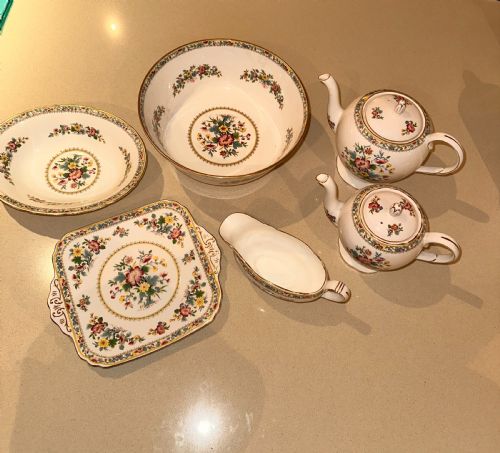


Edwardian Porcelain Tea Set
An edwardian porcelain tea set brings the refined elegance of the early twentieth century straight to the afternoon table.
Edwardian Porcelain Tea Set
When you search for an edwardian porcelain tea set, you look for matching services designed for formal afternoon hospitality. These groupings often include teacups, saucers, and serving pieces produced around the turn of the twentieth century.
The versions you meet on this page span traditional English styles alongside late Victorian influences and transitional Edwardian designs. They appear in forms ranging from compact trios to extensive seventy-piece services.
How they were made
Potters shaped these services using fine porcelain and bone china, forming delicate walls suitable for refined domestic use. Artisans then applied hand-painted decoration to the ceramic surfaces.
Many examples incorporate cobalt enamel and rich gold leaf details or gilt highlights applied around the rims and handles. Kiln firing fixed these colours permanently into the glaze.
What varies in quality
Quality rests primarily on the crispness of the hand-painted brushwork and the complexity of the pattern. Pieces featuring intricate floral motifs or detailed cobalt enamel show a higher level of artisan skill than plain wares.
The preservation of the gilding also separates the fine examples from standard production. Intact gold leaf and rich cobalt accents indicate careful preservation over the decades.
Coalport·Royal Worcester·Royal Albert Crown China·Wileman Foley Shelley·Copeland Spode·Gladstone potteries
The Edwardian Porcelain Tea Set Glossary
- Bone china
- A type of porcelain containing bone ash, known for its high strength, chip resistance, and translucent white body.
- Gilding
- The application of gold leaf or gold paint to ceramic surfaces, typically accenting handles, rims, and borders.
- Cobalt enamel
- A deep blue vitreous pigment fused to the porcelain body during firing, often used for striking contrasting borders.
- Tea trio
- A matching set comprising a teacup, a saucer, and a corresponding tea plate designed for individual use.
Edwardian Porcelain Tea Set: Frequently Asked Questions
How many pieces make a complete tea set?
A standard service usually includes cups, saucers, and plates for multiple guests alongside larger serving items. The exact number of components varies depending on whether the service was intended for a small gathering or a large party.
Larger dinner and tea services on this page can reach up to one hundred pieces. Smaller sets often comprise simple trios or pairs of cups and saucers.
Can I use my antique tea set daily?
These delicate ceramics require gentle handling because of their age and hand-painted details. Hand washing in warm water helps preserve the porcelain and prevents the gold leaf from fading.
Harsh detergents and automatic dishwashers damage the historic glaze and delicate gilding. Many collectors reserve these sets for special occasions rather than everyday breakfast use.
How do I identify Edwardian porcelain?
Edwardian tea wares typically feature softer pastel palettes, naturalistic floral decoration, and lighter forms than heavy Victorian pieces. Many items carry maker marks or registered design numbers on the underside.
Comparing the stylistic motifs helps date the pieces accurately between the late nineteenth century and the outbreak of the First World War. Traditional English styles dominate this specific era.
What is blush ivory porcelain?
Blush ivory refers to a soft, matte cream-coloured ceramic body developed by major potteries during the late Victorian and Edwardian periods. It provides a warm background for delicate hand-painted floral decoration.
Potters frequently combined this finish with raised gold gilding to create an elegant aesthetic. Royal Worcester stands out as a primary maker of this distinctive technique.