
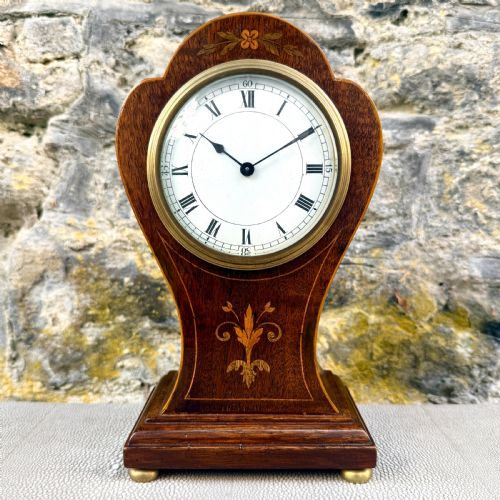
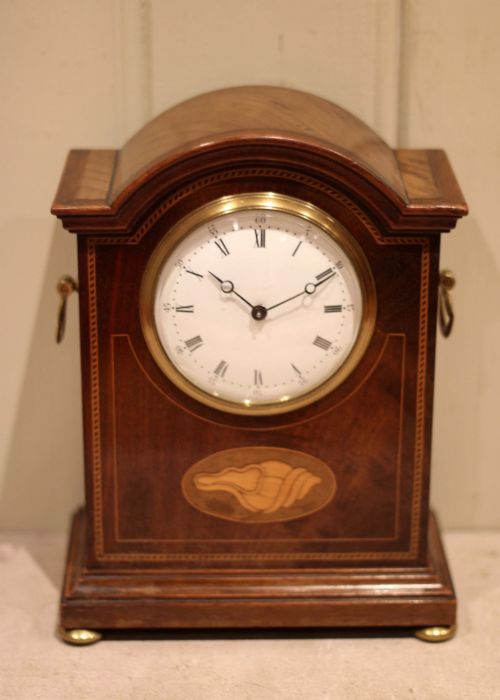
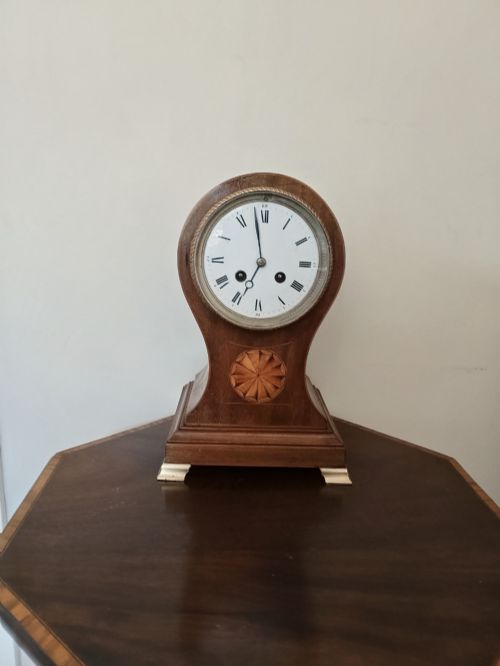
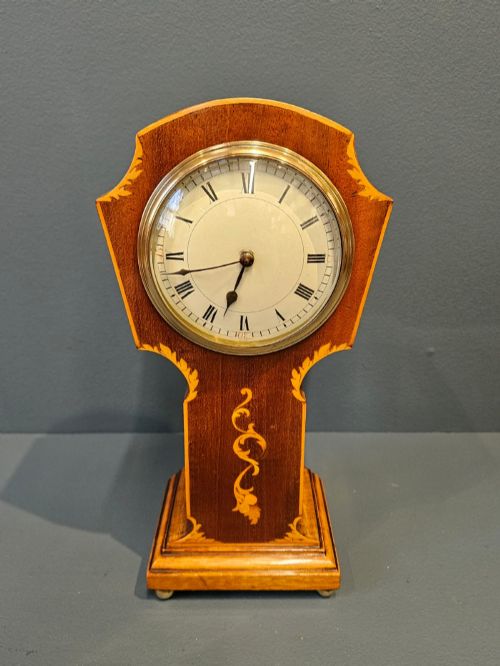


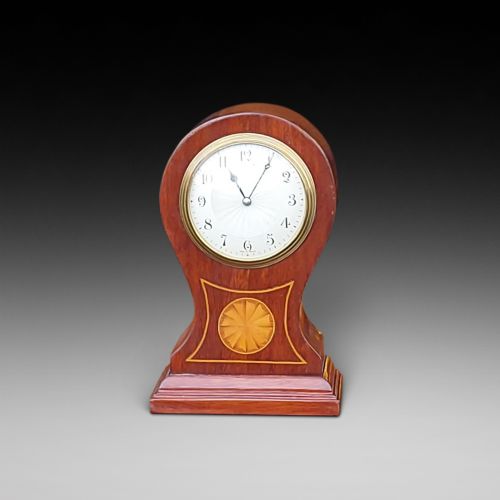


Edwardian Mahogany Balloon Clock
These Edwardian mahogany balloon clocks offer curving proportions and inlaid timber, bringing classic timekeeping to a mantelpiece.

Edwardian Mahogany Balloon Clock
An Edwardian mahogany balloon clock takes the form of a sweeping, curved case that narrows towards the top like a traditional aerostat. These timepieces belong primarily to the Edwardian period and the late nineteenth century, spanning dates from eighteen ninety to nineteen ten. The inventory shows pieces originating from both England and France, capturing a distinct turn of the century aesthetic.
Mantel clocks dominate this category, appearing in various proportions from small table versions to larger bracket clock designs. The silhouette ranges from standard swelling curves to waisted profiles, sometimes incorporating stylistic touches influenced by Art Nouveau. Buyers encounter both simple timepieces and striking movements designed to mark the hours in a drawing room or study.
Materials and Construction
Cabinet makers constructed these cases using solid mahogany and polished veneers, often framing the timber with contrasting details. Satinwood and boxwood inlay appear frequently across the surfaces, forming delicate stringing, herringbone patterns, or pictorial motifs such as a Dutch girl. This meticulous woodcraft relies on seasoned hardwoods selected for their rich grain and ability to hold a precise curve.
Brass fittings and bevelled glass doors protect the delicate dial faces inside the wooden housing. Enamel dials or silvered metal dials display the numerals, whilst French and English movements drive the internal gear trains. The integration of metalwork and cabinetry requires precise alignment so the balloon shape remains structurally sound.
The documented pieces span the Edwardian period, the late nineteenth century, and the early years of nineteen ten.
Evaluating the Craft
The distinction between ordinary examples and the finest pieces rests on the precision of the cabinet work and the complexity of the internal mechanism. Superior models exhibit crisp, unbroken inlay work alongside robust single fusee or striking movements. Lesser examples might display simpler timber selection with plain mahogany lacking decorative stringing or detailed brass furniture.
Proportion and visual balance dictate the standing of a balloon clock within a collection. A well-executed waisted or swelling case maintains symmetry along its curved profile without distortion in the wood. The clarity of the enamel or silvered dial and the presence of a maker stamp further elevate the desirability of the piece.
Mappin & Webb·Asprey London·Harrods
The Edwardian Mahogany Balloon Clock Glossary
- Balloon clock
- A mantel clock featuring a rounded, upward-swelling wooden case resembling the shape of a hot air balloon. This silhouette became especially popular during the Edwardian era.
- Fusee
- A conical pulley used in mechanical clocks to maintain even tension on the gear train as the mainspring unwinds. This mechanism improves timekeeping accuracy across the power reserve.
- Inlay
- A decorative technique where contrasting pieces of wood, such as boxwood and satinwood, are inserted into recessed portions of the mahogany carcase. Artisans utilise this method to create borders and pictorial designs.
- Silvered dial
- A metal clock face treated with a silver compound to produce a matte, reflective finish for the numerals. This treatment provides a clear contrast against dark mahogany timber.
- Waisted
- A case design that nips inward near the middle before swelling out again towards the base. This specific contour adds sculptural elegance to the standard balloon profile.
Edwardian Mahogany Balloon Clock: Frequently Asked Questions
How do I wind an Edwardian balloon clock?
Most of these clocks use a key inserted into the dial face to tension the mainspring behind the movement.
Take care not to overwind the mechanism, stopping as soon as resistance is felt to protect the internal springs.
Where should I place a balloon clock?
These pieces sit securely on mantelpieces, sideboards, or bracket shelves in reception rooms and studies.
Ensure the surface is completely level so the pendulum or balance wheel maintains a steady beat.
How can I tell the period of the clock?
Examine the wood selection, inlay styles, and dial materials to determine the likely date of manufacture.
Edwardian pieces often feature delicate boxwood or satinwood stringing combined with enamel or silvered dials.
What is the difference between a timepiece and a striking clock?
A timepiece simply tells the time without sounding any chimes or hours.
Striking models include additional gear trains and a gong or bell to sound the passage of time.