
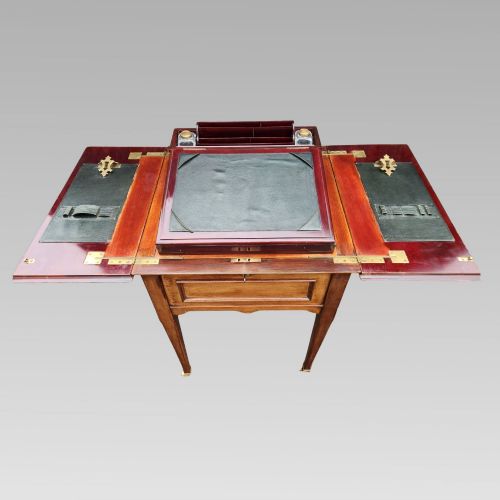


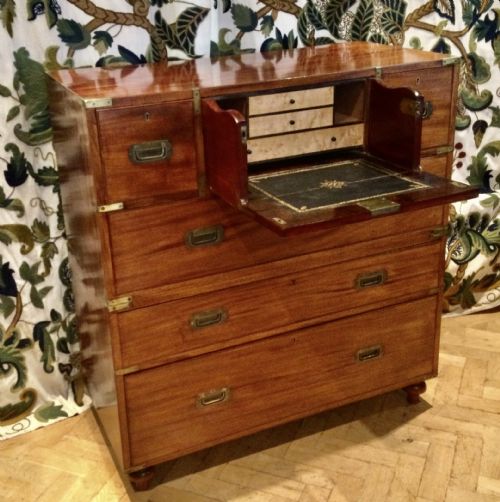
Edwardian Campaign Desk
These edwardian campaign desk pieces are portable writing furniture built for travel, offering utilitarian brass binding, folding frames and fitted interiors.
Edwardian Campaign Desk
An edwardian campaign desk combines traditional writing furniture with the modular, transportable design of military equipment. These pieces draw on earlier Victorian and nineteenth-century precedents to provide compact writing surfaces.
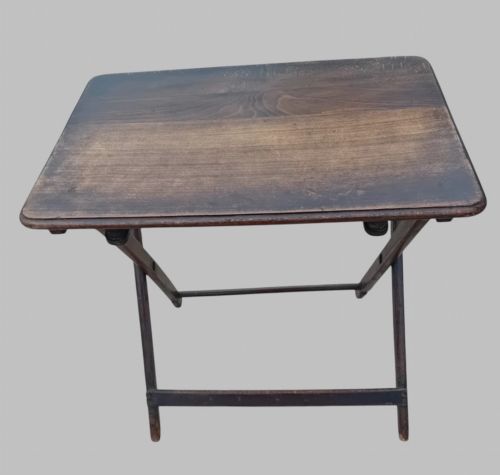
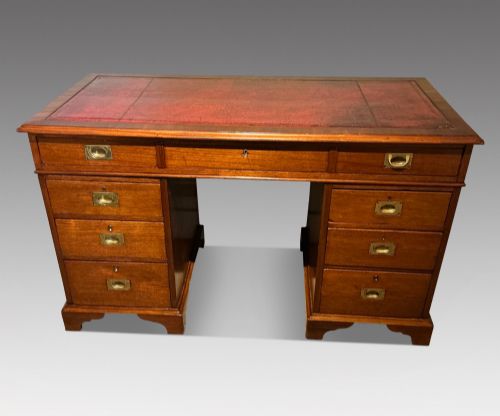
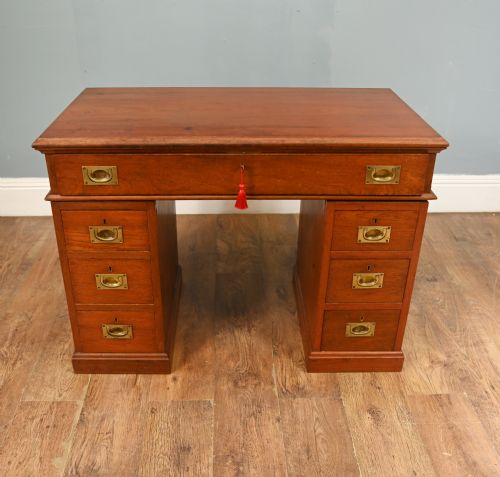
The version most commonly met on this page is the Edwardian mahogany or satinwood folding table, alongside pedestal desks and lap desks from the same period. They frequently feature inlaid wood or brass corners intended for durability during travel.
How they were made
Cabinetmakers constructed these pieces primarily from solid mahogany, walnut, teak, beech, and satinwood, chosen for strength and grain. Secondary woods and structural supports often utilised oak or simpler timbers.
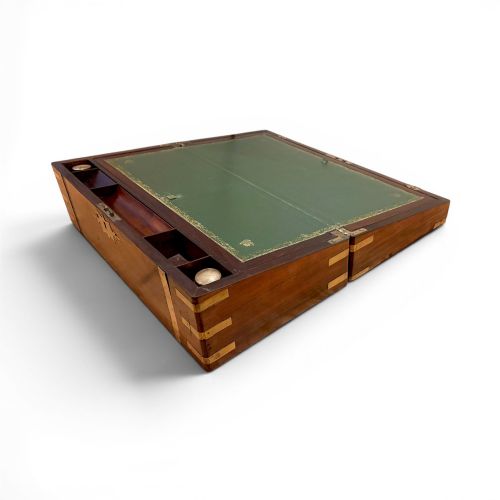
Metal hardware played a central role in construction, with recessed brass handles, corner brackets, and binding protecting the edges from impact. Fold-over mechanisms, secret drawers, and lift-action compartments utilised precise joinery to ensure stability when assembled.
Listings span from the 1860s through the Edwardian period to 1910, encompassing mahogany, walnut, teak, satinwood, beech, oak, brass, and leather.
What varies in quality
Quality rests in the precision of the brass hardware integration and the stability of the folding or modular joints. Superior examples maintain rigid alignment and smooth operation in their drawers and folding leaves.
The selection of timber grain and the fineness of inlay work separate standard utilitarian pieces from high-status examples. Original leather writing surfaces and intact working keys contribute to historical integrity.
The Edwardian Campaign Desk Glossary
- Campaign style
- Furniture designed for easy transport and military use, typically featuring brass corners and folding elements.
- Secretaire
- A desk or chest of drawers containing a fitted pull-out writing drawer with pigeonholes and small compartments.
- Writing slope
- A portable box with a slanted writing surface that opens to reveal storage for stationery and ink.
- Satinwood
- A durable hardwood with a lustrous, golden-yellow sheen used for fine inlay and cabinetwork.
Edwardian Campaign Desk: Frequently Asked Questions
What is an edwardian campaign desk?
An edwardian campaign desk is portable writing furniture inspired by military campaign pieces, designed for mobility with folding frames or compact proportions.
These pieces typically incorporate mahogany, satinwood, or walnut, often fitted with brass corners and recessed handles for transport.
How were campaign desks used?
Officers and travellers utilised these desks as portable writing stations during transit and military postings. They provided secure storage for correspondence, documents, and writing implements.
The fold-out mechanisms and fitted interiors allowed a complete workspace to pack down into a manageable box or table.
How do I tell Edwardian pieces apart from Victorian ones?
Edwardian campaign desks generally date from around 1901 to 1910, often exhibiting lighter timbers like satinwood and more decorative inlay work. Victorian examples, spanning the nineteenth century, tend to be heavier, constructed from dense mahogany or teak with robust brass binding.
Stylistic cues also help distinguish the eras, as Victorian pieces lean toward utilitarian military rigidity while Edwardian versions occasionally incorporate refined domestic styling.
Are campaign desks suitable for daily use?
These desks adapt well to contemporary use as compact writing tables or hallway furniture. Their clever compartments and folding designs offer practical storage for modern stationery and laptops.
Care should be taken with antique leather writing surfaces and original brass mechanisms to preserve their condition.