
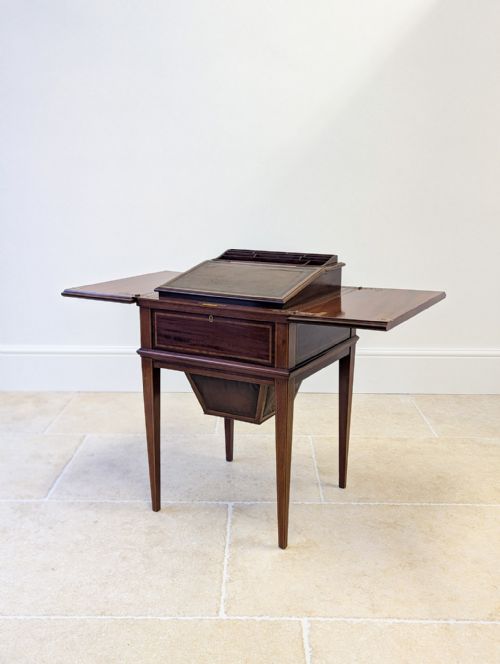
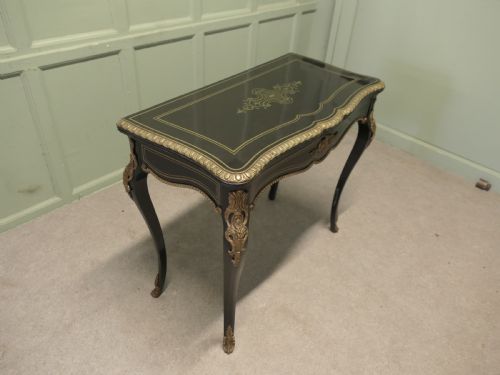
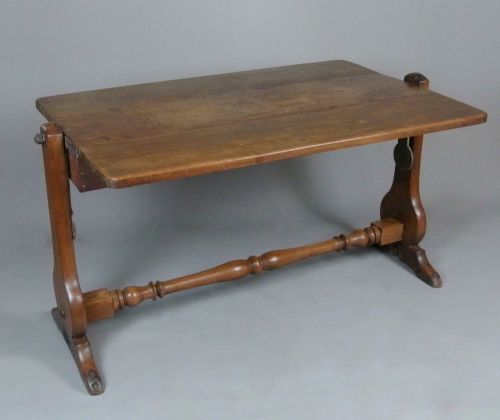
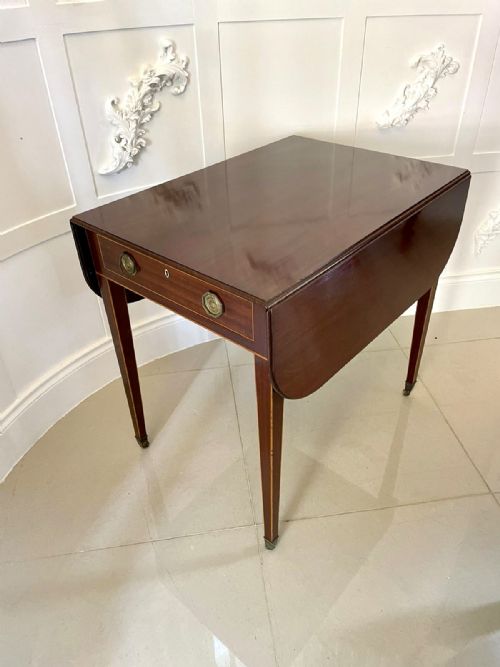
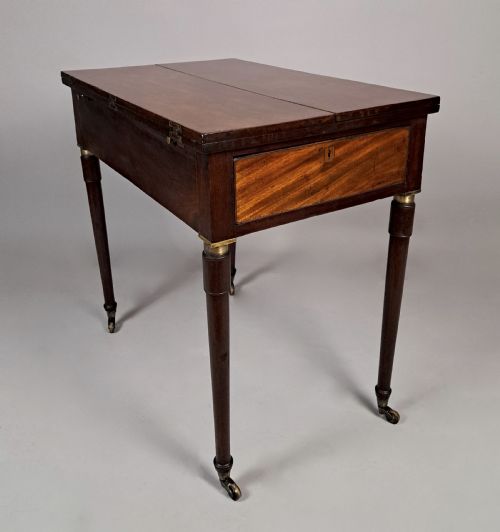
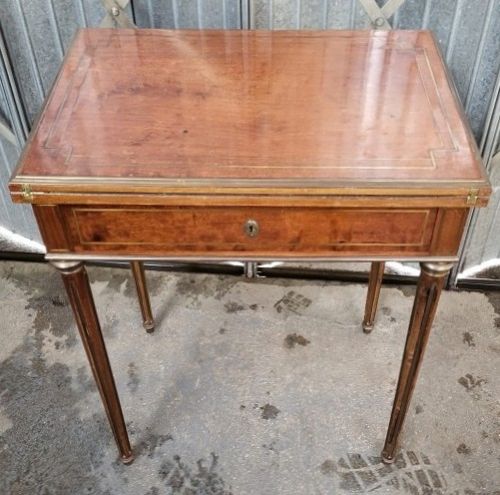

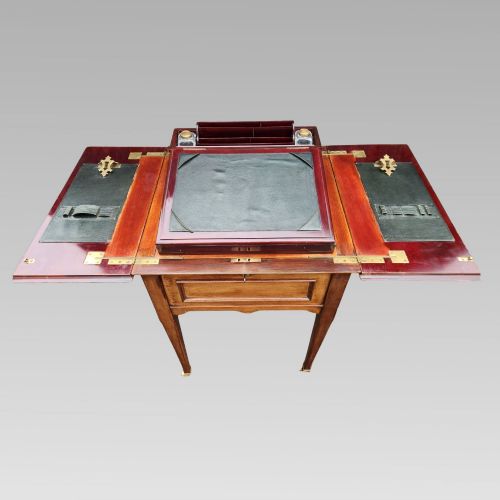


Folding Writing Table
A folding writing table provides a practical surface for correspondence while packing down neatly into compact spaces.
Folding Writing Table
A folding writing table serves as a portable desk or dual-purpose surface, appearing in forms such as campaign desks, games tables, and drop-leaf designs. When you search for a folding writing table, you encounter pieces engineered to save space, adapting from modest side tables into functional writing spaces.
The versions most common on this page date from the Georgian and Edwardian eras, along with Victorian and early twentieth-century examples. Makers constructed these tables in mahogany, walnut, and teak, frequently incorporating folding leaves, lift actions, and fitted drawers.
These items reflect the demands of travel, compact living, and multipurpose rooms. A buyer finds both utilitarian campaign pieces intended for travel and refined inlaid furniture designed for domestic use.
How they were made
Craftsmen built these tables primarily using hardwoods such as mahogany, walnut, and teak, selected for durability and finished with brass hardware to withstand movement. Inlaid details in satinwood, boxwood, and ebonised wood add decorative contrast to the primary timber surfaces.
Many examples incorporate specialised folding mechanisms, drop flaps, and lift actions that allow the desk surface to expand or stow away. Leather inserts often provide a smooth writing plane within the timber framework.
Listings feature woods such as mahogany, walnut, burr walnut, and teak, alongside brass hardware and leather inserts.
What varies in quality
Quality in a folding writing table lies in the precision of its mechanical joints and the integrity of its folding actions. Superior examples operate smoothly, utilising solid timbers and robust brass hinges that endure repeated transformation.
Finer pieces display careful timber selection, such as burr walnut or figured mahogany, alongside delicate inlay work and well-fitted internal drawers. Poorer variants rely on simpler construction and basic secondary woods without the refinement of period craftsmanship.
Gillows·J.C Vickery
The Folding Writing Table Glossary
- Campaign table
- A portable piece of furniture designed to fold or dismantle easily for military or travel use. These items often feature brass mounts and robust timber construction.
- Metamorphic
- Describing furniture that transforms from one form into another, such as a side table that converts into a writing desk. This engineering allows single pieces to serve multiple functions.
- Pembroke table
- A small, drop-leaf table with hinged flaps on either side, often featuring a single drawer. It provides flexible surface area for writing or occasional use.
- Inlay
- A technique where pieces of contrasting wood, such as satinwood or boxwood, are inserted into the primary timber surface to create decorative patterns.
- Ebonised wood
- Timber treated to resemble ebony, achieving a dark, polished finish frequently utilised in nineteenth-century decorative styles.
Folding Writing Table: Frequently Asked Questions
What is a folding writing table?
A folding writing table is a space-saving piece of furniture designed to provide a writing surface that can be folded, packed, or transformed when not in use.
These tables range from utilitarian campaign desks used during travel to refined Edwardian and Georgian examples meant for the home.
How do campaign writing tables work?
Campaign tables utilise clever hinges, folding legs, and removable sections so the entire desk packs down into a compact box or flat panel for transport.
Officers and travellers relied on these sturdy pieces to establish a functional workspace anywhere.
What materials are common?
Mahogany and walnut form the structural core of most examples, frequently complemented by brass corners, handles, and hinges.
Some pieces feature leather writing surfaces and decorative inlays in satinwood or boxwood.
How do I date a folding table?
Dating relies on stylistic clues, hardware design, and timber choice, ranging from eighteenth-century Georgian proportions to Edwardian inlay.
Mechanical complexity and specific maker signatures also help establish the era of manufacture.