
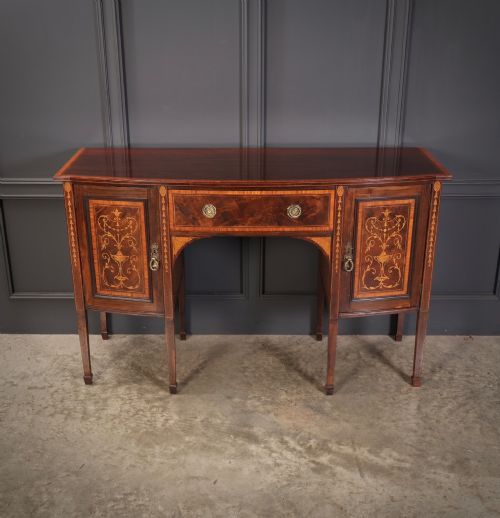


Edwardian Bow Front Credenza
An Edwardian bow front credenza offers elegant curved storage, bringing refined proportions and classical revival detail into a dining room or hall.
Edwardian Bow Front Credenza
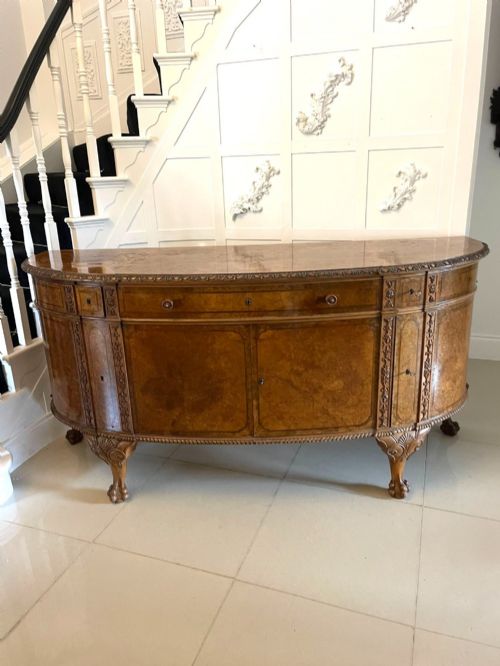
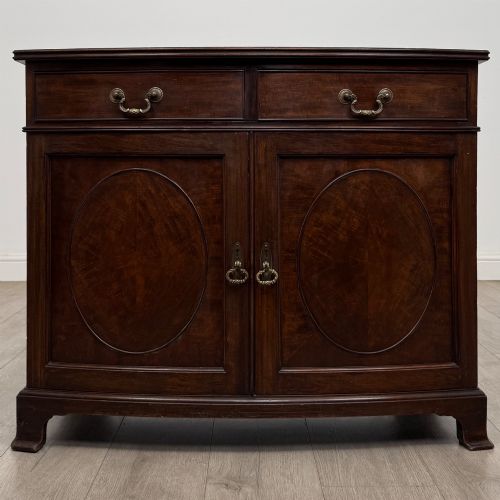
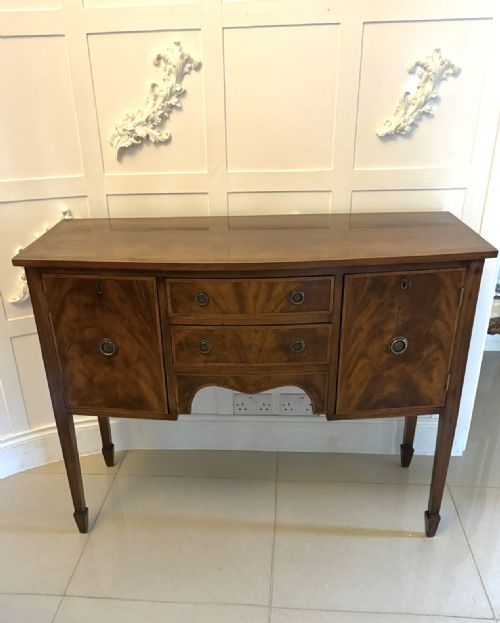
An Edwardian bow front credenza is a sophisticated storage piece designed with a gently curved frontal silhouette that softens the room. These cabinets appear primarily as sideboards and side cabinets originating from the early twentieth century alongside revival periods.
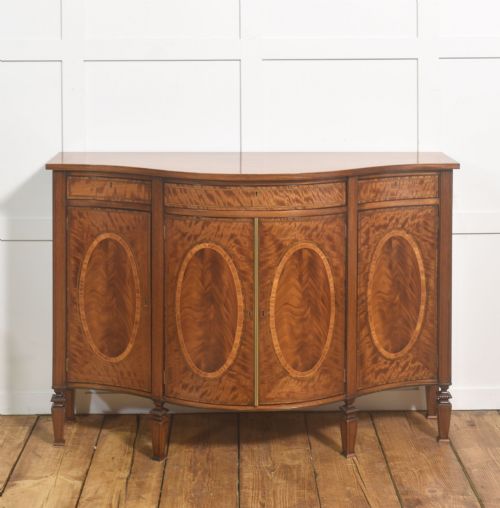
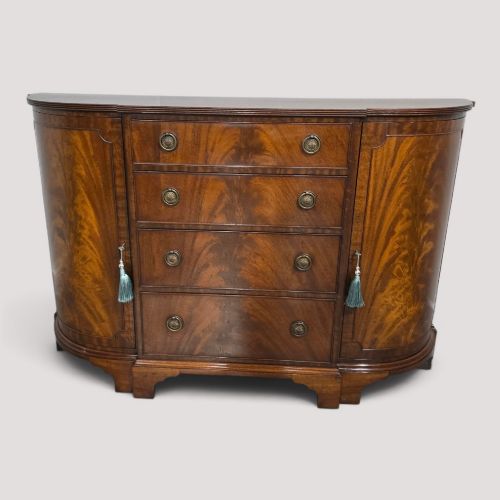
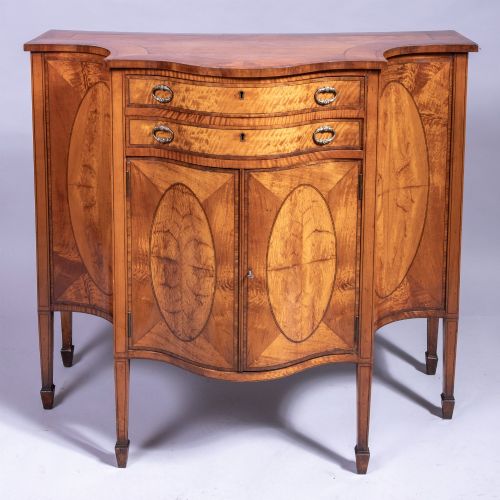
Buyers seeking this form encounter substantial mahogany and satinwood structures finished with delicate stringing and marquetry. The pieces function as practical servers and display surfaces while anchoring a traditional interior scheme with polished timber.
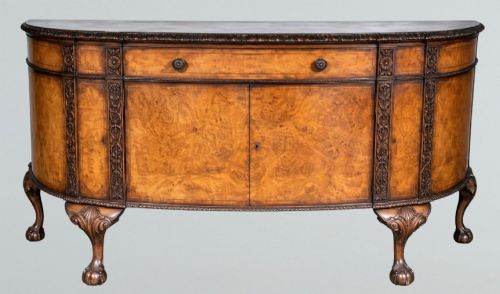
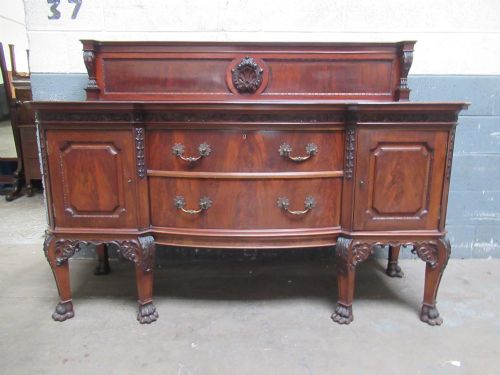
Examples span from compact small cupboards to large carved burr walnut service tables. The design draws heavily upon eighteenth-century classical motifs adapted for Edwardian dining rooms.
How they were made
Cabinetmakers constructed these pieces using solid mahogany, walnut, and hardwood frames overlaid with flame mahogany veneer or burr walnut. Satinwood panels provided a contrasting blonde ground for intricate boxwood inlay and marquetry decoration.
Brass mounts, handles, and gallery rails supplemented the woodwork, while specialised techniques shaped the timber into the characteristic convex curve. Polished finishes highlighted the natural grain patterns of the selected timbers.
One twenty-piece inventory includes a hidden twelve-piece cutlery set waiting patiently inside a burr walnut sideboard.
What varies in quality
The standard of timber selection and veneer matching defines the upper tier of these pieces. Fine grain figures on the bow front require careful symmetry and expert application across the curved surface.
Execution of the marquetry inlay and stringing marks the difference between workshop output. Crisp carving on walnut frames and substantial brass hardware indicate superior craftsmanship during production.
Edwards and Roberts
The Edwardian Bow Front Credenza Glossary
- Bow front
- A convex curved frontal profile that swells outward from the corners. This shape softens the rectilinear geometry of typical dining room furniture.
- Credenza
- A sideboard or buffet cabinet used for serving food and storing tableware. The term applies broadly to low side cabinets with cupboards.
- Marquetry
- Decorative patterns formed by fitting together contrasting veneer slices into a wooden surface. This technique creates pictorial or geometric designs on drawer fronts and doors.
- Sheraton Revival
- A late nineteenth and early twentieth century design movement replicating the neoclassical style of Thomas Sheraton. Pieces feature delicate proportions, tapered legs, and satinwood finishes.
- Satinwood
- A durable yellowish timber valued for its lustrous grain and smooth finish. Cabinetmakers utilised it extensively for contrasting crossbanding and inlay.
Edwardian Bow Front Credenza: Frequently Asked Questions
Where should a bow front cabinet go?
These cabinets suit dining rooms, grand hallways, or living spaces where surface area and enclosed storage are required. Their curved profile prevents sharp corners jutting into walkways.
Ensure adequate clearance around the piece so the doors and drawers open fully without obstruction from nearby furniture.
How do I identify an Edwardian piece?
Look for characteristic Edwardian indicators such as lighter mahogany tones, satinwood crossbanding, and refined boxwood stringing. Construction methods often combine machine precision with traditional hand finishing.
Compare the hardware, timber thickness, and internal secondary woods with pieces securely dated to the early twentieth century.
Can I store heavy items inside?
Solid mahogany and hardwood carcases provide sturdy internal shelving suitable for heavy tableware and dinner services. The internal depth accommodates large platters and serving dishes.
Distribute weight evenly across the shelves to maintain the structural integrity of the timber framing over time.
What is Sheraton Revival style?
Sheraton Revival refers to furniture manufactured around nineteen hundred that imitates the lighter neoclassical designs of the eighteenth-century designer. These items emphasise elegance, symmetry, and classical motifs.
Such pieces frequently incorporate satinwood veneers, painted details, and tapered spade feet rather than heavy Victorian mass.