
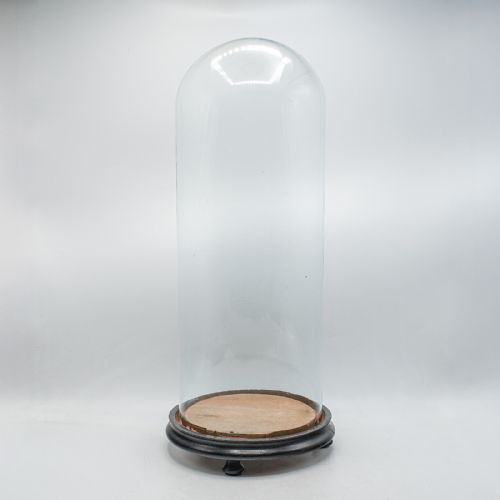
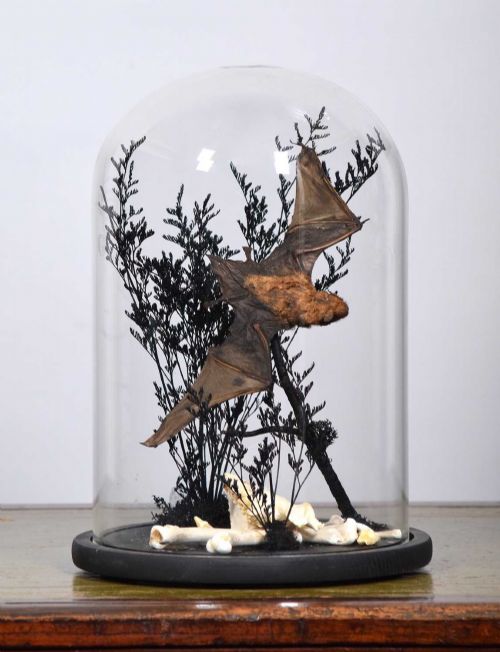
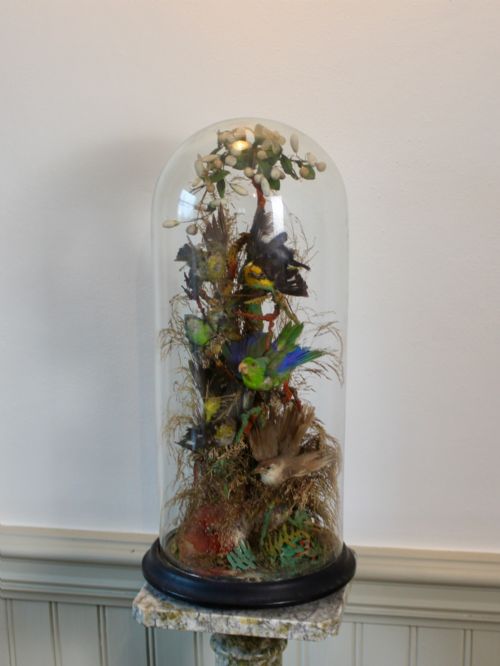


Ebonised Taxidermy Dome
An ebonised taxidermy dome brings preserved natural specimens into interior spaces beneath protective glass.
Ebonised Taxidermy Dome
When you search for an ebonised taxidermy dome, you encounter protective glass covers paired with blackened wooden bases designed to house preserved birds, bats, skeletons, and botanical compositions. These pieces originate predominantly from the Victorian, Edwardian, and late nineteenth-century periods, capturing the era's intense fascination with natural history and scientific collection.
You are most likely to meet Victorian and Edwardian examples featuring blown glass bell jars or oval covers resting directly upon moulded plinths. The specimens inside range from single colourful exotic birds and pairs of snow buntings to complex multi-species dioramas and anatomical skulls.
The form functions as both a domestic ornament and a mini museum showcase, often built with tall or wide proportions to accommodate branching perches. English makers constructed these protective cases to guard delicate feathers and bone structures from dust and atmospheric degradation.
Materials and technique
Makers utilised mouth-blown glass to create clear, protective domes and bell jars that fit snugly into grooved wooden bases. This glass often displays slight natural bubbles and uneven thickness characteristic of nineteenth-century production methods.
The wooden bases and plinths were finished with ebonising techniques to imitate costly ebony, providing a dark, uniform contrast that highlights the bright plumage and natural tones of the specimens within. Additional internal elements frequently incorporate fabric, felt, velvet, bone, and dried foliage to construct a believable habitat.
Taxidermists arranged birds, bats, and small animals around wooden branches or wire armatures fixed securely to the base before lowering the glass cover into place. Some specialised variants utilised flat-sided or ovoid glass covers tailored to specific display requirements.
Listings feature Victorian and Edwardian periods, utilising materials such as glass, ebonised wood, fabric, feathers, felt, bone, and velvet.
Variations in quality
Quality rests significantly on the skill of the taxidermist and the botanical accuracy of the internal composition, distinguishing master naturalists from amateur arrangers. Naturalistic posture and vibrant feather preservation elevate specific pieces well above basic domestic ornaments.
The clarity and integrity of the original glass dome heavily influence overall standard, with heavy, unblemished blown glass representing superior craftsmanship. Bases constructed from solid pine or hardwoods finished cleanly with ebonised treatments outlast simpler, lower-grade alternatives.
A Pollard·James Gardner
The Ebonised Taxidermy Dome Glossary
- Ebonised
- Wood treated with stain, dye, or varnish to resemble solid ebony. This dark finish was widely applied to nineteenth-century display bases to provide a neutral backdrop.
- Cloche
- A bell-shaped glass cover used to protect delicate items. These transparent bell jars sit directly upon matching wooden or fabric-lined plinths.
- Diorama
- A three-dimensional scene depicting animals or plants in a simulated natural habitat. These complex compositions often include rocks, branches, and painted backgrounds inside the glass enclosure.
- Pipistrellus pipistrellus
- The scientific term for the common pipistrelle bat. Specimens of this small mammal occasionally appear preserved within nineteenth-century scientific displays.
- Plinth
- The solid wooden base supporting the glass dome and internal specimens. These round, oval, or rectangular foundations frequently incorporate mouldings and footed supports.
Ebonised Taxidermy Dome: Frequently Asked Questions
How were these domes used historically?
Victorian and Edwardian households displayed these glass-covered specimens in parlours and studies as decorative ornaments and educational conversation pieces. They served as domestic display cases for natural history specimens collected during expeditions or prepared by professional taxidermists.
Naturalists and collectors also utilised specialised botanical and anatomical domes for academic study. The sealed glass environment protected fragile feathers, bones, and plant matter from dust and handling.
How do I identify a Victorian dome from an Edwardian one?
Victorian examples, dating roughly from 1837 to 1901, frequently feature heavy ebonised wooden bases with ornate mouldings and complex multi-bird compositions. The glass on nineteenth-century pieces often shows slight irregularities and thickness variations from hand-blowing techniques.
Edwardian domes, produced after 1901, tend toward slightly simpler display framing and cleaner lines while maintaining traditional taxidermy showcase formats. Documentation, labels underneath bases, or specific maker signatures often clarify the exact period of manufacture.
Where should I place a taxidermy dome at home?
Position the piece on a sturdy sideboard, mantelpiece, or dedicated display cabinet away from high-traffic areas. Stable placement prevents accidental knocks against the fragile glass cover.
Keep the dome out of direct sunlight and away from radiators or damp spaces. Fluctuating temperatures and ultraviolet light cause fading in historical feathers, fabrics, and taxidermy specimens.