
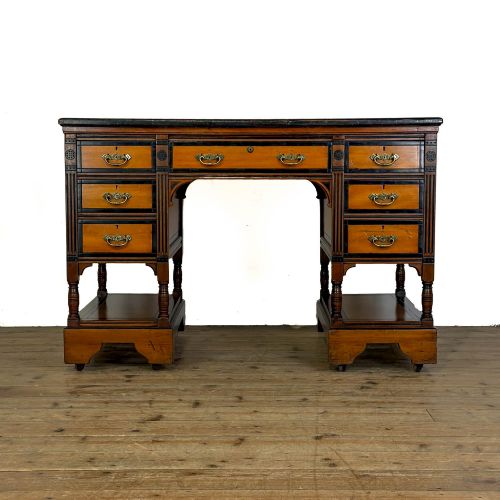
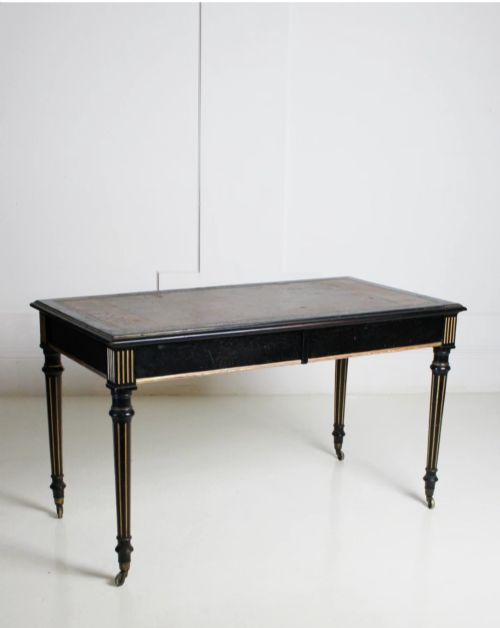
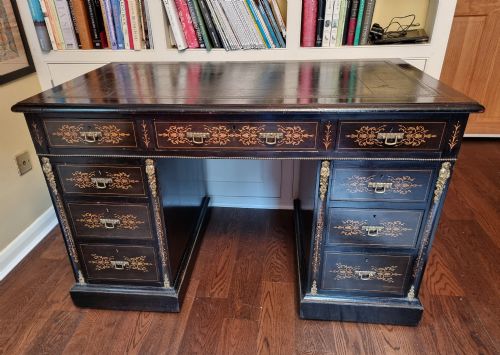
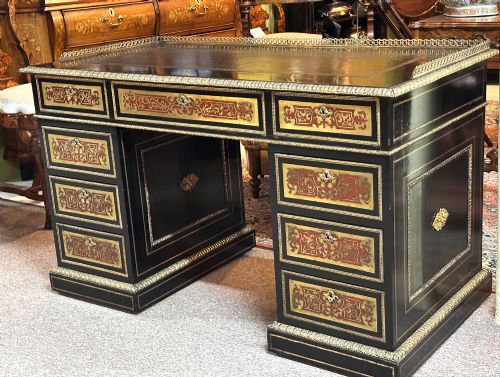
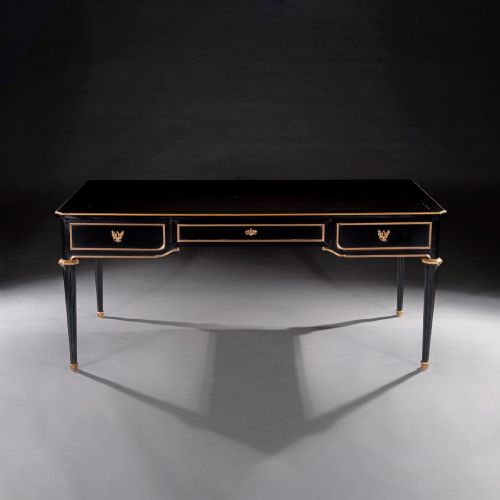
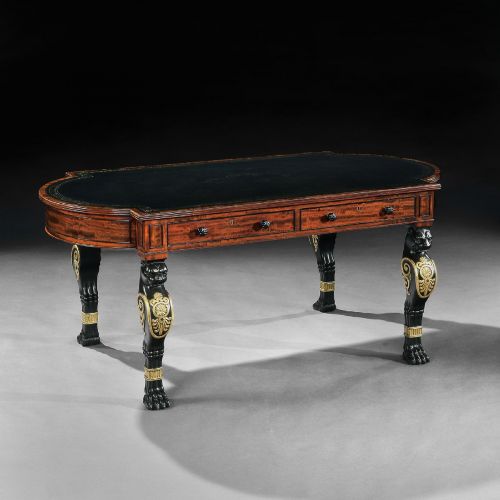


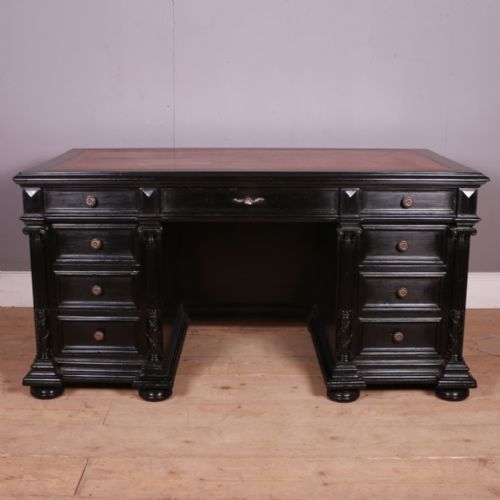


Ebonised Executive Desk
An ebonised executive desk is a striking centrepiece of dark wood and scholarly utility, built for serious work.
Ebonised Executive Desk
When you search for an ebonised executive desk, you are looking at substantial writing tables and pedestals finished in deep black, mostly originating from the nineteenth century. These pieces combine commanding presence with practical workspace.
The versions you are most likely to meet on this page span Victorian and Aesthetic Movement periods, alongside French and Regency revivals. They appear in forms such as double-sided partners desks, kneehole desks, and bureau plat writing tables.
Makers such as Edwards and Roberts contributed to this tradition, producing refined library tables and pedestal desks in ebonised wood, mahogany, and burr walnut. The selection here reflects diverse revivals, from French Boulle work to Swedish Empire styles.
How they were made
Construction relies on a foundation of solid timbers like mahogany, pine, or birch, which are then ebonised to achieve a deep, uniform dark finish. Selected examples incorporate burr walnut, satinwood, and amboyna for contrasting panels and interior surfaces.
Metal mounts in brass and ormolu provide structural accents and decorative framing around drawers and corners. Inset writing surfaces of leather complete the top, bordered by gilt tooling or wood banding.
Materials across the selection include ebonised wood, mahogany, burr walnut, amboyna, brass, ormolu, and leather.
What varies in quality
Quality rests in the precision of the ebonisation and the crispness of applied ormolu or brass mounts. Finer examples display meticulous joinery and carefully chosen secondary timbers beneath the dark finish.
The treatment of the writing surface and the execution of specialist decoration, such as Boulle work or marquetry, separate standard production pieces from top-tier commissions.
Edwards and Roberts
The Ebonised Executive Desk Glossary
- Ebonised wood
- Timber treated to resemble ebony, creating a dense black finish popular in nineteenth-century furniture design. This technique was widely utilised during the Victorian and Aesthetic periods.
- Ormolu
- Gilded bronze mounts and ornaments applied to furniture for decorative effect. It adds bright metallic contrast to dark ebonised surfaces.
- Partners desk
- A large double-sided desk designed for two people to work opposite one another. These pieces feature drawers and cupboards accessible from both sides.
- Bureau plat
- A freestanding French writing table with drawers in the frieze. It typically stands on slender legs rather than heavy pedestals.
- Boulle work
- Intricate marquetry inlay using brass and tortoiseshell, named after the cabinetmaker André-Charles Boulle. It appears on select French writing tables.
Ebonised Executive Desk: Frequently Asked Questions
What is an ebonised executive desk?
An ebonised executive desk is a substantial nineteenth-century writing table or pedestal desk finished in a dark, ebony-like stain. These pieces were designed for study or office use and often feature brass or leather details.
They appear in various revival styles, including Victorian, Regency, and French designs, offering both storage and a broad writing surface.
How do I care for ebonised wood?
Ebonised furniture requires gentle dusting with a soft, dry cloth to prevent scratching the dark surface. Avoid harsh chemical cleaners and direct sunlight, which can fade the finish over time.
Conditioning the wood occasionally with appropriate wax helps maintain the depth of the black colour and protects the timber.
Are these desks double-sided?
Many of the larger pedestal and partners desks listed here provide drawers and workspace on both sides. This allows two people to sit opposite each other.
Single-sided library tables and bureau plat designs are also common, intended to sit against a wall or float in the middle of a room.
What periods do these desks come from?
The pieces on this page primarily date from the nineteenth century, encompassing the Victorian era and the Aesthetic Movement. Later revivals from the early twentieth century also appear.
Stylistic influences range from Regency and French Napoleon III to Swedish Empire styles.