

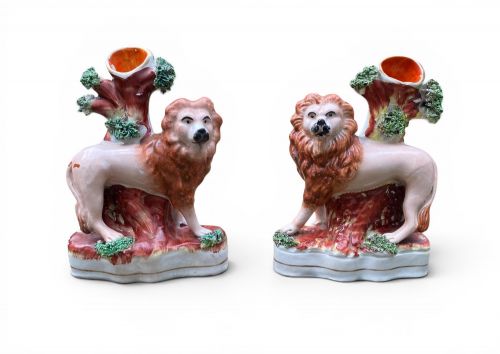


Earthenware Lion Ornament
An earthenware lion ornament brings a strong sculptural presence to a room, cast in clay and finished with rich glaze or enamel.
Earthenware Lion Ornament
An earthenware lion ornament takes many forms across different periods, from classic Staffordshire models to spill vases and bookends. Buyers searching for an earthenware lion ornament encounter figures modelled as recumbent beasts, seated guardians, or pairs with heraldic partners like the unicorn.
The pieces on this page span the eighteenth, nineteenth, and early twentieth centuries, drawing on British, European, and Japanese ceramic traditions. Victorian Staffordshire works appear most frequently, alongside Pearlware, tin-glazed earthenware, and Japanese Kutani porcelain interpretations.
Materials and construction
Potters shaped these earthenware lion ornaments using local clays and ceramic bodies, often applying pearlware or lead glazes to achieve smooth surfaces. Treacle glaze, tin glaze, and enamel painting provided the distinctive colouring for manes, bases, and eyes.
Many items were formed in moulds before hand-finishing and firing in kilns, allowing potteries to produce detailed figures like spill vases and bookends in pairs or single statues.
Some nineteenth-century lions peer out with small glass eyes that catch the room's light from across the mantelpiece.
Judging quality and character
Quality in an earthenware lion ornament rests on the crispness of the moulding and the expressive modelling of the face and mane. Strong, even glaze coverage and subtle hand-painting separate standard production pieces from finer sculptural works.
The depth of the glaze, whether rich treacle or lustrous tin, defines the visual weight of the sculpture and reflects the skill of the pottery.
Rockingham Pottery·Lancaster and Sons of Hanley
The Earthenware Lion Ornament Glossary
- Earthenware
- Porous pottery fired at lower temperatures than stoneware or porcelain, requiring a glaze to hold liquids.
- Pearlware
- A refined type of earthenware developed in the late eighteenth century with a bluish-white glaze that pooled in crevices.
- Treacle glaze
- A dark, translucent brown lead glaze heavily used on nineteenth-century British pottery to create a glossy, deep finish.
- Spill vase
- A hollow ceramic figure incorporating a small vertical cylinder designed to hold wooden spills for lighting fires or candles.
- Shishi
- A traditional Japanese guardian lion figure, often depicted with a stylised curly mane and dynamic posture.
Earthenware Lion Ornament: Frequently Asked Questions
What is a Staffordshire lion?
A Staffordshire lion is a ceramic figure produced by various potteries in the Staffordshire region during the nineteenth century, often modelled in pairs to sit on mantelpieces.
These ornaments typically feature yellow or brown glazes, glass eyes, and outstretched paws, capturing a stylised and majestic appearance.
How do I spot a spill vase?
A spill vase includes an integrated hollow tube beside or behind the main figure, intended to hold thin wood splints used for transferring flames.
In lion ornaments, this tube is often disguised as a tree trunk or pillar against which the animal stands.
What is tin glazed earthenware?
Tin glazed earthenware is pottery coated with a white glaze containing tin oxide, providing an opaque surface for painted decoration.
This technique appears on European pieces from the eighteenth century, giving the ceramic a smooth and slightly glossy finish.
Where should I display these figures?
These ornaments suit placement on mantelpieces, bookshelves, or side tables where their distinct silhouettes and glazes can be appreciated.
Pets and heavy foot traffic areas should be avoided to protect antique ceramic surfaces from accidental knocks.