

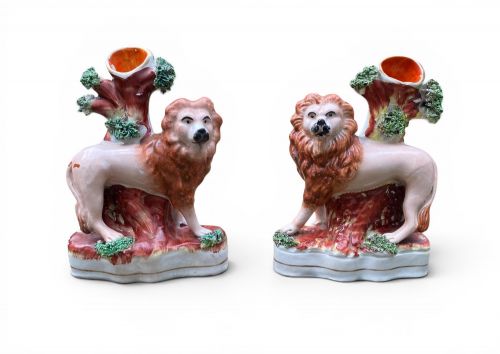


Staffordshire Lion Figures
Staffordshire lion figures are spirited earthenware beasts that bring quintessential Victorian character and domestic charm to a mantelpiece.
Staffordshire Lion Figures
Staffordshire lion figures encompass earthenware and pearlware sculptures modeled as majestic beasts, recumbent guardians, and spill vases. Collectors frequently encounter pairs from the nineteenth century, often decorated with rich glazes and enamel details.
The selection ranges from classic Medici models to utilitarian spill vases and decorative bookends. Production spans the Victorian era into the twentieth century, reflecting enduring popular appeal for ceramic animals.
The forms extend to narrative subjects like the death of the lion queen alongside heraldic pairs featuring the lion and unicorn. These diverse domestic ornaments showcase the varied output of English potteries over several decades.
Materials and methods
Potters shaped these figures from earthenware and pearlware, utilising ceramic moulds to achieve consistent sculptural forms. Glazing techniques included lead glaze and treacle glaze, which imparted a deep, lustrous finish to the surfaces.
Listings feature earthenware, pearlware, and glass materials across the nineteenth century, including specific dates from eighteen-forty to nineteen-twenty.
Assessing quality
Quality rests in the crispness of the moulding and the precision of the hand-painted details upon the earthenware body. Superior examples display clean application of the lead or treacle glaze without pooling or obscuring the underlying definition.
The presence of matching pairs and well-preserved gilding or enamel decoration distinguishes finer specimens. Stronger pieces retain clear anatomical structure in the modeling of the mane and expression, setting them apart from simpler production.
Rockingham Pottery·Lancaster and Sons of Hanley
The Staffordshire Lion Figures Glossary
- Pearlware
- A refined earthenware developed in the late eighteenth century featuring a subtle bluish glaze that pools in crevices. It represents a significant precursor to later Victorian ceramic bodies.
- Treacle glaze
- A dark, glossy brown lead glaze rich in manganese, widely utilised on pottery during the nineteenth century. It creates a deep, reflective surface particularly favored for animal figures.
- Spill vase
- A hollow ceramic vessel incorporated into a figure design, intended to hold wooden spills for lighting fires or pipes. These dual-purpose objects combine decoration with domestic utility.
- Gravelware
- A finish incorporating small grains or sand into the wet glaze or clay base to create a textured, gritty surface. It often simulates rocky terrain beneath animal figures.
- Medici lion
- A classical sculptural type depicting a majestic lion resting a paw on a sphere, originating from ancient marble prototypes in Italy. Staffordshire potters frequently adapted this iconic pose for ceramic mantel ornaments.
Staffordshire Lion Figures: Frequently Asked Questions
What are Staffordshire lion figures?
Staffordshire lion figures are ceramic ornaments produced by English potteries during the nineteenth and early twentieth centuries.
They depict lions in various poses, including recumbent positions, standing pairs, and versions holding spheres or serving as spill vases.
How were these lions used?
These ceramic beasts served primarily as decorative mantelpiece ornaments in nineteenth-century homes, often arranged in symmetrical pairs.
Some iterations doubled as spill vases designed to hold wooden tapers used for lighting candles, lamps, or coal fires.
How do I date Staffordshire lions?
Dating relies on examining the ceramic body, such as distinguishing early pearlware from later Victorian earthenware, alongside glaze types like treacle or standard lead glaze.
Stylistic cues, hand-painted enamel details, and manufacturing marks also help place pieces within specific nineteenth-century decades.
How should I display them?
These figures suit traditional placement on mantelpieces, bookshelves, or side tables where their vibrant glazes and sculptural forms can be appreciated.
Displaying matching pairs together maintains the symmetrical arrangement intended by the nineteenth-century makers.