
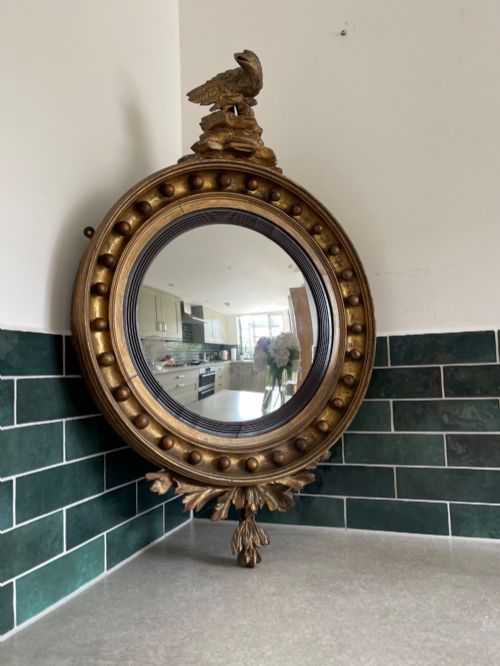


Eagle Crest Convex Mirror
An eagle crest convex mirror brings dramatic focal depth and historic grandeur to a room, led by Regency and nineteenth century examples.
Eagle Crest Convex Mirror
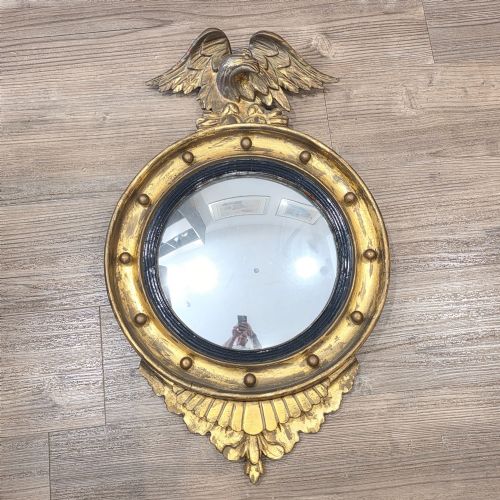
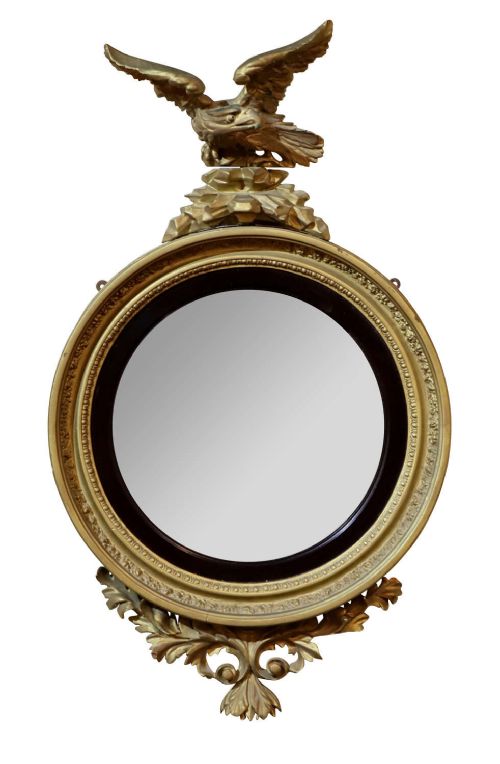
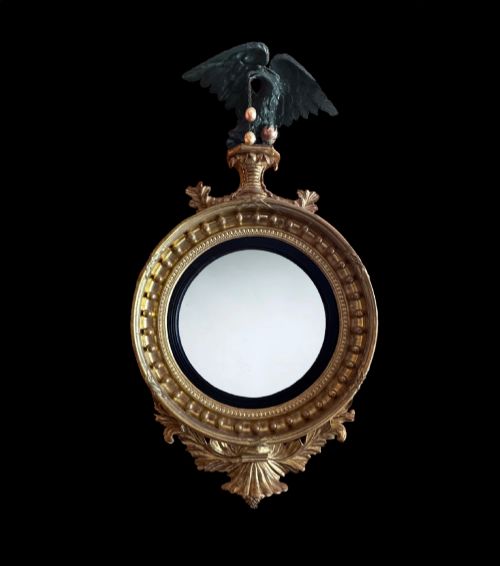
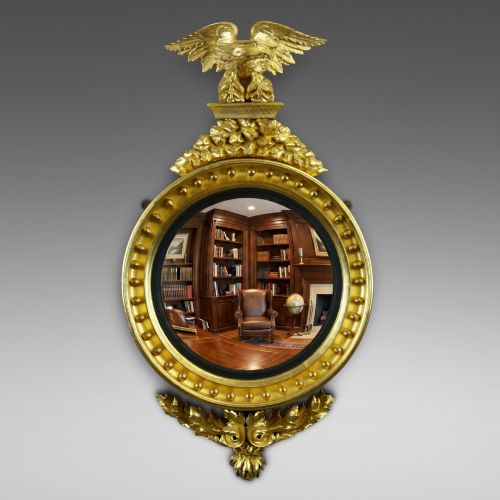
An eagle crest convex mirror is a circular wall glass designed to distort perspective across a room while catching light from every angle. When searching for an eagle crest convex mirror, buyers encounter numerous Regency and nineteenth century pieces dominated by giltwood frames and carved bird surmounts.
The dominant forms span standard circular wall mirrors and grander girandole variants fitted with candle arms. Most examples on offer stem from the Regency and Victorian periods, often featuring prominent spread eagles perched atop moulded circular frames.
Georgian and nineteenth century iterations appear frequently, ranging from smaller domestic glasses to imposing wall pieces. The overarching aesthetic remains rooted in Regency design, balancing heavy circular wooden rims with detailed avian crests.
Materials and construction
Makers shaped these frames primarily from giltwood, timber, and gesso, applying gold leaf or gilding over carved wooden structures. Ebonised wood and brass also appear in select mouldings to provide sharp contrast against the golden finish.
Curved mirrored glass sits deeply within the circular rebated frame, often accompanied by plaster gesso enrichments that form the eagle crest and decorative bezels. Skilled artisans carved the timber bases by hand before applying layers of priming and gilding.
Every eagle crest stands eternal guard, watching over rooms that have shifted from candle glow to electric light.
Distinctions in quality
Quality rests primarily on the depth and crispness of the carved woodwork, particularly the anatomical detail within the eagle surmount and the precision of the surrounding gesso enrichment. Superior pieces display master carver execution where the bird's wings and talons exhibit distinct, deep relief rather than soft casting.
The condition and original integrity of the gilt surface also separate standard examples from finer works, alongside the depth of the convex glass plate itself. Heavier timber construction and well-preserved fire gilding indicate a higher grade of workshop production during the Regency period.
The Eagle Crest Convex Mirror Glossary
- Convex mirror
- A curved glass plate that reflects a wide, circular panoramic view of an interior space. These glasses bend light outward to make small rooms appear larger.
- Giltwood
- Timber coated with gold leaf or a gold-coloured metallic finish over a prepared gesso base. This material defines the bright reflective frames of the period.
- Gesso
- A plaster-like mixture applied to wood frames to create a smooth surface for carving and gilding. Artisans modelled intricate decorative details into this compound.
- Girandole
- A decorative wall mirror fitted with one or more candle branches projecting from the frame. These arms multiplied the ambient illumination within candlelit rooms.
- Surmount
- The decorative ornament or carving fixed to the very top of a mirror frame. On these pieces, it typically takes the form of a spread eagle.
Eagle Crest Convex Mirror: Frequently Asked Questions
How do I hang a heavy convex mirror?
These mirrors require robust wall fixings due to the substantial weight of the timber frame and thick curved glass. Secure heavy brass mirror plates directly into wall studs or structural masonry.
Avoid relying solely on plasterboard hooks, as the outward projection shifts the centre of gravity and increases pulling strain.
Why are convex mirrors round?
Circular frames distribute tension evenly around the curved glass plate while providing a balanced geometric counterpoint to the dramatic eagle crest above. The round format also maximises the panoramic visual field.
This shape has remained the standard format since the early nineteenth century for this specific optical style.
Can I place one in direct sunlight?
Direct sunlight should be avoided because the curved glass acts as a magnifying lens that can focus heat onto nearby walls or furnishings. This concentration of light poses a scorching risk to wallpaper and fabrics.
Positioning the glass opposite a window safely captures ambient daylight without creating intense focal points.
How do I clean the curved glass?
Wipe the glass gently with a soft microfibre cloth slightly dampened with water or mild glass cleaner. Spray the cloth rather than the mirror to prevent liquid seeping behind the gilt rebate.
Moisture running down the edges can damage the fragile silvering on the back of the antique glass plate.
What rooms suit a girandole mirror?
Girandole versions with candle arms suit principal reception rooms, hallways, or dining spaces where additional atmospheric lighting is desired. The projecting branches add architectural presence to formal walls.
They also function effectively above mantlepieces where the reflected candlelight bounces across the room.