


Dutch School Landscape Artwork
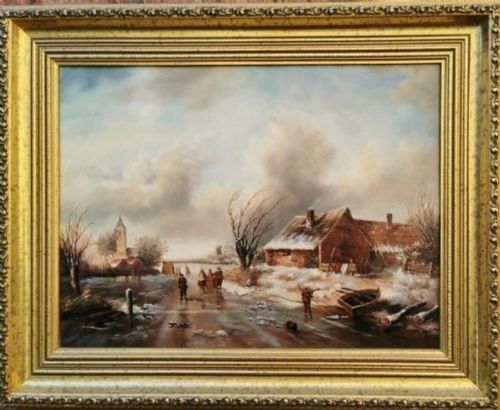
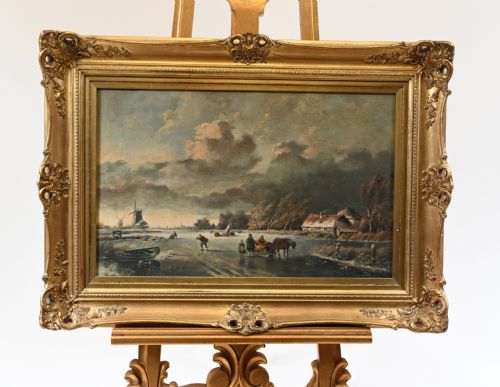
Dutch school landscape artwork captures quiet canals, freezing winters, and wide skies with a characteristic tonal restraint.
Dutch School Landscape Artwork
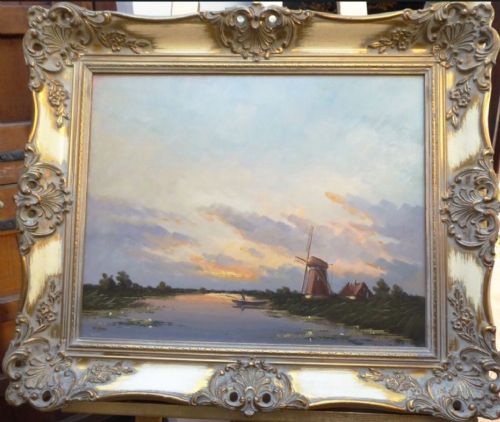
Dutch school landscape artwork spans quiet rural scenes, frozen canals with skaters, and atmospheric coastal views reflecting centuries of painting tradition. Buyers look for these works to bring a moody, observational realism and historic depth into domestic interiors.
The selections available here lean heavily towards oil paintings on canvas and wood panel, alongside occasional watercolours. Nineteenth-century examples and mid-century interpretations dominate, capturing everything from misty river banks to bustling windmill towns.
Works range from intimate cabinet-sized winter scenes to larger framed coastal views. Most follow the time-honoured Dutch preoccupation with flat horizons, dramatic cloud formations, and subtle natural light.
How they were made
These works rely primarily on oil paint applied to prepared canvas, wood panels, or occasionally paper supports. Artists built up their compositions using layered brushwork to capture the shifting, damp atmosphere of the Low Countries.
Many of the framed pieces feature elaborate giltwood or gesso frames that complement the dark, rich palettes of the canvases. Watercolours on paper offer a lighter, more fluid alternative, capturing translucent light and quick topographical impressions.
Several winter scenes preserve the tiny brushstrokes of nineteenth-century skaters frozen mid-stride on Dutch canals.
What varies in quality
Quality rests on the confidence of the brushwork and the artist's ability to render atmospheric light and atmospheric depth within a restricted palette. Stronger pieces demonstrate assured control over tone, guiding the eye naturally across the horizon and through the middle distance.
The harmony between the painting and its original or period frame also influences the overall integrity of the piece. Finer works maintain clear provenance and legible signatures, showing deliberate compositional balance rather than formulaic repetition.
Pieter Cornelis Dommersen·Cornelis Christian Dommersen·Johannes Philippus Galjaard·Hendrik Willebrord Jansen·William Raymond Dommersen·Pieter Cornelis Steenhouwer·Fred Mayor·Andreas Schelfhout·Louis Smets·Anthonij Anton Mauve·Laurens Plas·E Van Drielst·David Adolph Constant Artz·Hermanus van Brussel
The Dutch School Landscape Artwork Glossary
- Canvas
- A heavy woven fabric stretched across a wooden frame to serve as a painting support. It provides a slightly textured surface that holds layered oil paint effectively.
- Giltwood
- Wood carved and covered with a thin layer of gold leaf or gold paint. It frequently frames nineteenth-century oils to add warmth and formal weight.
- Oil Paint
- A slow-drying paint made by mixing pigments with a drying oil, typically linseed oil. This medium allows for subtle blending and rich tonal depth.
- Panel
- A flat piece of wood used as a rigid support for painting. Artists often selected wood panels for smaller, highly detailed cabinet works.
- Watercolour
- A paint consisting of pigment suspended in a water-based solution. It is traditionally applied to paper to achieve translucent washes and delicate effects.
Dutch School Landscape Artwork: Frequently Asked Questions
What defines a Dutch school landscape?
These works typically focus on flat horizons, expansive skies, and atmospheric weather conditions observed in rural or coastal settings. They emphasise naturalistic lighting and tonal subtlety over idealized grandeur.
Subjects frequently include canals, windmills, winter ice skaters, and pastoral farmyards rendered in oil or watercolour.
How should I care for an oil painting?
Keep the artwork out of direct sunlight and away from rapid changes in room temperature and humidity to protect the canvas and wood. Dust the surface very gently with a soft, dry brush without applying pressure.
Avoid using any water, chemical cleaners, or damp cloths on the paint surface or the gilt frame.
What is the difference between canvas and panel supports?
Canvas provides a flexible, textured surface that absorbs the weight of layered oil paint across larger compositions. Wood panels offer a rigid, smooth foundation favoured by artists painting finer, smaller details.
Panel supports require stable atmospheric conditions to prevent the wood from warping over time.