


Dutch Rococo Desk
Dutch rococo desk pieces offer elaborate floral marquetry, burr walnut timber and bombe forms that command attention in any room.
Dutch Rococo Desk
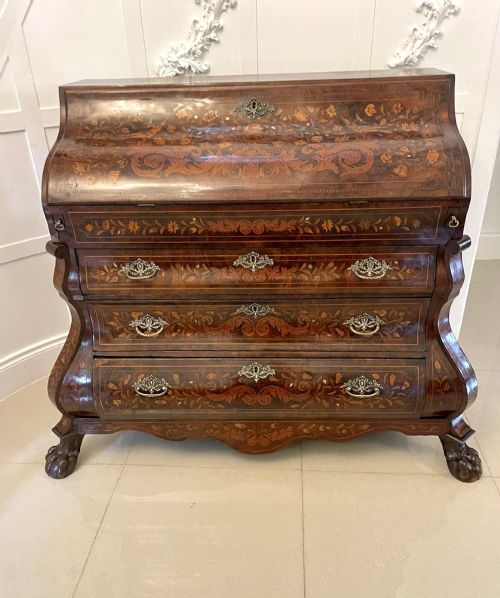
A dutch rococo desk brings together practical writing storage and exceptional decorative ambition from the eighteenth century. These pieces encompass bureau bookcases, slope-front bureaux and writing cabinets that dominate an interior through their sheer scale and ornate surfaces.
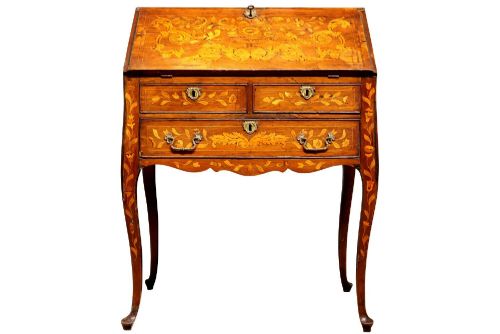
The versions most commonly met on this page feature rich burr walnut foundations embellished with intricate fruitwood marquetry. Bureau bookcases and slope-front desks display the characteristic bombe profile alongside detailed floral and bird motifs.
How they were made
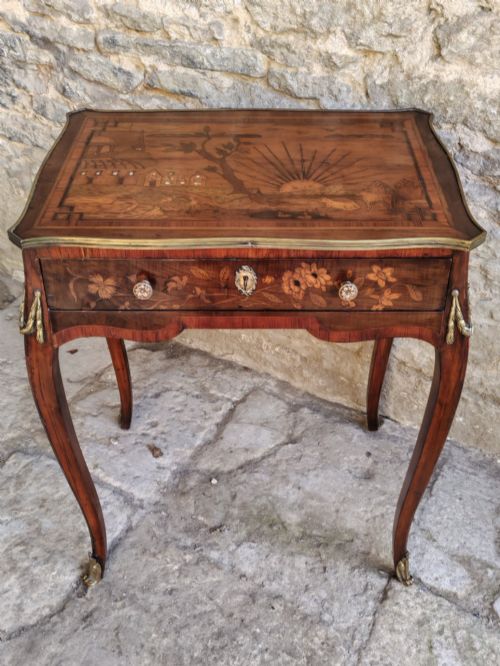
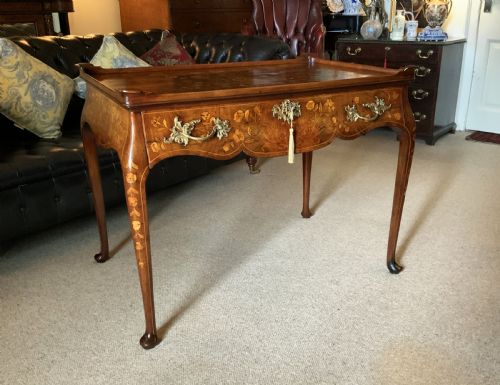
Cabinetmakers constructed the foundational carcase from oak and walnut, applying burr walnut veneers to create deeply figured exterior surfaces. Artisans then meticulously inlaid fruitwood marquetry depicting complex floral arrangements and avian subjects directly into the timber.
The distinct swelling bombe shape required advanced woodworking techniques to curve the solid wood and veneer without splitting. Brass handles and escutcheons completed the construction, fastened securely to drawers that concealed fitted interior compartments.
Listings span the eighteenth and nineteenth centuries, incorporating Georgian and Rococo Revival styles executed in walnut, fruitwood, and oak.
What varies in quality
Quality rests upon the density and ambition of the fruitwood marquetry and the choice of burr walnut timber. Pieces featuring complete floral and bird schemes across every surface sit at the higher end of the range compared to examples with restrained decoration.
The execution of the bombe contour dictates the visual success of the piece, requiring balanced curves that maintain structural integrity. The crispness of the inlay work and the preservation of the original walnut grain define the distinction between standard and superior examples.
The Dutch Rococo Desk Glossary
- Bombe
- A bulging, outward-curved swelling shape typical of continental furniture fronts and sides. This form creates a dynamic silhouette that catches light across the veneered surfaces.
- Marquetry
- Decorative patterns formed by fitting together small pieces of tinted wood veneer. Artisans cut delicate floral and bird motifs to adorn the exterior panels of the bureau.
- Bureau
- A sloping desk lid that opens down to reveal a fitted interior of small drawers and pigeonholes. It serves as a compact writing station above a set of wider storage drawers.
- Burr walnut
- Wood taken from the wart-like growth on a walnut tree, yielding highly turbulent and swirling grain patterns. Cabinetmakers prized this timber for its rich visual texture on principal display surfaces.
Dutch Rococo Desk: Frequently Asked Questions
How do I use a bureau desk?
The sloping fall-front opens downward to create a flat writing surface above the main body. Inside, small pigeonholes and hidden drawers organise letters and writing materials.
Beneath the writing flap, several full-width drawers provide substantial storage for household paperwork or linens. The upper bookcase sections on taller models house display shelving behind glazed or panelled doors.
What rooms suit a bureau bookcase?
These substantial pieces demand space to command a study, drawing room or large hallway effectively. Their decorated marquetry surfaces function as focal points that complement traditional interior schemes.
Placing the furniture away from direct sunlight protects the delicate fruitwood inlay and walnut veneers from fading. Adequate clearance allows the fall-front flap to open fully without obstructing movement.
How do I distinguish eighteenth-century examples?
Eighteenth-century pieces rely upon hand-cut fruitwood marquetry and traditional construction methods using solid oak secondary timbers. The floral and bird motifs display organic irregularity rather than mechanical uniformity.
Later revival pieces often incorporate machine-cut veneers and different internal wood selections. Examining the construction inside the drawer linings and behind the backboards reveals the period of manufacture.
What is the difference between bureau and bureau bookcase?
A standard bureau consists of a lower chest of drawers surmounted by an angled writing flap. It provides compact workspace and modest storage capacity within a single waist-height unit.
A bureau bookcase adds a towering upper storage cabinet designed for books or display items. This vertical extension transforms the furniture into a monumental architectural piece.