
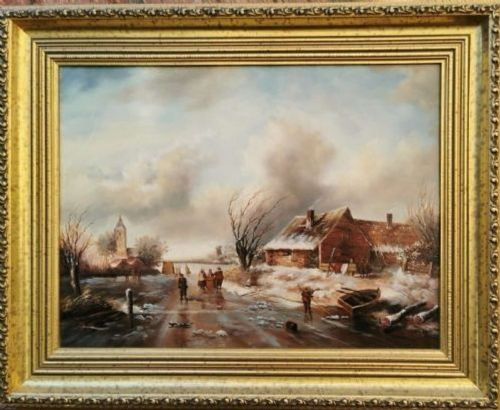


Dutch Canal Oil Painting
A dutch canal oil painting brings quiet waterways, windmills and winter frost straight into a room through rich brushwork.
Dutch Canal Oil Painting
A dutch canal oil painting captures the distinct waterways, frozen winter scenes and windmills characteristic of the Low Countries. These works range from nineteenth-century realism and maritime studies to mid-century impressionist interpretations.
Buyers will encounter subjects varying from quiet rural canals and barges to specific urban sights like Rotterdam and Flemish riverscapes. Works span the nineteenth century through the mid-twentieth century, encompassing both traditional Dutch school compositions and later impressionist variations.
The pieces often feature traditional formats including oil on canvas, wood panels and boards, framed in period gilt or gesso moulding. Signed works by named nineteenth-century artists sit alongside unsigned examples from the broader Dutch school.
Materials and Methods
These works are painted in oil paint on prepared canvas or wood panels, utilising the rich texture and slow drying time of the medium to build depth in water and sky. Painters applied pigment with varying brush weights, from smooth realism to the thicker impasto strokes seen in impressionist and post-impressionist examples.
Canvases and panels are frequently housed in decorative wooden frames finished with gilt or gesso, complementing the tonal palette of the oil paint. The combination of canvas, wood and oil provides durability while retaining the subtle atmospheric light specific to these canal scenes.
Current listings feature oil paint on canvas, wood and board across the nineteenth and twentieth centuries.
Judging Quality and Execution
Quality rests in the handling of light on water and the atmospheric depth of the sky, where skilled artists create convincing space and movement. Weaker examples rely on flat, formulaic application without the tonal subtlety that defines stronger works from the Dutch school.
The integration of the painted surface with the framing plays a role, as period giltwood and gesso mouldings enhance the visual weight of the canvas. Attribution also influences distinction, separating fully signed works by recorded nineteenth-century painters from anonymous studio or school pieces.
William Raymond Dommersen·William Dommersen·Willem Maris
The Dutch Canal Oil Painting Glossary
- Dutch School
- A broad term denoting artists working in the style or tradition of the Netherlands, often focusing on landscape, maritime and domestic subjects. This grouping covers centuries of distinct regional painting traditions.
- Gesso
- A plaster-like mixture applied to wood or canvas as a base for painting, or used to build up decorative details on frames. It provides a smooth, absorbent surface for subsequent layers of gilding or oil paint.
- Impasto
- Paint applied thickly to a canvas, standing out in relief from the surface and retaining the marks of the brush or palette knife. This technique adds tactile texture and catches ambient light.
- Giltwood
- Wood carved and covered with a thin layer of gold leaf or metallic powder. It is commonly found on period frames enclosing nineteenth-century canvases.
Dutch Canal Oil Painting: Frequently Asked Questions
How old are these paintings typically?
The works span from the nineteenth century through to the mid-twentieth century, with dates recorded from eighteen-eighty to nineteen-sixty.
Earlier nineteenth-century examples often reflect strict realism or maritime traditions, while twentieth-century pieces lean towards impressionist interpretations.
What subjects appear in these scenes?
Common subjects include frozen winter landscapes, windmills, barges on waterways and specific urban canal views.
Some compositions depict recognizable locations such as Rotterdam or Venice alongside anonymous Flemish riverscapes.
What surfaces were used by the artists?
Painters utilised oil paint applied directly to woven canvas, wooden panels or prepared boards.
Canvas is most frequent in nineteenth-century works, while boards appear alongside canvas in mid-century examples.
How should I hang and light them?
These oil paintings suit traditional or mid-century interior spaces where their muted tones and gilt frames provide natural warmth.
Keep them away from direct sunlight and excessive heat sources to protect the canvas and oil pigments over time.