
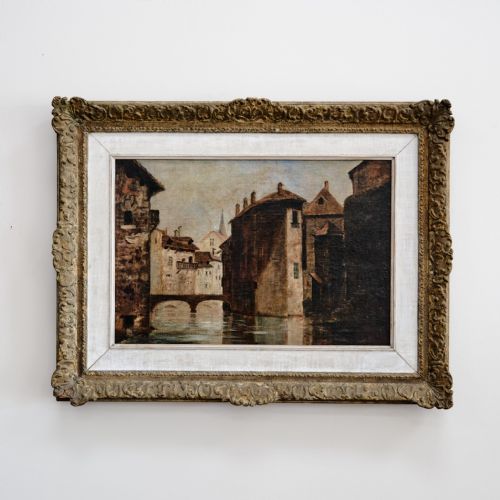
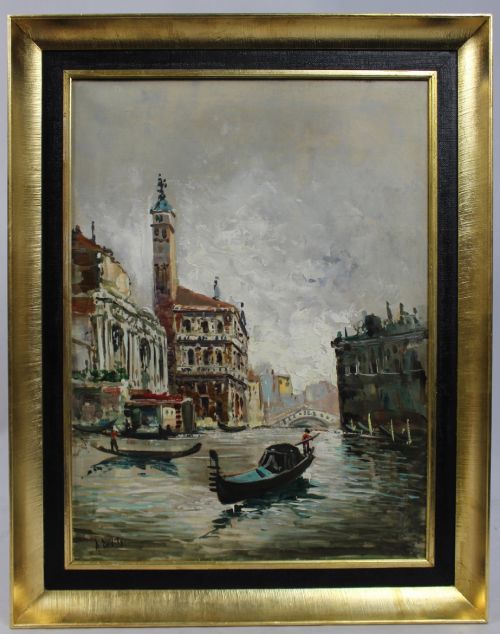


Impressionist Canal Painting
Impressionist canal painting captures the play of light on water across Venice, France, and Britain using rapid brushwork.
Impressionist Canal Painting
An impressionist canal painting focuses on waterways, barges, and gondolas set against European cities and rural landscapes. These works span the nineteenth century through the mid twentieth century, encompassing French, Italian, Dutch, and British schools.
Most pieces on this page are oil on canvas or watercolour on paper. Subjects range from grand Venetian waterways to quiet Flemish and English canals with figures on bridges.
Buyers encounter works from the nineteenth century alongside mid-century interpretations. The selection leans heavily towards Venetian scenes and continental European riverscapes.
Materials and technique
Artists painted primarily with oil paint on canvas or watercolour on paper, sometimes utilising gesso on wood supports. These mediums allowed painters to capture transient effects of daylight and atmospheric moisture.
The technique relies on loose, visible brushstrokes rather than tight academic finish. Painters built up texture with oil paint or applied washes of watercolour to render reflections on water.
Listings feature works created across the 19th century and several decades of the 20th century.
What separates the best from the rest
Quality rests upon the artist's command of light and atmosphere over water. Stronger works convey movement in the reflections and depth in the surrounding architecture without relying on laboured detail.
The handling of the brush determines the success of the composition. Confident, economical strokes elevate a canvas, whereas hesitant application flattens the scene.
Antonio DeVity·Fred Lawson·E A Minardo·Claude Jousset·Marc Aldine·Antoine Bouvard Senior·Vittore Zanetti Zilla·Herbert Royle·Hercules Brabazon Brabazon·Frank Wasley·Henry Wimbush·Charles Clement Calderon·Helen Donald-Smith·G E Roberts·Alfred Van Neste
The Impressionist Canal Painting Glossary
- Impressionism
- A nineteenth century painting style focused on capturing the visual impression of a moment, especially regarding shifting light. It rejects rigid academic detail in favour of visible brushwork.
- Canvas
- A heavy woven fabric stretched across a wooden frame to serve as a support for oil paint. It provides a flexible texture that holds heavy pigment.
- Watercolour
- A paint consisting of pigment suspended in a water-soluble vehicle, typically applied to paper. It relies on the white of the paper to show luminosity through translucent washes.
- Gesso
- A primer mixture consisting of a binder mixed with chalk, gypsum, or pigment used to prepare wood or canvas surfaces for painting. It creates a smooth, stable ground for oil or tempera.
- Gondolier
- A traditional oarsman who propels a flat-bottomed Venetian boat along canals. This figure frequently populates Italian canal scenes.
Impressionist Canal Painting: Frequently Asked Questions
What subjects appear in these paintings?
These works depict European waterways, including Venetian canals with gondolas, French rivers, and British canals. Scenes often feature bridges, old mansions, and figures walking along the banks.
Artists favoured locations where water reflects surrounding architecture and sky. Venice remains the most frequent setting across the selection.
How do I date an impressionist canal painting?
Dating relies on stylistic clues, framing materials, and artist signatures recorded in the titles and archives. Pieces span from the nineteenth century through the 1960s.
Mid-century works often show looser brushwork and brighter palettes compared to 19th-century French and British school paintings.
How should I hang and light these paintings?
Oil paintings on canvas and watercolours on paper require protection from direct sunlight to prevent fading. Wall placement should avoid damp areas such as unheated exterior walls.
Warm picture lights placed above the frame enhance the loose brushwork and tonal shifts typical of impressionist landscapes.
What is the difference between oil and watercolour?
Oil paint uses a drying oil binder on canvas or wood, allowing thick texture and rich layering. Watercolour uses a water-soluble binder on paper for transparent washes.
Oils offer a heavier surface presence while watercolours present a lighter, luminous quality.