


Victorian Canal Landscape
A victorian canal landscape captures bustling waterways and quiet English locks through nineteenth-century brushwork.
Victorian Canal Landscape
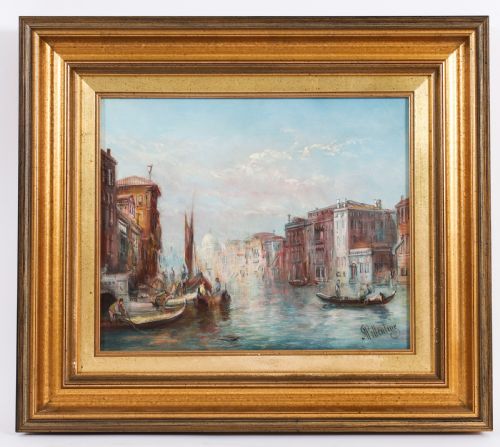
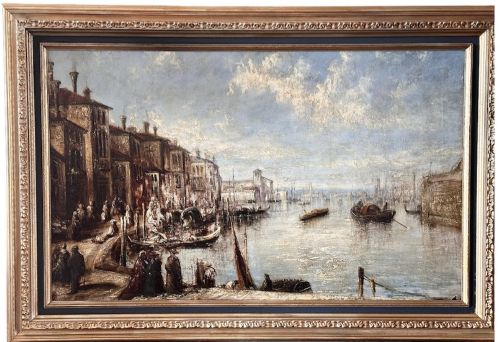
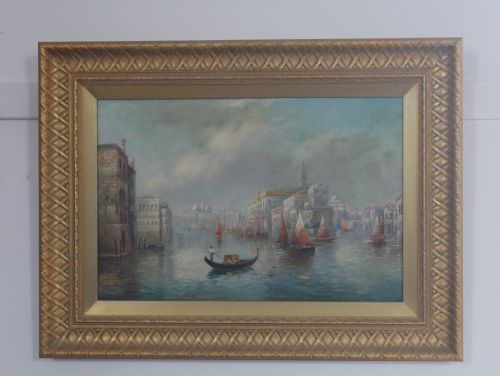
A victorian canal landscape brings together nineteenth-century views of European waterways and English lock scenes, focusing heavily on Venetian canals and local river navigations. Buyers exploring this category encounter framed oil paintings on canvas and delicate watercolours on paper depicting daily traffic, historic palazzos, and towpaths.
The most common examples on this page are Venetian townscapes and Grand Canal views rendered by British and continental artists working during the Victorian period. Alongside these Italian scenes appear domestic watercolours and oils showing English locks, docks, and windmills from the latter half of the nineteenth century and early twentieth century.
Materials and construction
Painters of the era utilised oil on canvas or watercolour applied to paper, mounted beneath glass within wooden frames, frequently finished in gilded wood or giltwood. Canvases provide depth for complex townscapes and atmospheric skies, whilst watercolours capture the translucent quality of water and light.
Artists built their compositions using traditional pigments, layering oil paint to build rich architectural details of Venetian palazzos or applying washes of watercolour for softer riverbanks. Framing was integral to presentation, with gilded mouldings enhancing the warmth and brilliance of the painted surface.
Listings feature works spanning the nineteenth century into the early twentieth century, utilising oil on canvas, paper, and watercolour.
The spectrum of quality
Quality rests upon the artist's ability to render light reflecting off water and the precise architectural perspective of bridges, palaces, and lock gates. Superior works demonstrate confident brushwork and accurate spatial depth, whereas weaker examples suffer from rigid lines and muddy colour palettes.
The handling of atmosphere distinguishes fine academic output from standard topographical recording. Masterful treatment of the lagoon haze or the mist rising from an English canal elevates a canvas far beyond a simple record of a scene.
Alfred Pollentine·Francis Moltino·Thomas Baker·Jane Vivian·William Dommersen
The Victorian Canal Landscape Glossary
- Oil on Canvas
- A painting medium where pigments suspended in drying oil are applied to stretched fabric. This technique allows for rich texture and deep colour saturation.
- Watercolour
- A painting method where water-soluble pigments are used on paper. It creates luminous, translucent washes ideal for capturing light on water.
- Giltwood
- Wood that has been coated with gold leaf or a gold-coloured finish. It is commonly found on traditional picture frames from this period.
- Lock
- A device used for raising and lowering boats between stretches of water on river navigations. English canal scenes frequently depict these operational structures.
Victorian Canal Landscape: Frequently Asked Questions
How do I care for a watercolour painting?
Keep watercolours away from direct sunlight to prevent the pigments from fading over time. Ensure they hang in stable humidity conditions to protect the paper.
Professional framing behind glass with acid-free mounts safeguards the surface against atmospheric pollutants and moisture damage.
Where were these canal scenes painted?
Artists painted these subjects across various European locations, focusing heavily on the waterways of Venice such as the Grand Canal and the Giudecca. Other works depict domestic English waterways, locks, and docks in regions like Yorkshire and Cheshire.
Foreign travel during the nineteenth century encouraged painters to record continental architecture, whilst local industrial waterways inspired domestic landscape painting.
How do I distinguish oil paintings from watercolours?
Oil paintings feature a textured, heavier paint layer applied to stretched canvas or wooden panels. They possess a rich sheen and greater opacity.
Watercolours appear flat and translucent on paper, typically displayed beneath protective glass to prevent smudging or paper degradation.
How should I hang a framed oil painting?
Support heavier canvas works using robust wall fixings suited to the weight of the wooden and giltwood frame. Hang the piece at eye level away from direct heat sources.
Stable room temperatures prevent the wooden stretcher bars and canvas from warping or slackening over the years.