
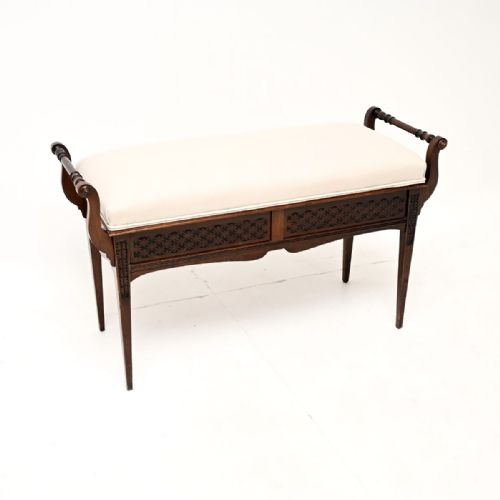
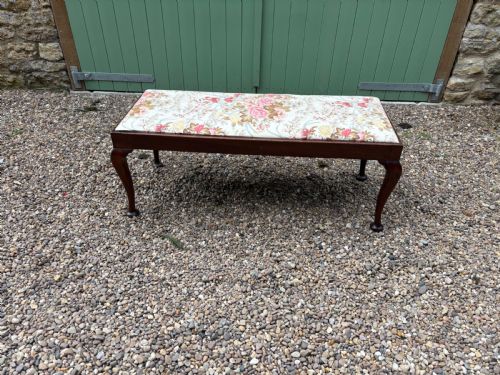
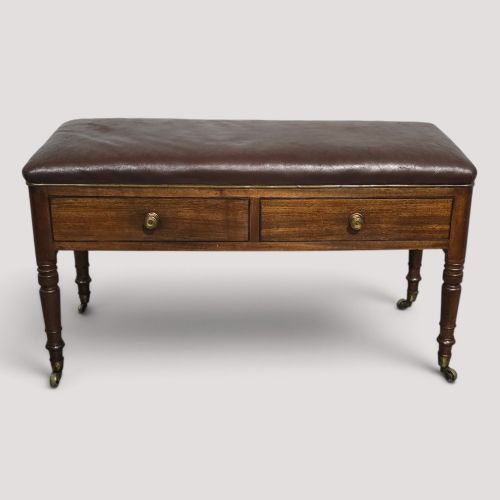
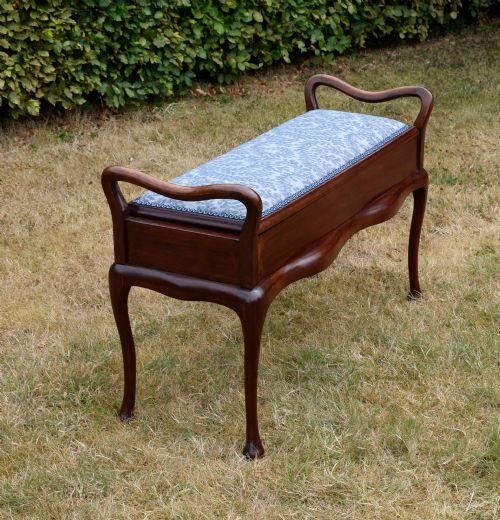
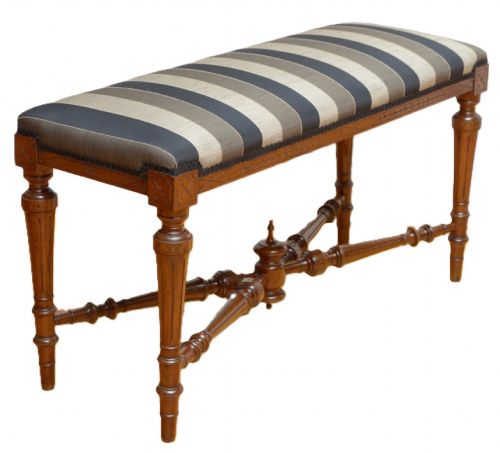


Duet Seating Bench
These duet seating bench pieces offer double-width proportions designed for two, spanning revival styles from Victorian and Edwardian periods.
Duet Seating Bench
A duet seating bench provides wider proportions than a standard stool, designed specifically to accommodate two people side by side. These pieces frequently appear as piano or music stools alongside long window seats.
The selections available here range across the Regency, Victorian, and Edwardian eras, alongside various twentieth century examples. Makers adopted styles spanning Grand Regency, French Provincial, and Louis XVI.
Form follows function closely across these examples, whether built as freestanding piano seats or low window benches. Many incorporate hinged seats that open to reveal storage compartments for sheet music.
How they were made
Cabinetmakers utilised dense hardwoods such as mahogany and walnut for the structural frames, often applying decorative inlay work. Giltwood surfaces appear on French-influenced pieces alongside brass fittings.
Upholstery forms a central element of construction, utilising fabrics, leather, velvet, and tapestry stretched over padded tops. Hinged mechanisms allow the seat lid to lift smoothly on internal compartments.
Many a Victorian pianist stored secret stashes of sweets alongside sheet music inside the hinged seat.
What varies in quality
The refinement of the timber framework and the crispness of any inlaid decoration distinguish finer examples from standard production. Cabinetmakers who invested time in hand-carved details or precise wood selection produced superior results.
Upholstery finish and the execution of hinged mechanisms indicate the original grade of manufacture. Sturdiness in the double-width frame dictates how well the structure withstands shared weight over decades of use.
The Duet Seating Bench Glossary
- Duet stool
- A wide seating form built for two people to sit together. This format is commonly associated with keyboard instruments.
- Window seat
- A long bench designed to fit within the recess of a window. These pieces feature low profiles and decorative upholstery.
- Inlay
- A technique where contrasting woods or materials are set into the primary surface. This adds decorative pattern to mahogany and walnut frames.
- Giltwood
- Timber treated with a thin layer of gold leaf or gilt finish. It appears on decorative French-style framework.
Duet Seating Bench: Frequently Asked Questions
What is a duet seating bench used for?
These double-width seats serve primarily at piano and keyboard instruments for shared playing sessions. They also function as decorative window seats in reception rooms.
Their elongated proportions allow two people to sit comfortably together while maintaining a compact footprint in the room.
How do I identify an Edwardian duet stool?
Edwardian examples frequently display mahogany frames with subtle inlaid decoration. They date from the early twentieth century and often double as piano music seats.
Construction from this period tends to balance revival styles with practical storage solutions beneath hinged tops.
Do these benches include music storage?
Many piano duet stools feature a hinged seat lid that opens upward. This reveals an internal compartment designed originally for holding sheet music.
Window seats and purely decorative benches typically lack this internal cavity, focusing entirely on the upholstered top.
What materials are used for the upholstery?
Original and replacement upholstery spans fabric, leather, velvet, and tapestry needlework. The choice of covering usually reflects the period and stylistic influence of the frame.
Plain leather and velvet suit utilitarian piano benches, while patterned textiles and tapestries align with French Provincial or Victorian designs.