
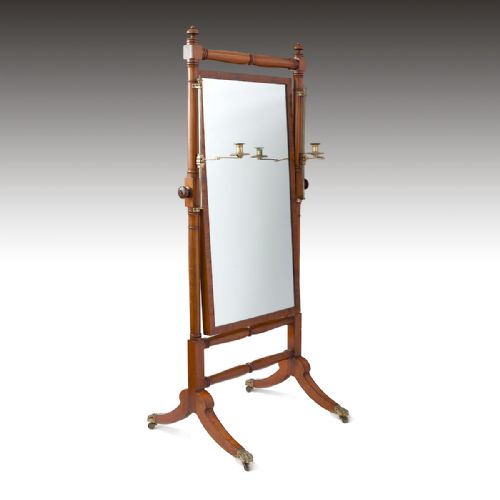
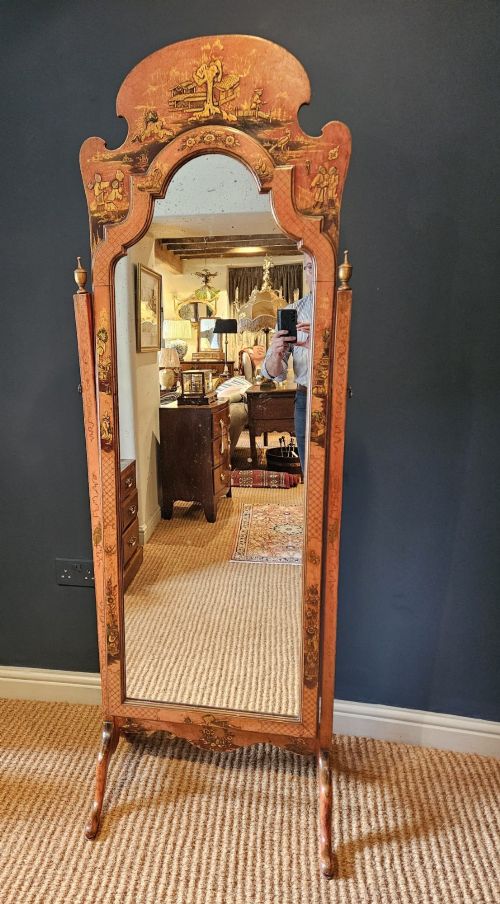
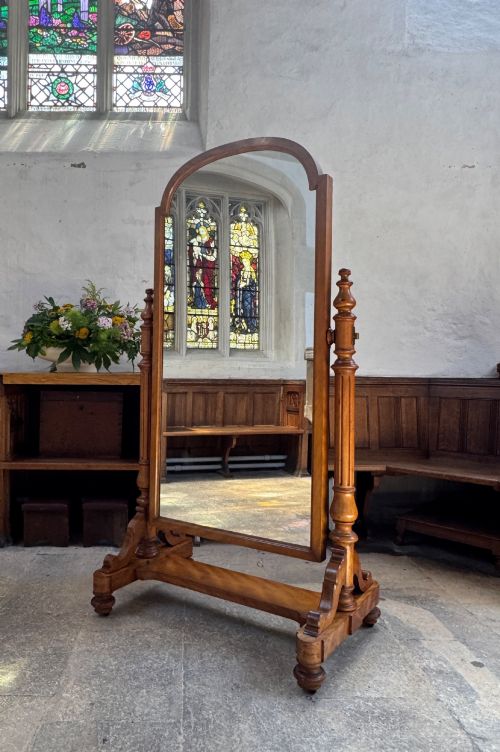
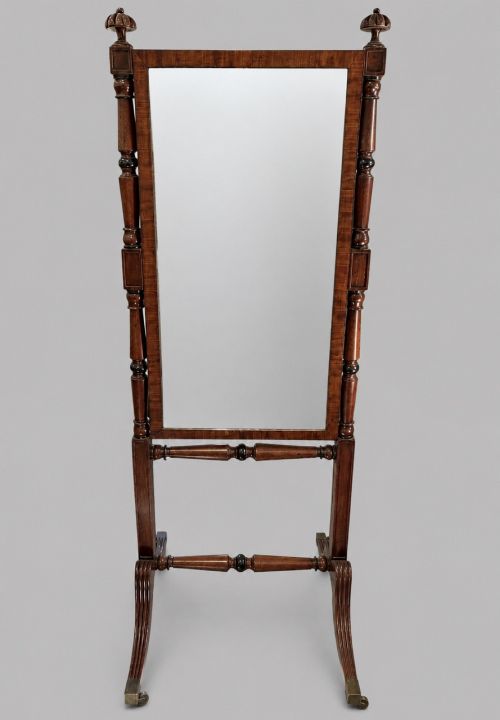

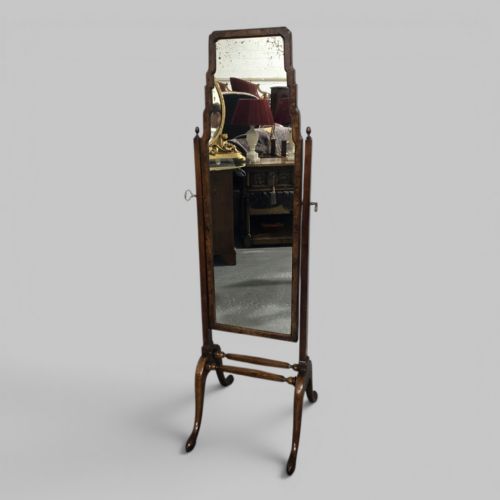


Dressing Room Standing Mirror
A dressing room standing mirror brings height and reflected light to a room, offering full-length views through centuries of distinct cabinetmaking traditions.
Dressing Room Standing Mirror
A dressing room standing mirror stands independently on a frame, allowing a complete view of attire from the floor upwards. These pieces take various forms, from Regency country house designs to later revival styles.
The selections available here span several distinct periods, with Victorian and 1920s pieces appearing frequently alongside earlier Regency and George III examples. Walnut, mahogany, and lacquered wood dominate the structural forms of these mirrors.
Buyers encounter traditional cheval mirrors mounted on swiveling pivots alongside painted floor mirrors and black-framed mercury glass variants. Each piece reflects the aesthetic preferences of its decade, from Queen Anne revivals to Louis XV flourishes.
How they were made
Makers utilised dense timbers such as mahogany and walnut, often selecting figured veneers like burr walnut to create rich surface patterns. Lacquered wood and painted finishes also appear, particularly on later 1920s interpretations.
Brass fittings such as sabots and castors supported the pivoting frames of nineteenth-century examples, allowing the glass to tilt smoothly. Mirror glass itself is housed within sturdy wooden uprights secured by pivot screws.
One double-sided dressing room mirror waits here, ready for quick outfit checks from two directions at once.
What varies in quality
Quality rests in the selection of timbers, where figured veneers and solid mahogany frames show superior cabinetmaker work compared to simpler stained woods. The heft and detail of brass mounts and castors further separate standard pieces from exhibition quality items.
Proportion and stability define the construction, ensuring that tall swiveling frames remain balanced on their bases. The clarity of the glass and the joinery of the surrounding wooden frame complete the measure of the piece.
The Dressing Room Standing Mirror Glossary
- Cheval mirror
- A large standing mirror supported by a frame with vertical posts and pivot pins, allowing the glass to swing. This form became popular for bedroom and dressing room use during the Georgian and Victorian periods.
- Sabot
- A metal sleeve or mount fitted to the foot of a furniture leg, commonly cast in brass to protect the wood and add decoration. These fittings frequently appear on Regency and William IV pieces.
- Mercury mirror
- A mirror produced using a tin-mercury amalgam behind the glass before the modern silvering process was adopted. This technique yields a deep, slightly cloudy reflection characteristic of older plates.
- Veneer
- A thin layer of finely figured wood applied over a secondary timber base to create a decorative surface. Cabinetmakers selected burr walnut and mahogany veneers for high-status dressing mirrors.
- Castor
- A small wheel attached to the base of furniture legs to ease movement across floors. On standing mirrors, brass castors allowed the heavy frames to be repositioned within a room.
Dressing Room Standing Mirror: Frequently Asked Questions
What is a cheval mirror?
A cheval mirror is a tall standing floor mirror mounted on a pivoting frame between two upright posts. This design lets the user tilt the glass to various angles for full-length viewing.
Originally introduced in the eighteenth century, the form remained a staple of dressing rooms through the Victorian era and into the twentieth century.
How do I date a standing mirror?
Dating relies on identifying the timber, style references, and construction methods used in the frame. For instance, Regency and William IV pieces often display sabots and sabre legs, while 1920s examples show chinoiserie or revival motifs.
Hardware such as screws, pivot joints, and castors also provide clues to the period of manufacture.
Where should I place a dressing mirror?
These mirrors require adequate floor space and a stable surface to stand safely without tipping. Placing them opposite a window helps maximise reflected light in a dressing room or bedroom.
Because they offer a full-length view, positioning them where there is enough clearance to step back is essential.
Are these mirrors fixed or adjustable?
Most traditional standing mirrors utilise pivot pins set into vertical uprights, allowing the glass frame to tilt forward or backward. This adjustable mechanism enabled users to alter the angle of reflection easily.
Some modern or alternative floor mirrors are fixed rigidly within their frames rather than pivoting.