
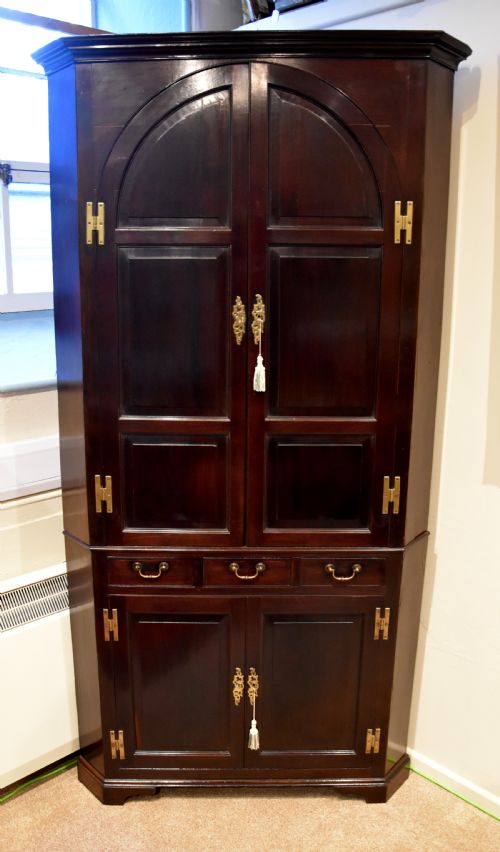


Double Corner Cabinet
A double corner cabinet fills an awkward junction in a room while offering substantial display space.
Double Corner Cabinet
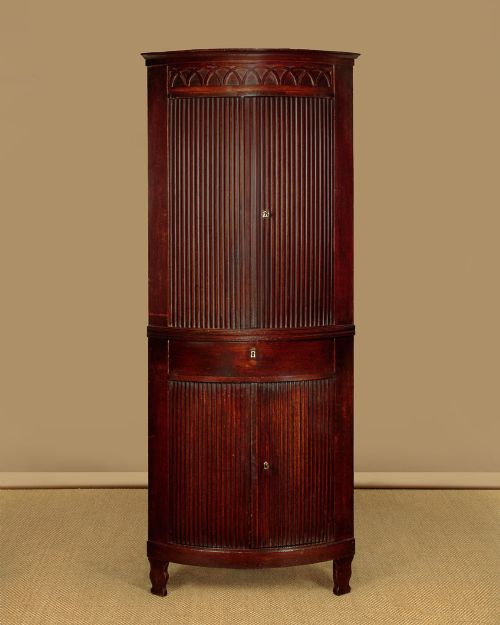
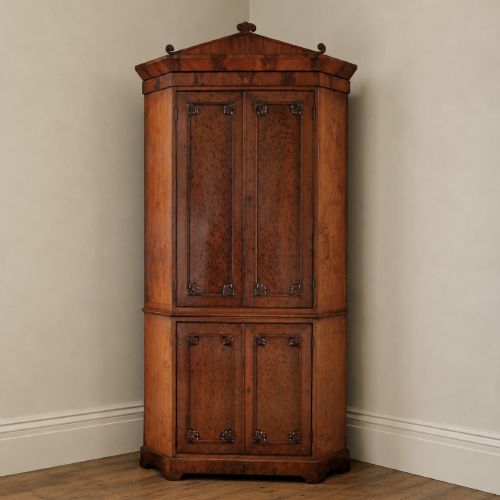
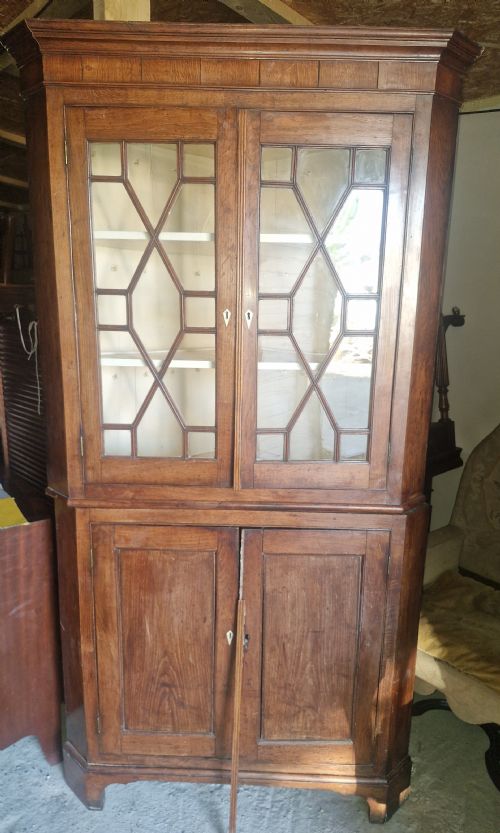
A double corner cabinet stands as a taller, two-part piece designed to fit snugly into the ninety-degree angle of a room, taking advantage of vertical space that standard furniture ignores. When searching for a double corner cabinet, buyers encounter standing and floor-spanning versions split into upper and lower sections, often with glazed doors above for display and solid panels below for storage. These pieces bridge domestic utility with architectural presence, turning unused corners into focal points.
The materials and periods span the Georgian era through to Edwardian revivals, employing woods such as mahogany, oak, and walnut. Many examples incorporate two-part construction to ease movement and installation within traditional domestic settings. The surviving evidence shows both hanging single-section cupboards and grander standing double-height formats, with the latter defining the core of this selection.
How they were made
Cabinet makers constructed these pieces using solid timbers and veneers over supportive secondary woods, relying on dovetailed joints for stability in the carcass and frame-and-panel construction for doors. Mahogany and oak dominate the surviving record, supplemented by walnut, elm, and satinwood inlay for decorative contrast. Timber selection served both structural strength and visual depth, particularly in figured cuts like plum pudding mahogany.
Glazing bars divided the upper display doors into geometric patterns such as ovoid and diamond shapes, requiring precise joinery to support individual panes of glass. Inlays of satinwood and marquetry appeared on later Edwardian pieces, whilst earlier Georgian versions depended on the grain of Cuban mahogany or the rustic density of Welsh oak.
The inventory records oak, mahogany, walnut, elm, and satinwood across Georgian, Regency, and Edwardian periods.
What varies in quality
Quality rests in the choice of timber and the ambition of the joinery, distinguishing utilitarian country pieces from high-fashion urban commissions. Superior examples display carefully matched veneers, crisp carving on mouldings, and intricate glazing bar arrangements that require advanced carpentry skills.
The integration of the two sections defines the better standing cabinets, ensuring the cornice and base align harmoniously without awkward transitions. Finer maker attributions, such as work associated with Edwards and Roberts, show in the precision of the marquetry and the retention of original brass hardware and working keys.
Edwards and Roberts
The Double Corner Cabinet Glossary
- Double corner cabinet
- A tall cabinet made in two distinct stacked sections designed to fit into the corner of a room. It provides both enclosed storage and display capacity.
- Bow front
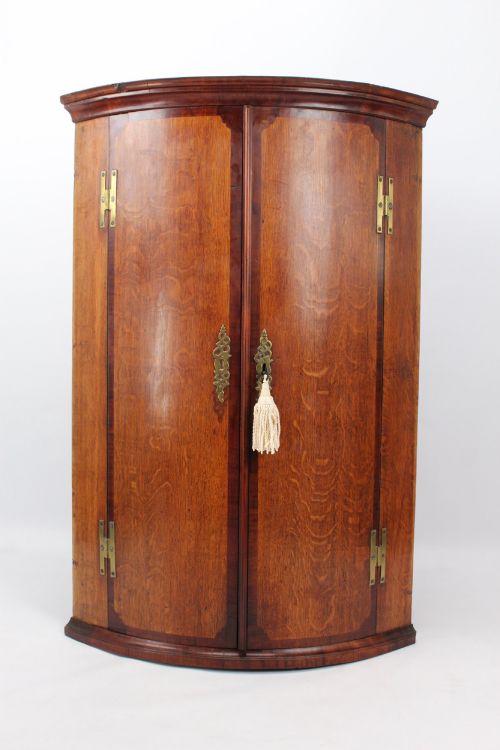
- A convex curved front facade that projects outward in a smooth arc. This shape softens the angular geometry typical of corner furniture.
- Glazing bar
- A narrow wooden strip that holds individual panes of glass within a sash. Elaborate glazing patterns indicate finer cabinet making.
- Marquetry
- Decorative patterns formed by fitting together small pieces of veneer into wooden panels. It often depicts floral or symmetrical motifs on Edwardian and Georgian surfaces.
Double Corner Cabinet: Frequently Asked Questions
Where does a double corner cabinet work best?
These cabinets fit neatly into the unused ninety-degree junction of a dining room, hallway, or drawing room. Their angled back allows them to anchor a corner while drawing the eye upward.
Because they utilise vertical space efficiently, they provide storage without dominating the floor area of a smaller room.
How do I distinguish Georgian from Edwardian examples?
Georgian pieces generally rely on architectural proportions, solid timbers, and restrained classical mouldings. Cuban mahogany and dark oak dominate this earlier period.
Edwardian versions often incorporate lighter satinwood inlay, marquetry decoration, and revival styles that reflect a retrospective interest in eighteenth-century design.
Are double corner cabinets difficult to move?
Standing versions divide into two separate horizontal sections, which makes transporting and positioning them manageable. The upper display cabinet lifts off the lower cupboard base.
Hanging models require secure wall fixings to support their weight, particularly when filled with heavy ceramic or glass collections.
What is the difference between single and double height?
Single height or hanging corner cupboards mount directly to the wall and feature one set of doors. They suit more compact spaces and lower ceilings.
Double height standing cabinets rest on the floor and incorporate both an upper display section and a lower enclosed cupboard, creating a commanding architectural presence.