


Domed Stationery Box
A domed stationery box keeps your correspondence tidy on a desk while showing off rich nineteenth-century cabinet work.
Domed Stationery Box
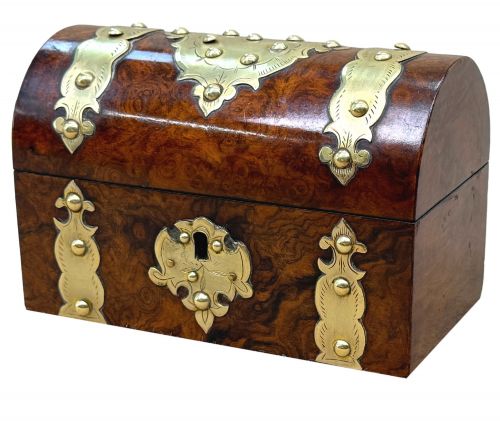
A domed stationery box is a desk accessory designed to hold writing paper, envelopes and letters securely beneath a curved lid. Most pieces seen here belong to the Victorian period, originating around eighteen-sixty or later in the nineteenth century.
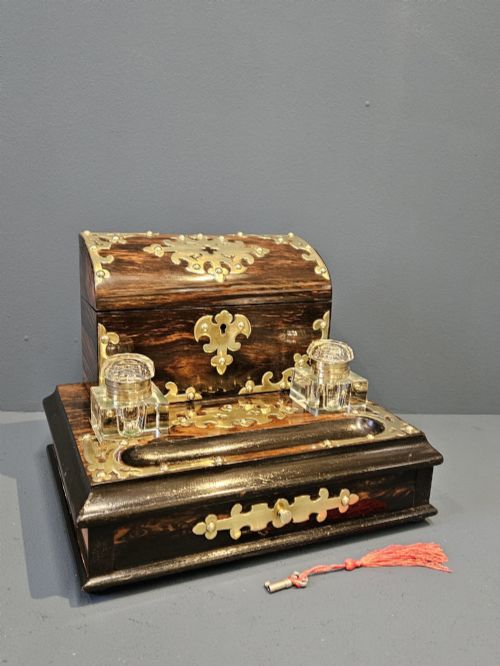
The form appears in various configurations, including letter boxes, caskets and writing slopes equipped with internal compartments. Walnut, burr walnut and coromandel wood dominate the current selection, often accented with brass mounts or strapwork.
How they were made
Cabinet makers constructed these boxes using dense hardwoods like walnut, burr walnut and coromandel, chosen for their striking grain patterns. The curved dome top required precise steaming or multi-layered construction to hold its shape over time.
Metalwork played a structural and decorative role, with brass bindings, mounts and strapwork fastened to the corners and edges. Interiors frequently utilised fitted wooden dividers to organise paper, while some examples incorporated glass or ceramic elements.
Some boxes still hide unexpected original contents waiting inside.
What varies in quality
The choice of timber creates a fundamental distinction, with heavily figured burr walnut and richly grained coromandel sitting above standard domestic woods. The complexity of the brass mounting and the precision of the joinery further separate standard production from finer work.
Interior arrangement and original fittings also dictate the standard of a piece. Boxes that retain dedicated compartments, glass inkwells or original contents demonstrate a higher degree of initial craftsmanship and better preservation.
Trussell Brighton·Briggs Piccadilly London
The Domed Stationery Box Glossary
- Dome top
- A curved lid style that rises in an arch above the rectangular base of the box, providing extra interior clearance. This shape allows the box to house taller envelopes or layered correspondence.
- Coromandel
- A dense, heavily figured exotic timber from Asia utilised in high-end nineteenth-century cabinet making. It displays dark brown streaks against a lighter background.
- Burr walnut
- Walnut timber taken from a tree growth or burl, producing swirling, intricate grain patterns. It was favoured for decorative veneering on Victorian desk accessories.
- Brass bound
- Cabinet work edged or reinforced with fitted brass strips along the corners and seams. This technique added structural durability and visual contrast to the wood.
Domed Stationery Box: Frequently Asked Questions
What is a domed stationery box used for?
These boxes were built to hold writing paper, envelopes and incoming letters on a Victorian desk. The curved lid provided sufficient clearance for stacked correspondence while keeping the desktop tidy.
Today, they serve the same practical purpose for modern stationery or act as decorative desktop caskets in a study.
How do I date a domed stationery box?
Most examples originate from the Victorian era, specifically around eighteen-sixty to eighteen-eighty. Stylistic clues such as Gothic Revival brass strapwork or the choice of coromandel wood point directly to this period.
Construction methods, including hand-cut dovetails and brass fixings, help distinguish nineteenth-century pieces from later reproductions.
What woods were used for these boxes?
Cabinet makers relied heavily on walnut, burr walnut and coromandel for their rich grain and durability. Oak, pollard oak and spalted ash appear less frequently across the surviving pieces.
Exotic veneers were carefully selected to showcase natural patterns on the curved lids and main panels.
Where should I place a stationery box?
A domed stationery box sits comfortably on a desk, bureau or side table where its timber grain can be appreciated. The curved top makes it a striking focal point among other desktop accessories.
Keep the wood away from direct heat sources and strong sunlight to protect the polish and prevent the veneer from drying.