


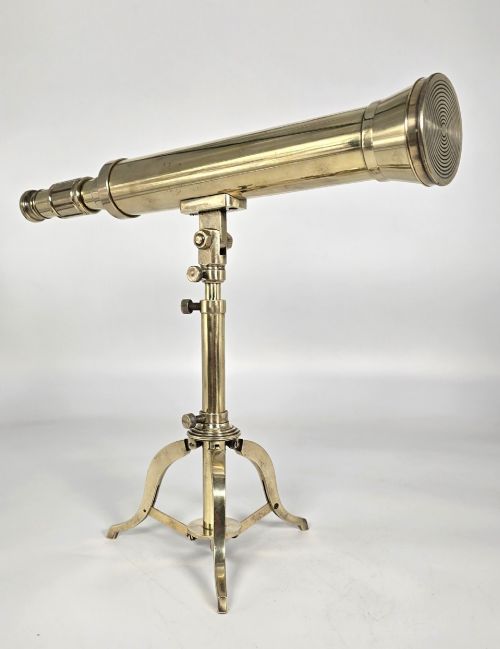


Desktop Brass Spyglass
Desktop brass spyglass instruments are precision optical tools that bring historical maritime craft directly onto your study table.
Desktop Brass Spyglass
When you search for a desktop brass spyglass, you are looking at scientific and maritime instruments designed for close study rather than handheld navigation at sea. These optical pieces sit on compact tripod stands or wooden bases, meant for permanent display in a library or study.
You are most likely to meet Victorian and Georgian examples on this page, often fashioned with multiple draw tubes of polished brass. Many of these library telescopes survive in their original fitted mahogany cases, complete with lenses that reveal the hand of 18th-century London makers.
Materials and construction
Makers fashioned these instruments using turned brass for the primary barrels, frequently pairing the warm metal with hand-stitched leather grips or polished mahogany bodies. Nickel plating appears on later twentieth-century iterations, offering a brighter silver finish alongside the traditional golden brass.
Optics relied on precise glass lenses housed within telescoping draws that extended smoothly to achieve focus. Workshops mounted these brass tubes onto folding tripod stands or heavy tabletop bases to steady the magnification for indoor viewing.
The listings here span the eighteenth, nineteenth, and early twentieth centuries, featuring brass, mahogany, leather, and nickel.
Assessing quality and finish
The distinction between ordinary and exceptional instruments lies in the crispness of the optical engineering and the crispness of the maker's signature engraved upon the brass barrel. Signed works by noted London opticians command closer attention because their lens alignment and material thickness remain superior.
The survival of original fitted wooden cases and fully functional folding tripod stands elevates a piece considerably. Finer examples retain their original lacquered brass finish and smooth draw action, whereas lesser pieces often show heavy replacement parts or hazy optics.
Nairne & Blunt·Johnson·Newton & Co·S & B Solomons·Matthew Berge·G. Adams
The Desktop Brass Spyglass Glossary
- Draw
- A sliding tubular section of a telescope that extends to adjust the focal length. Most library instruments feature between two and four draws.
- Library telescope
- A larger optical instrument designed for indoor use on a table or stand rather than for carrying in the field. These pieces usually feature larger objective lenses for brighter indoor viewing.
- Tripod stand
- A three-legged support base, often folding, used to mount the telescope securely on a desktop. Such stands provide the stability needed for higher magnification viewing.
- Objective lens
- The primary glass lens at the front of the telescope that gathers light. Its diameter determines the brightness and clarity of the magnified image.
Desktop Brass Spyglass: Frequently Asked Questions
What is a desktop brass spyglass?
A desktop brass spyglass is a historical optical instrument designed to rest on a table or stand for indoor viewing.
These pieces combine brass tubes with glass lenses and were traditionally used in studies and libraries to examine distant objects.
How do you use a library telescope?
You mount the brass barrel onto its tabletop tripod or resting base, then gently pull out the draw sections.
By sliding the tubes inward or outward, you adjust the focus until the distant view appears sharp through the eyepiece.
How do I date an antique telescope?
Dating relies on maker signatures, the style of the brass lettering, and the construction methods used on the draw tubes.
Georgian and Victorian pieces often show distinct proportions and typography that link them directly to London workshops of the period.
Why are some telescopes nickel plated?
Nickel plating began to appear on later optical instruments produced around the early twentieth century.
This finish offered a bright, protective surface layer that reduced tarnishing compared to traditional polished brass.