
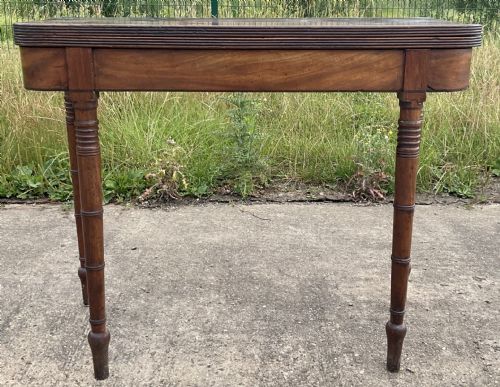
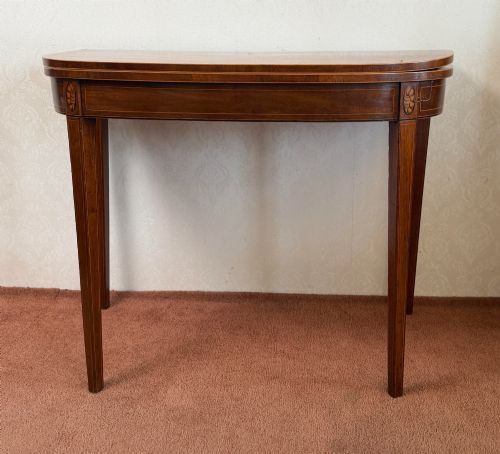
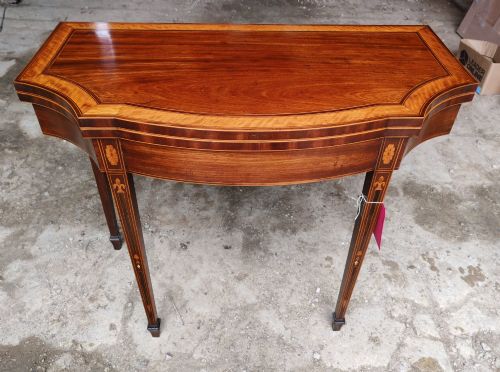
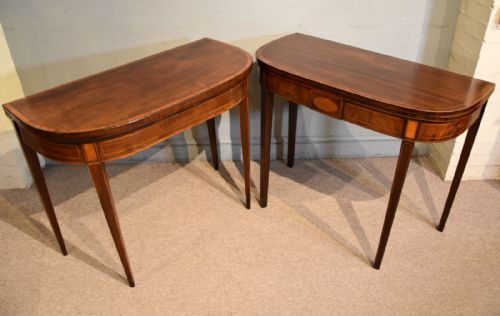


Demilune Fold Top Table
A demilune fold top table brings half-moon elegance to a room, opening to reveal a generous surface for tea or cards.
Demilune Fold Top Table
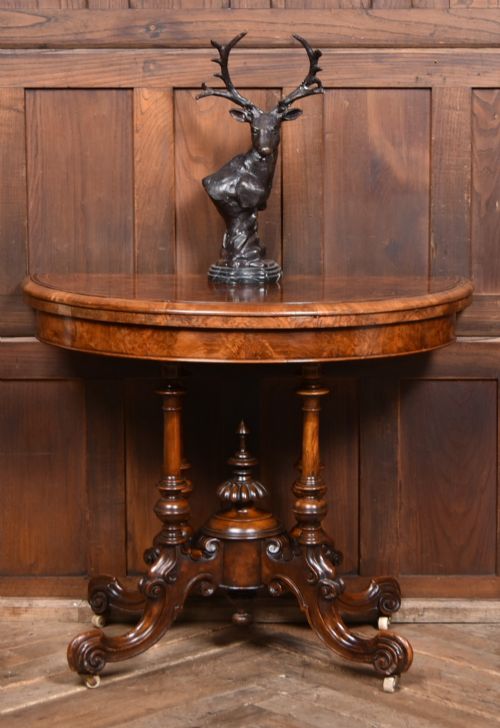
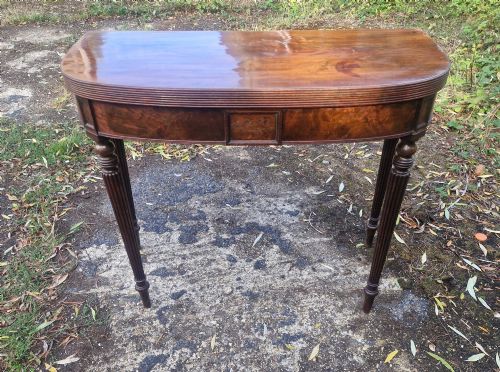
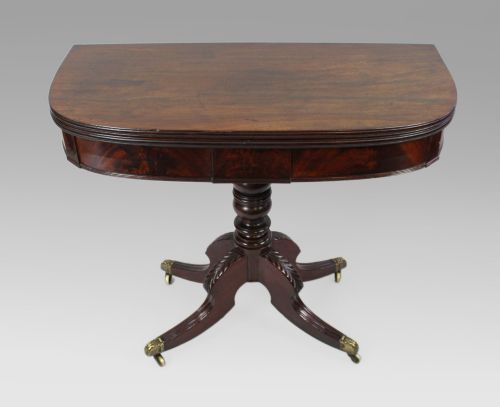
A demilune fold top table is typically encountered as a card table, tea table, or games table originating from the eighteenth and nineteenth centuries. These semicircular pieces sit flush against a wall when closed, saving space until the hinged top opens to double the surface area.
The selections span Georgian, Regency, and Victorian periods, alongside later revivals. Mahogany predominates, frequently complemented by walnut, rosewood, and satinwood, reflecting the changing tastes of British, Irish, and Swedish cabinet makers across eras.
Buyers seeking a demilune fold top table will find forms functioning variously as console tables, side tables, and triple top variants. Regional variations, such as Irish and Scottish examples, sit alongside standard metropolitan cabinet work.
Materials and construction methods
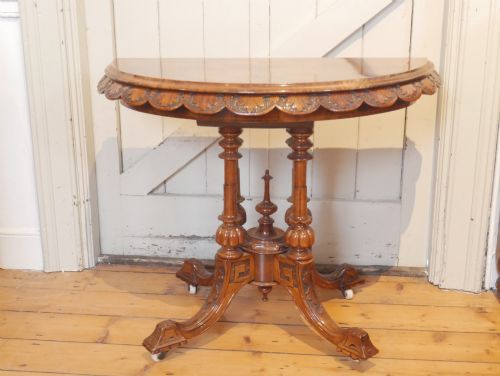
Construction relies heavily on Honduras mahogany, burr walnut, and rosewood, chosen for their grain patterns and stability. Timber selection often dictates whether the top displays plain figured wood or elaborate cross-banding and marquetry.
Inlays of satinwood, boxwood, and brass provide linear contrast and detail around the frieze and edges. Table legs range from simple tapered styles to carved forms in specific regional traditions.
The folding mechanism employs clever wooden hinges or pivoting frames designed to support the swinging leaf securely when open. Secondary timbers inside the frame maintain structural integrity through centuries of use.
Many tables retain secret compartments hidden within their folding frame for storing counters and dice.
Distinctions in quality
Quality rests upon the choice of veneer and timber figure, particularly on the top surface. Superior pieces exhibit book-matched mahogany or rich burr walnut that forms a coherent pattern when the leaf unfolds.
The precision of the inlay work and the crispness of any carved details separate standard cabinet work from exceptional examples. Finer tables maintain tight joints in the folding mechanism and use dense, heavy secondary woods.
Proportion and scale dictate the success of the silhouette, with desirable pieces maintaining balanced dimensions whether closed against the wall or open in the centre of the room.
Gillows
The Demilune Fold Top Table Glossary
- Demilune
- Shaped like a half-moon. This semicircular form allows the table to stand neatly against a wall when folded.
- Fold-over
- A hinged top design that opens out to double the surface area. It typically reveals a baize-lined interior for playing cards or a polished timber surface for tea.
- Cross-banding
- A strip of veneer applied to the border of a tabletop with the grain running perpendicular to the main panel. This technique creates a distinct visual framing effect.
- Marquetry
- The art of creating decorative patterns using pieces of various coloured woods. Floral and geometric motifs are often inlaid into the primary surface.
- Triple top
- A table construction featuring three leaves. The upper leaves unfold to provide storage compartments or alternative playing surfaces beneath.
Demilune Fold Top Table: Frequently Asked Questions
How were demilune tables used originally?
These tables served primarily as stylish furniture for social occasions, functioning as console or side pieces during the day. When guests arrived, the hinged top opened to accommodate tea service or card games.
Their dual nature made them practical for period drawing rooms where floor space was at a premium. The semicircular closed shape kept circulation clear until the room required extra surface area.
How do I tell Georgian tables from Victorian ones?
Georgian tables, dating from the eighteenth and early nineteenth centuries, tend to display restrained classical proportions and fine mahogany timbers. Inlays often utilise boxwood and satinwood lines with subtle geometric focus.
Victorian pieces, emerging after the mid-nineteenth century, frequently employ burr walnut and heavier floral marquetry. Their proportions can be bolder, and revival styles often emulate earlier Georgian or Sheraton aesthetics with denser internal framing.
Can these tables be used for dining?
Most demilune fold top tables are unsuited for full dining because their folding leaves rely on delicate pivoting supports rather than heavy structural legs. They are engineered for light weight use such as playing cards or serving tea.
Placing heavy objects or leaning weight onto the opened leaf can strain the hinge mechanism. Their ideal modern function mirrors their historic purpose as accent pieces that open for occasional entertaining.
What woods should I expect to find?
Mahogany forms the majority of eighteenth-century and Regency examples, often featuring figured Honduras timber on the top surface. Walnut and rosewood gain prominence in later Victorian and Edwardian periods.
Secondary decorative elements incorporate satinwood, boxwood, and brass inlay. Burr walnut is particularly common on nineteenth-century card tables, offering complex swirling grain patterns.
Where should I place a demilune table?
A demilune table sits best flat against a hallway or living room wall where its semicircular profile occupies minimal depth. It provides a surface for lamps, decorative objects, or mirrors hung above.
When positioned in a larger space, pulling the table away from the wall and opening the top creates a striking centrepiece for a room. Ensure adequate clearance around the piece for the leaf to swing open freely.