
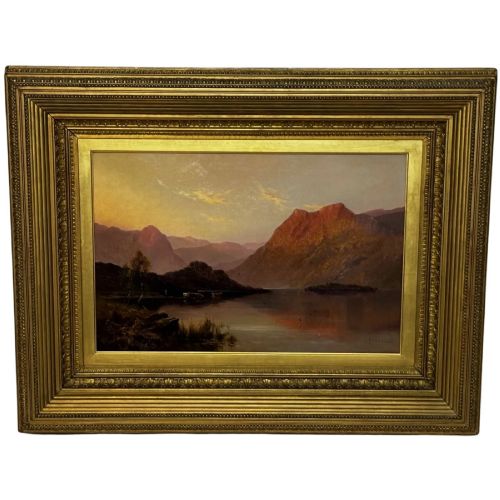


De Breanski Oil Painting
A de breanski oil painting captures the dramatic light and atmosphere of Victorian landscapes and coastal scenes, prized by collectors for rich detail and romantic mood.
De Breanski Oil Painting
A de breanski oil painting represents the skilled output of an artistic family renowned for capturing British and Welsh topography during the nineteenth and early twentieth centuries. When searching for a de breanski oil painting, collectors encounter characteristic scenes of Scottish highlands, serene lakes, and maritime views.
The works on this page span the Victorian era up to the early twentieth century, encompassing expansive canvases and intimate boards. Buyers most frequently meet peaceful river valleys, dramatic mountain backdrops, and coastal harbours set against glowing sunsets or misty mornings.
Subjects range from tranquil Welsh river landscapes near Betws-y-coed to vigorous seascapes featuring fishing boats coming into harbour. The enduring appeal lies in the romantic handling of light upon water and heather, executed with the realism typical of the period.
Materials and technique
These works are executed using oil paint on stretched canvas or wooden board, mediums that allowed artists to build rich textures and subtle tonal gradations. The application of oil pigment enabled the layering necessary to depict shifting atmospheric conditions over water and mountain ranges.
Framing is an integral component of the presentation, frequently involving heavy gilded wood and moulded gesso frames that complement the grand scale of the compositions. The combination of durable canvas supports and ornate giltwood framing ensured these nineteenth-century works survived in stable condition.
Several canvases capture cows stubbornly standing in Scottish lochs at sunset, apparently unfazed by the dramatic lighting.
Distinguishing quality across the range
Quality in these works rests upon the specific family member's hand, the scale and ambition of the composition, and the atmospheric depth achieved in the landscape. Paintings by Alfred de Breanski Senior often command attention for their luminous handling of Highland light and meticulous detail in foliage and cattle.
The preservation of the original oil surface and the integrity of the heavy gilded wood frame heavily influence desirability. Works that retain their original canvas tension and uncleaned, vibrant pigment layers represent the pinnacle of the genre.
Alfred de Breanski Snr·Gustave de Bréanski·Alfred Fontville de Breanski Jr
The De Breanski Oil Painting Glossary
- Oil on canvas
- A traditional painting technique where oil pigments are applied to a woven fabric support stretched across a wooden frame. This method permits rich blending and tactile brushwork.
- Giltwood
- Wood that has been treated with a thin layer of gold leaf or gilt finish, commonly used for ornate nineteenth-century picture frames. It provides a reflective border that enhances the illumination within the painting.
- Gesso
- A plaster-like mixture applied to wooden frames as a base for moulding and gilding. It creates smooth, decorative surfaces capable of holding intricate relief patterns.
- Realism
- An artistic movement focused on depicting subjects as they appear in everyday life without idealisation. In these pieces, it manifests in the accurate representation of topography, weather, and livestock.
- Seascape
- A genre of fine art that focuses on scenery centred on the sea, ships, and coastal views. Gustave de Breanski specialised in this form, capturing coastal waters and harbours.
De Breanski Oil Painting: Frequently Asked Questions
How do I identify an authentic de breanski oil painting?
Authentication relies on examining signature styles, typical subject matter such as Scottish highlands or coastal waves, and period framing materials like gesso and gilded wood.
Comparing brushwork and signature styles against recorded examples from the family helps confirm attribution.
What subjects did the de breanski family paint?
The family focused heavily on British and Welsh landscapes, particularly mountainous lake views, river valleys at sunset, and maritime coastal scenes.
Their repertoire also includes depictions of cattle in highlands and bustling harbour entrances.
How should I care for an antique oil painting?
Keep the canvas away from direct sunlight, high humidity, and extreme temperature fluctuations to prevent cracking in the oil paint and warping of the stretcher bars.
Dust the gilded wood frame gently with a dry, soft brush without applying liquid cleaners to the surface.
What is the difference between works by father and son?
Alfred de Breanski Senior generally established the iconic luminous Highland landscape style during the Victorian period, known for warm sunset lighting.
His son, Alfred Fontville de Breanski, continued the tradition into the twentieth century with similar attention to Welsh and Lake District topography.