
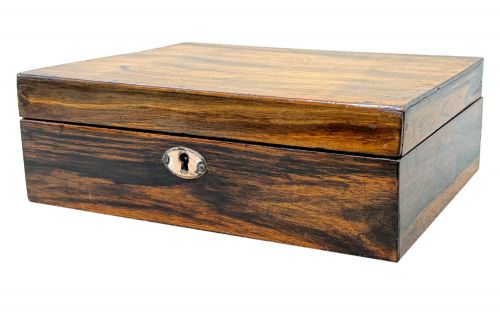


Dark Wood Sewing Box
A dark wood sewing box brings tactile warmth and refined utility to a room, holding needlework or small treasures with understated grace.
Dark Wood Sewing Box
A dark wood sewing box encompasses everything from tabletop caskets to substantial freestanding work tables designed for needlework and domestic crafts. These pieces emerge primarily from the Regency, William IV, and Victorian periods, reflecting an era when personal handiwork occupied a central place in daily parlour life.
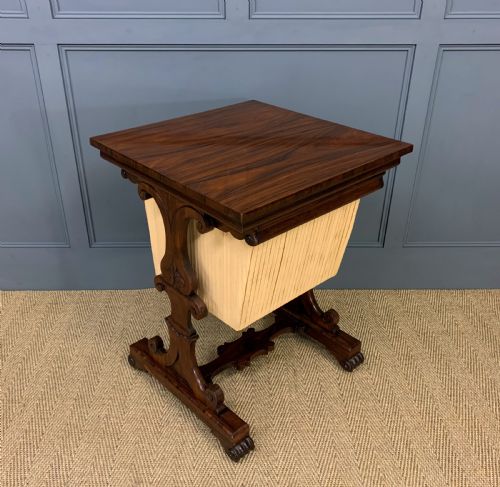
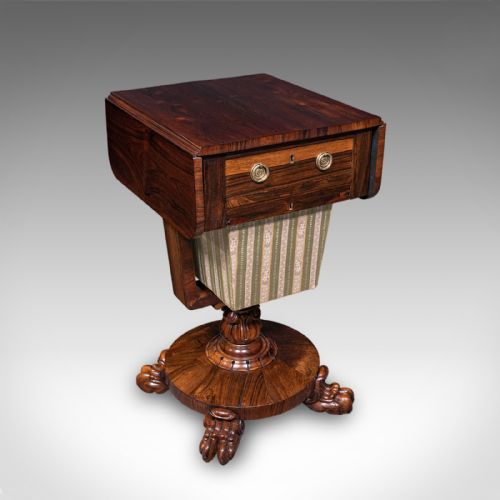
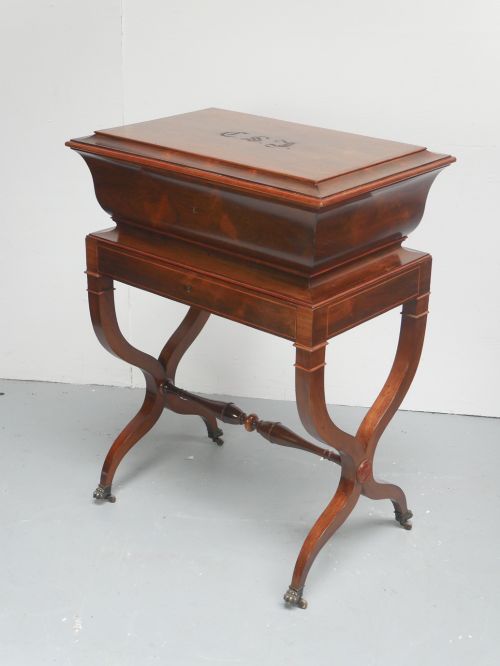
Rosewood and mahogany dominate the selection on this page, often built as compact boxes or fitted tables complete with internal compartments, fabric bags, and writing surfaces. Tables frequently feature drop leaves and turned pillars, while smaller boxes sit upon miniature feet or operate as portable caskets.
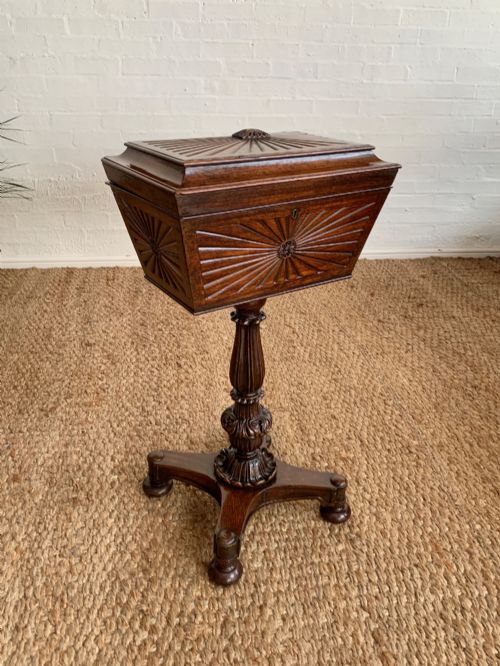
Origins stretch across English, French, and Anglo-Indian workshops, demonstrating diverse regional interpretations of functional luxury. Buyers encounter objects ranging from small rectangular work boxes to metamorphic sewing tables and elaborate teapots repurposed for storage.
Materials and construction methods
Cabinetmakers utilised dense tropical timbers such as rosewood, coromandel wood, and mahogany, selecting them for their rich grain patterns and durability. Boxwood stringing, mother-of-pearl inlay, and brass fittings provide crisp linear contrast against these dark polished surfaces.
Internal compartments often feature delicate silk, fabric, and fitted trays designed to organise needles, thread, and small tools. Structural joinery prioritises stability in freestanding tables while maintaining lightweight portability in tabletop work boxes.
Secret compartments occasionally reveal themselves behind hidden spring releases in 19th-century rosewood boxes.
Judging execution and finish
Quality reveals itself through the crispness of carved details like sunburst motifs and the precision of marquetry inlay rather than surface shine alone. Superior examples maintain original fitted interiors, sound internal silk linings, and fully functional locks with matching keys.
The choice of timber underpins the overall grade, with richly figured coromandel wood or book-matched rosewood veneers commanding greater appreciation than plainer mahogany boards. Proportions also dictate execution, separating balanced, sturdy freestanding tables from heavier or awkwardly scaled pieces.
Lesage
The Dark Wood Sewing Box Glossary
- Work table
- A freestanding domestic table equipped with drawers, compartments, or an attached fabric bag specifically intended for sewing and needlework.
- Teapoy
- A small pedestal cabinet originating from the Anglo-Indian trade, frequently adapted in British homes to house tea canisters or sewing implements.
- Coromandel wood
- A heavily figured, dense hardwood from Southeast Asia displaying dark brown and black stripes, highly prized by 19th-century cabinetmakers.
- Marquetry
- The decorative art of applying pieces of veneer to a structural structure to form geometric or floral patterns.
- Boxwood
- A pale, fine-grained yellowish wood commonly utilised for contrasting stringing and inlay work on darker furniture.
Dark Wood Sewing Box: Frequently Asked Questions
What is the difference between a sewing box and a work table?
A sewing box is a portable tabletop casket designed to be carried from room to room, housing small threads, needles, and thimbles within a compartmentalised tray.
In contrast, a work table stands on its own legs as a piece of furniture, often incorporating a hanging fabric bag or deep drawer beneath the top to accommodate larger projects.
How do I distinguish between Regency and Victorian pieces?
Regency items generally display classical restraint, clean architectural lines, brass inlay, and light brass mounts influenced by ancient Roman and Greek forms.
Victorian pieces tend to feature heavier proportions, more ornate carving such as scrollwork or floral motifs, and intricate marquetry or coromandel veneers.
What was the fabric bag beneath the table used for?
The hanging silk or fabric pouch beneath a work table held unfinished knitting, embroidery, or sewing scraps while the lady of the house worked in the parlour.
These bags were gathered onto wooden hoops or frames, allowing easy access to bulky textiles without cluttering the tabletop surface.
Where should I place a sewing box in a modern home?
Tabletop boxes sit comfortably on sideboards, desks, or lamp tables, serving as secure storage for modern stationery, jewellery, or sewing accessories.
Freestanding work tables function effectively beside armchairs as occasional tables or lamp stands, retaining their original utility in a contemporary sitting room.