


Dark Wood Music Chest
These dark wood music chests are practical storage cabinets designed for sheets and folios, offering a tidy place to keep your collection.
Dark Wood Music Chest
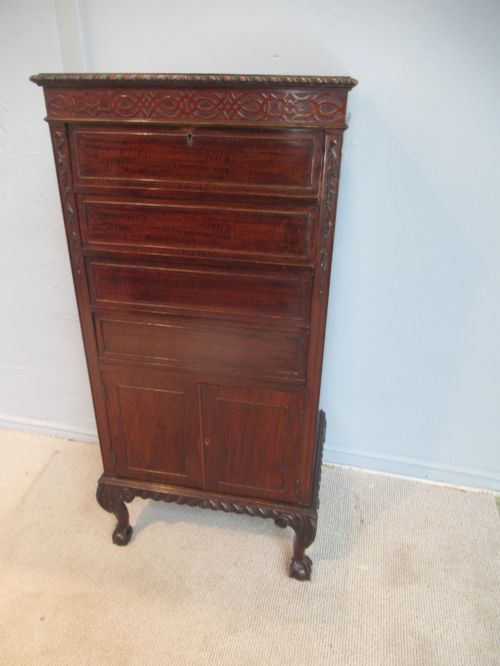
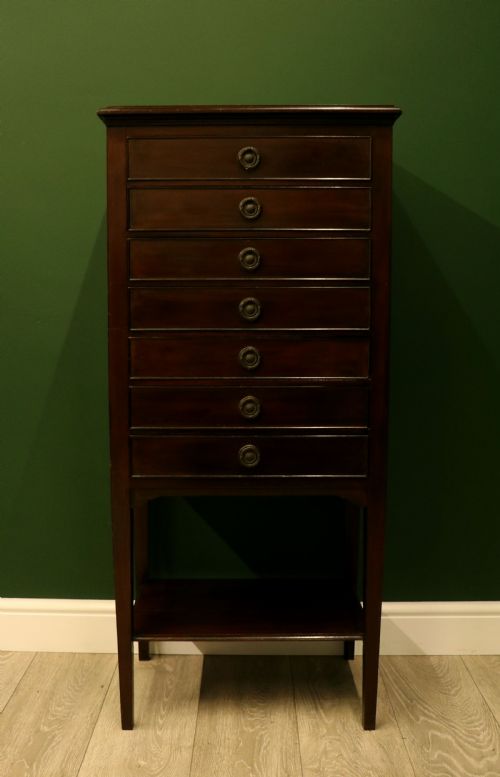
A dark wood music chest is a specialised storage cabinet designed to hold sheet music, folios, and scores in domestic parlours. These items emerge from Victorian, Edwardian, and early twentieth-century periods, spanning from eighteen seventy-five to nineteen twenty. Cabinets take vertical forms with drop-down or sliding drawers, though related display cabinets and music boxes also appear.
Most examples found here are constructed in mahogany and rosewood, reflecting the preference for dark timbers during the nineteenth and early twentieth centuries. You encounter Victorian pairs, Edwardian inlaid designs, and later nineteen-twenties file cabinets that continue the same functional typology. They serve equally well today as small drawer units or bedside cabinets in modern homes.
Construction and materials
Makers built these pieces primarily using solid mahogany and rosewood timbers, often incorporating wood inlay for decorative effect on drawer fronts and doors. Brass handles and fittings provide functional contrast to the dark polished surfaces, while glass panels feature in related display variants. The cabinet carcass work relies on traditional joinery designed to support heavy stacks of paper without sagging.
Surface finishing involves French polishing to bring out the natural grain and deep colour of the mahogany or rosewood. Inlaid motifs employ lighter contrasting veneers set flush into the primary timber surfaces. Metal components such as brass drop handles and hinges are screwed securely into the solid wood framing.
Listings span the Victorian, Edwardian, and early twentieth-century periods, utilising mahogany, rosewood, and brass.
Judging quality
Quality rests in the selection of timber and the precision of the cabinetwork rather than sheer size or ornamentation. Pieces featuring refined wood inlay and matched grain patterns across the drawer banks command greater appreciation than plain utilitarian boxes. The presence of original brass hardware and well-fitted internal dividers marks out superior examples.
Proportion and structural integrity distinguish better workshops from mass production. Well-constructed music chests have smooth-running drawers that fit their apertures properly without binding. The depth of colour in the French polish and the crispness of any inlaid detailing reveal the original maker's standard of craftsmanship.
The Dark Wood Music Chest Glossary
- Mahogany
- A durable tropical hardwood prized for its reddish-brown colour and stability in cabinetmaking. It forms the primary material for the majority of these music cabinets.
- Rosewood
- A dense, heavily figured dark timber with distinctive grain patterns used on finer Victorian and Edwardian examples. It takes a high polish and often appears alongside inlaid decoration.
- Fretwork
- Openwork carving or pierced decoration applied to cabinet doors or galleries. It lightens the visual weight of heavy dark timber.
- Inlay
- A technique where pieces of contrasting wood or other materials are inserted into depressions in the base timber to form decorative patterns. Edwardian makers utilised this frequently on music chests.
- Folio cabinet
- A tall storage unit with shallow drawers designed specifically to hold large loose sheets of paper, prints, or music. These function identically to traditional sheet music cabinets.
Dark Wood Music Chest: Frequently Asked Questions
What fits inside a dark wood music chest?
These cabinets contain shallow drawers specifically dimensioned to hold folded or flat sheets of music and paper folios without bending them.
Today, the internal depth and width suit sheet music, art prints, documents, and modern vinyl records or stationery items.
How do I date a music cabinet?
Dating relies on stylistic clues such as Victorian heaviness, Edwardian inlaid rosewood veneers, or cleaner nineteen-twenties lines.
Construction methods, handles, and timber choices also indicate whether a piece originates from the late nineteenth century or the early twentieth.
Can I use one as a bedside table?
Their vertical proportions and compartmentalised drawers make these chests a practical height for placement beside a bed.
The enclosed storage keeps bedside clutter out of sight while offering a sturdy surface top for a lamp.
How do I maintain the wood finish?
Polished mahogany and rosewood require dusting with a soft dry cloth and protection from direct sunlight and extreme humidity.
Applying occasional specialist wax feeds the finish and preserves the natural lustre of the dark timber without building up residue.