






Dark Teak Centre Table
A dark teak centre table brings heavy colonial carving and dense tropical timber straight into the middle of a room.
Dark Teak Centre Table
A dark teak centre table is typically a nineteenth-century piece reflecting Anglo-Indian, Anglo-Burmese, or colonial tastes. These tables arrive in forms such as circular tilt-top occasional tables, campaign dining pieces, and low coffee tables.
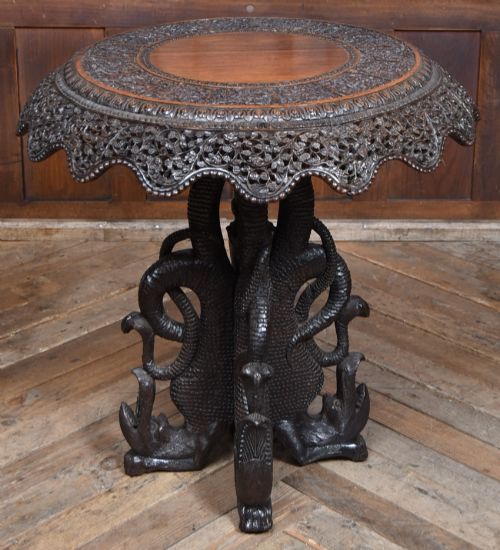
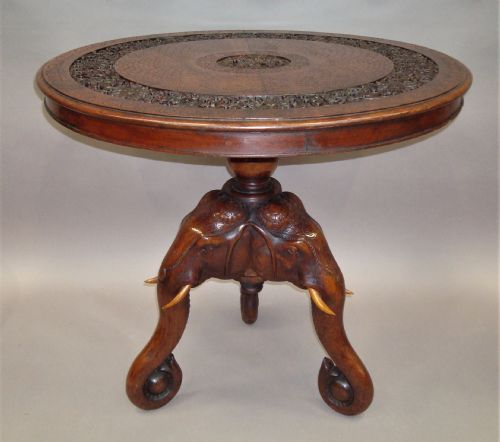
The versions most frequently met on this page showcase intricate regional carving featuring motifs like elephants, alongside simpler circular tops designed to stand freely in a room. Originating largely from nineteenth-century workshops, they utilise dense imported hardwoods intended to anchor a scheme.
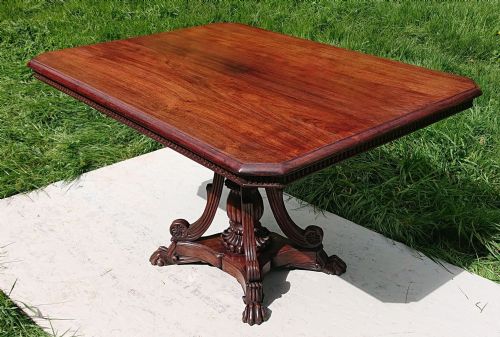
Buyers seeking a dark teak centre table encounter formats ranging from compact occasional stands to large dining and display surfaces. The selection spans the Victorian era and the broader nineteenth century, reflecting global trade and British colonial craftsmanship.
How they were made
Makers constructed these tables using dense tropical timbers, predominantly teak, padouk, and rosewood, often paired with secondary hardwoods. Surfaces received deep, hand-carved relief work executed by regional artisans working in colonial outposts.
Tilt-top mechanisms, iron fittings, brass accents, and occasional bone inlays appear across the surviving pieces to provide structural movement and decorative contrast. Joinery was substantial to support heavy carved tops and solid pillar bases.
Several tables feature carved elephants traversing the timber base, ensuring your tea tray travels with a small herd.
What varies in quality
Quality rests in the crispness and depth of the hand-carved detail across the teak surface. Superior examples demonstrate confident relief work without the softening or shallow flatness seen in later or more hurried workshop output.
The structural integrity of the base and the stability of tilt-top mechanisms distinguish finer tables from simpler utilitarian forms. Selection of timber also dictates quality, with dense, evenly coloured teak and padouk holding a deeper natural lustre than mixed secondary hardwoods.
The Dark Teak Centre Table Glossary
- Anglo-Indian
- Descriptive term for furniture made in India during the British period, combining British forms with local carving traditions. These pieces often utilise native hardwoods such as teak.
- Tilt-top table
- A table featuring a hinged top that pivots vertically to allow storage against a wall when not in use. This mechanism is frequently found on nineteenth-century occasional and centre tables.
- Padouk
- A heavy, durable reddish-brown tropical hardwood utilised in nineteenth-century colonial furniture making. It shares similar weight and density characteristics with teak.
- Campaign table
- Portable furniture designed for military officers, constructed to dismantle or fold easily for transport. Surviving examples often feature brass hardware and robust joints.
Dark Teak Centre Table: Frequently Asked Questions
Where did these tables originate?
These tables originate from nineteenth-century British colonial regions, notably India and Burma, where local craftsmen constructed them for colonial officers and export markets.
Makers utilised native tropical timbers like teak and padouk, applying traditional regional carving styles to standard British furniture forms.
How do I use a tilt-top table?
The hinged top pivots from a horizontal surface to a vertical position by releasing an under-table catch. This allows the piece to rest flat against a wall to save floor space when empty.
In daily use, the top locks securely into the horizontal position on its pillar base to serve as a centre or occasional table.
Are these pieces suitable for daily dining?
Certain larger formats, including campaign dining pieces, were originally built to seat multiple people for meals. Their sturdy hardwood construction handles everyday use effectively.
Tilt-top occasional tables and heavily carved centre tables function better for display, reading, or resting objects rather than active daily dining.
How do I date a nineteenth-century table?
Dating relies on examining the timber density, hand-carving techniques, and structural hardware such as brass brackets or iron fixings. Nineteenth-century examples often display distinct regional carving patterns.
Periods cited on this page span the Victorian era and the broader eighteen-hundreds, reflecting the lifespan of colonial furniture production.