

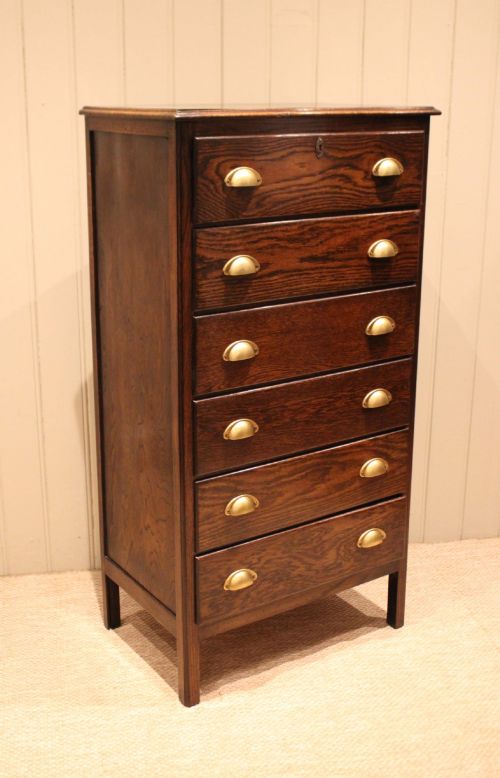



Dark Oak Filing Cabinet
A dark oak filing cabinet brings serious early twentieth-century presence into a room, combining practical storage with handsome timber grain.
Dark Oak Filing Cabinet
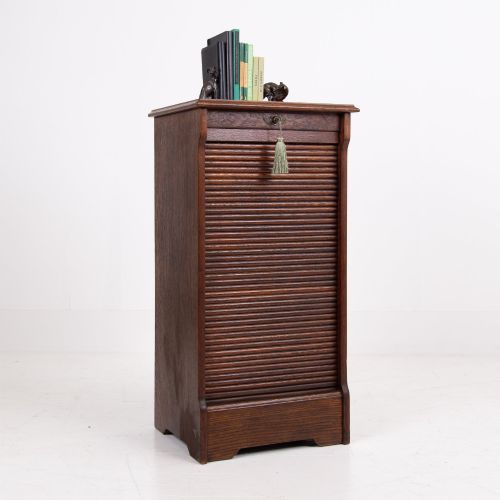
A dark oak filing cabinet offers substantial storage rooted in early twentieth-century design, appearing across Edwardian and Art Deco periods. These pieces frequently feature clever tambour doors that slide away to reveal internal drawers or shelving.
The version most commonly met on this page is the single or double tambour front office cabinet, alongside occasional music cabinets and small desktop drawers. Origins span English workshops to French makers, all sharing a sturdy timber construction.
Buyers seek these cabinets for their functional utility and rich, dark patination. They sit comfortably in home studies and modern offices alike, hiding paperwork behind smooth-running wooden slats.
Materials and Construction
Construction relies heavily on solid oak, selected for durability and finished in dark tones that highlight the natural grain. Metal mechanisms often support internal moving parts.
Tambour fronts demand precise craftsmanship, consisting of numerous small wooden slats glued to canvas backings so they bend smoothly around curves. Brass handles and fittings frequently complete the hardware.
Joinery from the Edwardian and early twentieth-century periods prioritises strength, ensuring these office cabinets endure heavy daily use for generations.
Dark Oak Filing Cabinet Retail Price Guide 2026
Typical asking prices for dark oak filing cabinet among the pieces listed under this phrase on Sellingantiques today, from the lower quarter to the upper quarter. They describe what is for sale here now, not the wider market.
Several cabinets were originally built purely to organise sheet music, meaning your modern tax returns get stored where Waltzes once rested.
Assessing Quality and Merit
Quality rests significantly on the smoothness of the tambour mechanism and the condition of its canvas backing. Slats that bind or sag indicate wear or poor past maintenance.
Timber selection and depth of colour separate standard utility pieces from finer examples. Richly figured dark oak and intact original brass hardware elevate a cabinet's standing considerably.
The Dark Oak Filing Cabinet Glossary
- Tambour
- A flexible door made of narrow strips of wood affixed to canvas, allowing it to slide smoothly around a curved track. This clever design saves space in busy offices.
- Edwardian
- Dating from the reign of King Edward VII, this period favours lighter proportions while retaining traditional craftsmanship. Pieces from this era often show refined detailing.
- Art Deco
- A twentieth-century style characterised by sleek geometric forms and streamlined shapes. It brings a sophisticated modernist edge to traditional timber furniture.
- Music Cabinet
- A specialised storage piece designed originally for sheet music, featuring shallow internal drawers. These adapt easily for modern stationery and paperwork.
Dark Oak Filing Cabinet: Frequently Asked Questions
How do tambour doors work?
Tambour doors consist of narrow wooden slats attached to a flexible canvas backing, enabling them to slide along concealed tracks. They vanish completely into the cabinet carcass when opened.
This ingenious mechanism allows access to contents without requiring clearance for swinging doors, making these cabinets ideal for tight spaces.
Are these cabinets suitable for modern laptops?
Many of these pieces offer internal drawers or shelving dimensions that accommodate modern paperwork and smaller devices. Desktop drawers and music cabinets work particularly well for contemporary desk accessories.
Buyers should check internal measurements carefully before purchasing to ensure specific items fit comfortably within the historical compartments.
How do I care for dark oak timber?
Maintain the finish by applying quality beeswax occasionally and buffing gently with a soft cloth. Avoid placing cabinets near direct heat sources or strong sunlight to prevent timber splitting.
Regular dusting preserves the rich dark patination and keeps the wooden tambour slats running smoothly along their tracks.
How can I tell an Edwardian piece from a 1930s one?
Edwardian pieces often display softer decorative moulding and traditional brass hardware inherited from nineteenth-century tastes. Cabinets from the 1930s tend towards cleaner lines, occasionally leaning into Art Deco simplicity.
Examining internal construction methods and drawer linings helps confirm the manufacturing era more accurately.