
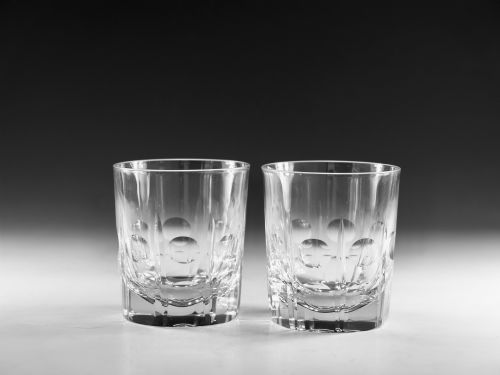
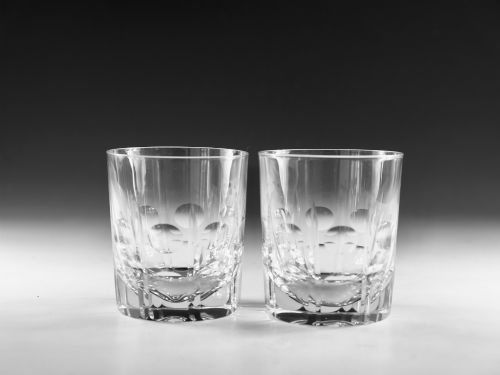
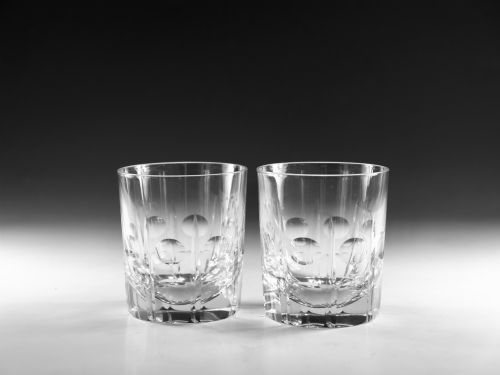
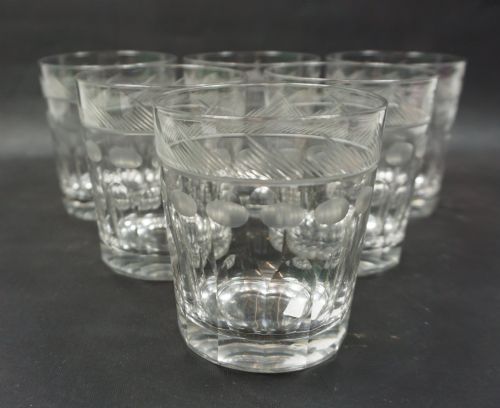


Cut Glass Whisky Tumblers
Cut glass whisky tumblers are robust drinking vessels designed to hold spirits, offering satisfying weight and brilliant refractive facets.
Cut Glass Whisky Tumblers
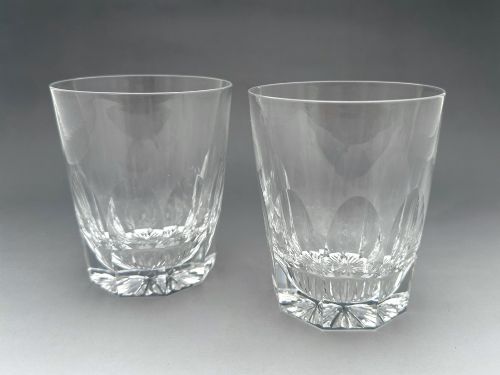
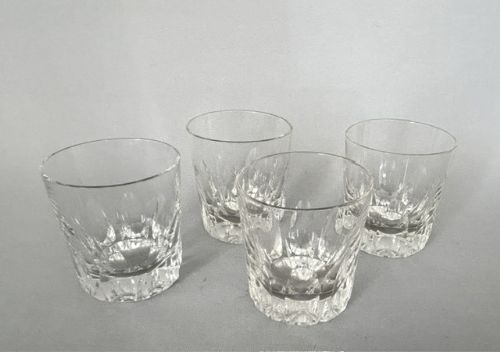
Cut glass whisky tumblers are solid drinking vessels designed for spirits, appearing primarily in Victorian and early 20th-century English forms across this selection. Buyers find single items, pairs, and larger matched sets ranging from small examples to heavy crystal versions.
The objects span Georgian, Victorian, Edwardian, and 1930s periods, showing how drinking habits and glass-cutting fashions evolved over time. These sturdy vessels were built for daily use, combining practical heft with decorative surface work.
How they were made
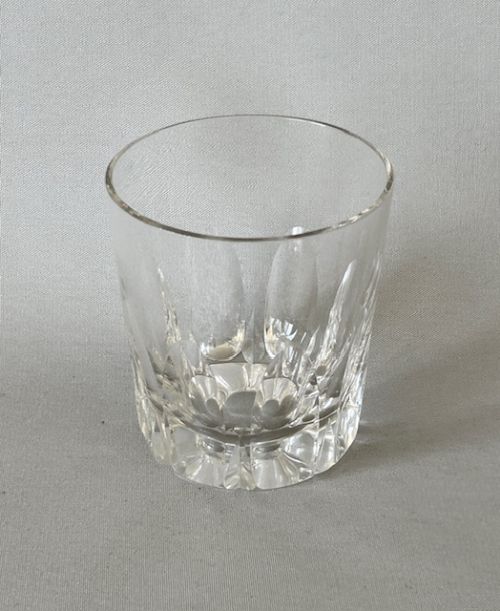
The makers utilised lead crystal, lead glass, and standard glass, shaping each piece through blowing and heavy manual wheel-cutting. Artisans ground geometric patterns and blaze cuts directly into the thick walls to catch the light.
The resulting heavy bases and faceted sides required skilled handling to maintain balance and clarity. Surface polishing softened the sharp edges left by the cutting wheels while preserving the crispness of the design.
Victorian drinkers relied on heavy glass bases to keep their spirits upright when tavern tables wobbled.
What varies in quality
Quality rests in the depth and precision of the cutting, the clarity of the metal, and the overall weight of the piece. Superior examples show crisp, clean facets that remain sharp to the touch without being crude.
The thickness of the base and the symmetry of the panels dictate the tactile experience in the hand. Earlier Georgian and Victorian pieces often display distinct hand-cut irregularities that set them apart from later production.
The Cut Glass Whisky Tumblers Glossary
- Lead crystal
- Glass containing a significant proportion of lead oxide, which increases weight, brilliance, and softness for easier cutting. This material gives these tumblers their characteristic ring and clarity.
- Blaze cut
- A specific linear cutting technique featuring wide, shallow facets that reflect light dramatically. It appears frequently on Georgian and Regency drinking vessels.
- Metal
- The specific term for the molten glass composition used by makers before it is shaped and cooled. The quality of the metal affects the overall brilliance of the finished tumbler.
- Facet
- A flat surface cut into the exterior of the glass to refract light and provide grip. Multiple facets create the complex geometric patterns seen on these pieces.
- Regency
- An English design period spanning the early 19th century, known for strong classical influences and bold cut glass decoration.
Cut Glass Whisky Tumblers: Frequently Asked Questions
How do I clean antique cut glass?
Wash these tumblers gently in warm water using mild soap, avoiding sudden temperature changes that can crack old glass.
Dry them immediately with a lint-free cloth to maintain the brilliance of the faceted surfaces.
Were these used only for whisky?
While named for whisky, these robust vessels served for various spirits and water throughout the 19th and early 20th centuries.
Their heavy bases were specifically designed to prevent tipping on dining tables and sideboards.
How can I tell Victorian from Georgian pieces?
Georgian and Regency examples often feature broader blaze cuts and darker, heavier metal with distinct optical distortions.
Victorian and later 19th-century pieces generally show more intricate, machine-influenced geometric patterns and brighter metal clarity.
Can I use these tumblers daily?
These solid drinking vessels were originally built for regular use and handle everyday occasions well.
Hand washing remains essential to preserve the vintage glass and prevent damage in modern dishwashers.