
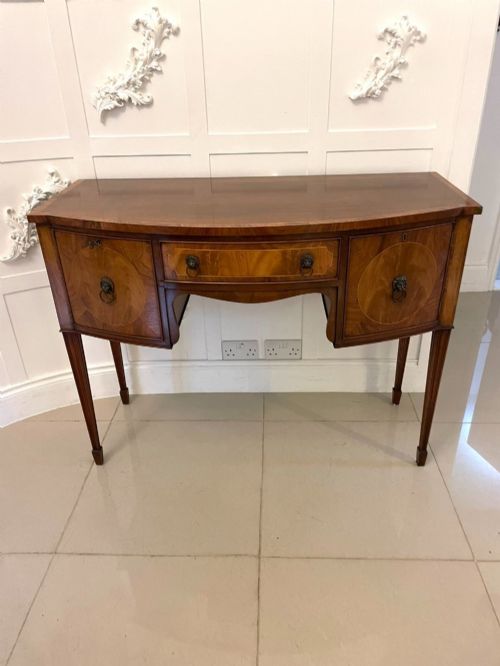
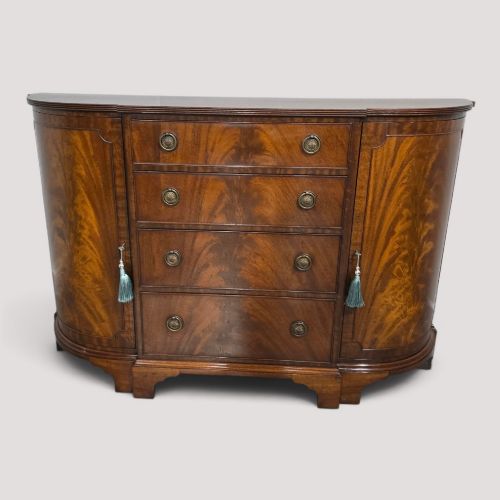
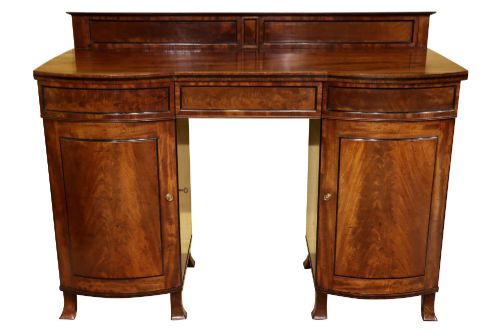
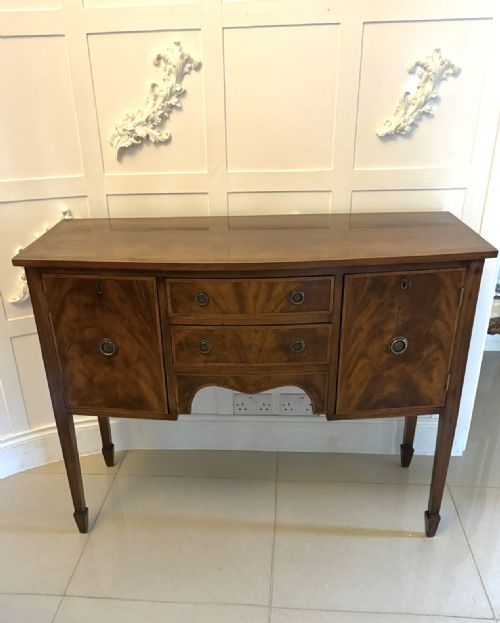

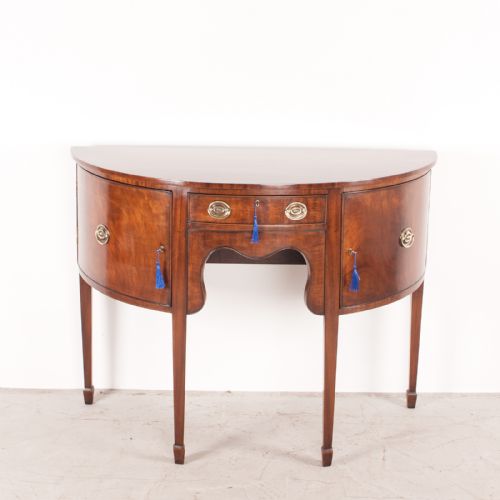


Curved Front Mahogany Server
A curved front mahogany server offers sweeping lines and rich timber grain, serving dining rooms with both practical storage and undeniable elegance.
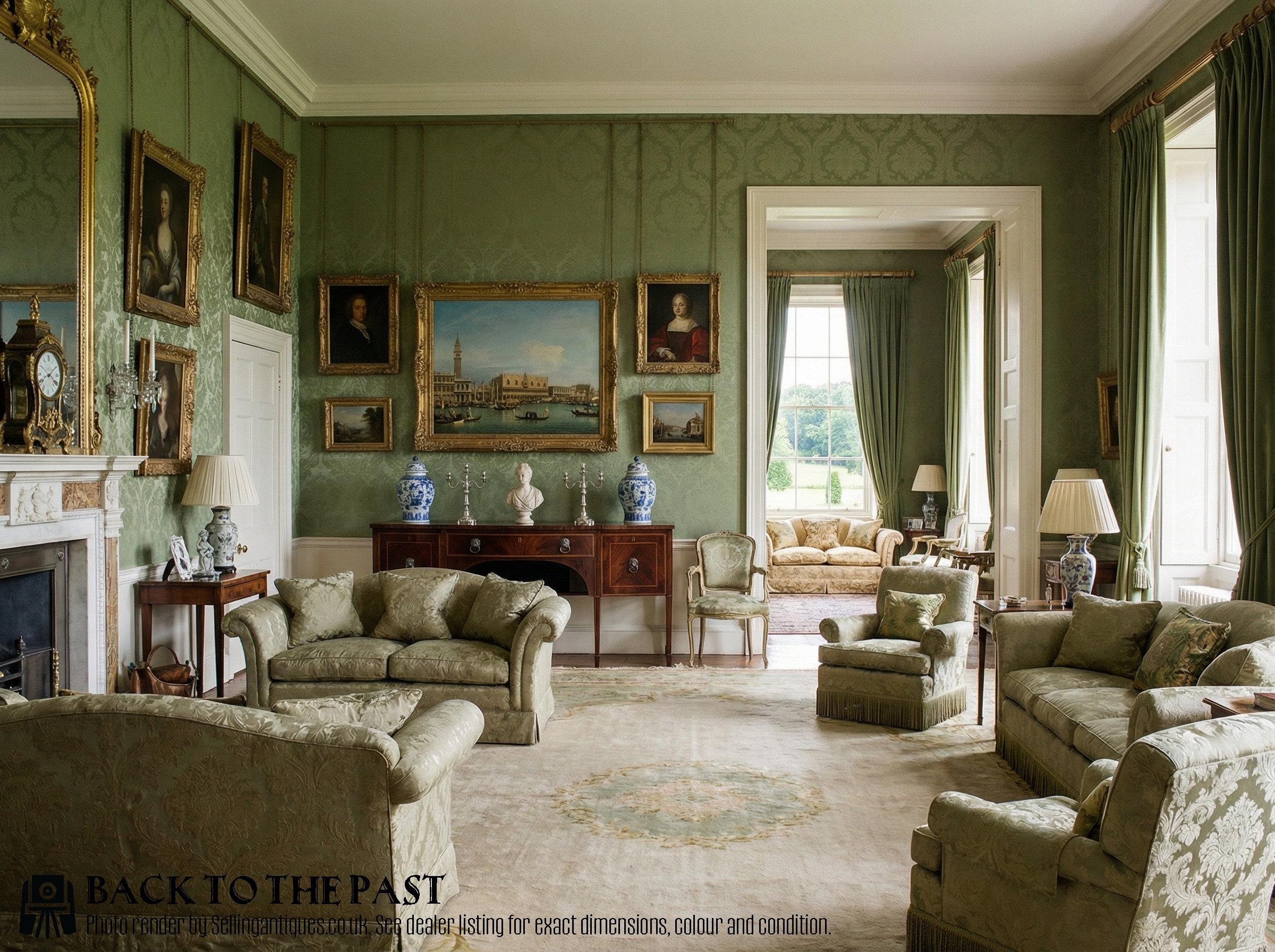
Curved Front Mahogany Server
A curved front mahogany server provides a distinctive concave or convex silhouette that sets it apart from standard rectangular dining furniture. When exploring the curved front mahogany server category, buyers frequently encounter bowfront and serpentine forms originating from the Georgian, Regency, and Edwardian eras.
The pieces on this page span from the eighteenth century into the twentieth century, encompassing formal sideboards, smaller side tables, and serving tables. Workshops during these periods employed solid timbers and detailed veneers to shape these grand dining room additions.
Most examples present either a bowed front or a more complex serpentine outline, often supported by tapering legs or heavy pedestals. These items function as focal points in period dining spaces while offering concealed storage for silver and linen.
Construction and materials
Cabinetmakers constructed these servers using solid mahogany frames, frequently applying flame mahogany veneer to large drawer fronts to create dramatic visual patterns. The timber selection dictates the depth of colour and the responsiveness of the surface to polish.
Inlay work forms a significant part of the decorative technique, utilising contrasting strips of boxwood and satinwood to edge panels and borders. These fine stringing details highlight the sweeping curves of the woodwork with geometric precision.
Materials appearing across current selections include solid mahogany, flame mahogany veneer, boxwood inlay, satinwood, and brass.
Assessing quality and craftsmanship
Quality in a curved front mahogany server rests upon the integrity of the timber selection and the precision of the curved joinery. Superior examples display seamless matching of veneer grains across multiple drawer fronts, whereas simpler pieces rely on basic solid boards.
The finesse of the boxwood and satinwood inlay separates standard production from exceptional cabinet work. Furthermore, the crispness of the secondary wood used for drawer linings indicates the original workshop standards.
The Curved Front Mahogany Server Glossary
- Bowfront
- A convex curved front projecting outward from the centre. This shape softens the room and maximises internal depth.
- Serpentine
- A concave central section flanked by convex ends, creating an undulating outline. It demands advanced woodworking skill to execute properly.
- Flame mahogany
- A veneer cut from timber where the grain resembles flickering flames. It provides high visual movement on drawer fronts.
- Stringing
- Thin inlaid lines of contrasting light wood, such as boxwood, used to outline panels. This technique frames the primary mahogany surfaces.
- Demi lune
- A half-moon shape used for smaller side tables and servers. It fits snugly against dining room walls.
Curved Front Mahogany Server: Frequently Asked Questions
What is a curved front mahogany server used for?
These servers function primarily in dining rooms for holding serving dishes, cutlery, and glassware during meals. They also display decorative items such as lamps or silver when not in active use.
The deep drawers and cupboards provide substantial concealed storage while maintaining a decorative profile against the wall.
How do I date a curved front mahogany server?
Dating relies on examining the construction methods of the drawers, the style of the legs, and the specific inlay patterns present. Georgian and Regency pieces show hand-cut dovetails and specific handle styles.
Later Edwardian and revival pieces often utilise more uniform machine-cut elements and different secondary woods underneath.
How do I care for mahogany furniture?
Maintain mahogany surfaces by dusting regularly with a soft, dry cloth and avoiding direct sunlight to prevent fading. Natural waxes help nourish the timber grain over time.
Keep these servers away from direct heat sources to prevent the mahogany veneer from lifting or cracking.