




Curved Front Console Table
A curved front console table brings elegance and practical surface space to a hallway or drawing room.
Curved Front Console Table
A curved front console table is an elegant architectural piece designed to sit against a wall in a hallway, drawing room or dining room. The selection spans Georgian, Victorian and Edwardian eras, alongside pieces from around nineteen twenty, incorporating mahogany, walnut and painted wood.
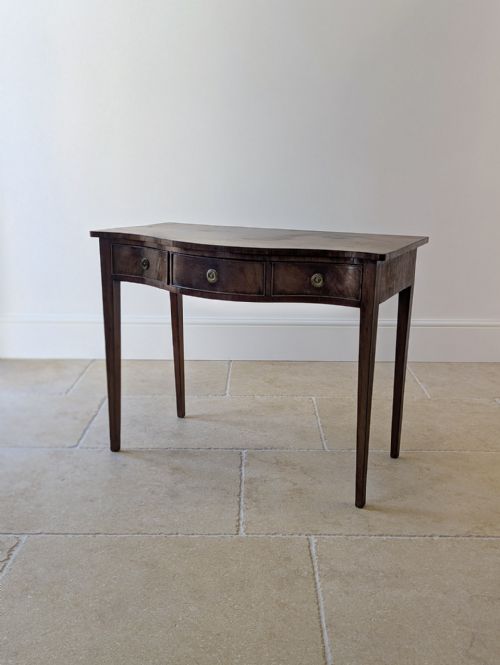
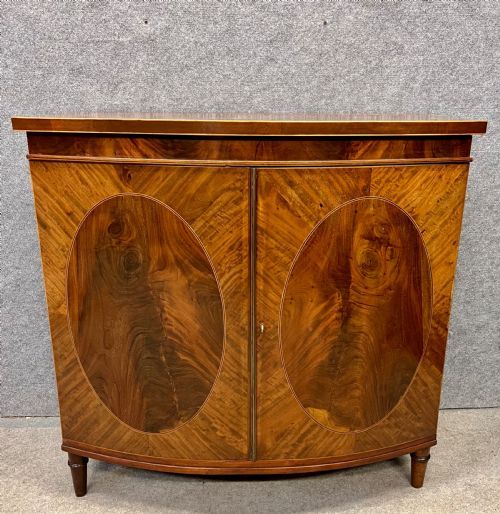
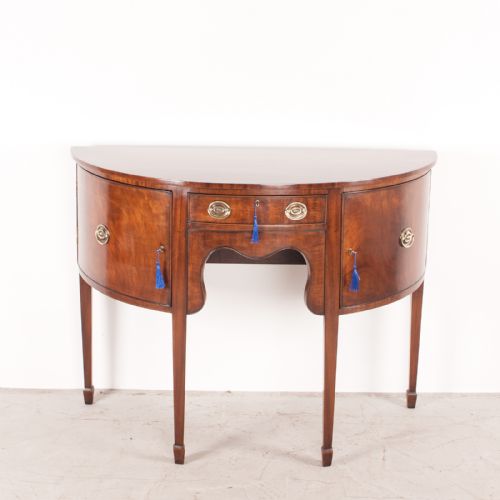
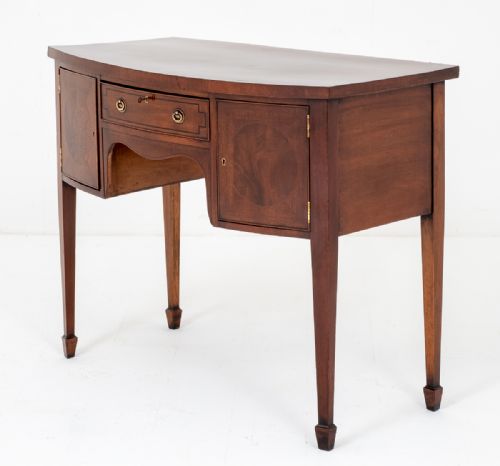
Forms on this page include traditional side tables, smaller lamp tables, serving tables and demi lune cabinets with tambour fronts or drawers. Makers and designers utilised shapes such as bow front, serpentine and demi lune to soften linear interiors and provide useful surface space.
How they were made
Cabinet makers constructed these tables primarily in solid and veneered mahogany, burr walnut and satinwood inlay, often incorporating brass feet for decorative accent. Surfaces frequently display rich timber grain, while specific examples feature painted wood finishes or inset marble tops.
Construction techniques visible across the periods involve precise curved joinery for the bowed, serpentine and demi lune fronts, alongside the integration of drawers and tambour doors. Timber selection dictates the visual depth of each piece, pairing figured grains with traditional polishing methods.
One nimble eighteenth century Dutch cabinet hides its contents behind a flexible wooden tambour while standing proudly on tiny brass feet.
What varies in quality
Quality rests in the precision of the curved joinery and the selection of timber veneers, such as figured mahogany or burr walnut. Superior examples demonstrate seamless alignment along the bowed or serpentine fronts and refined detailing in satinwood inlay.
The Curved Front Console Table Glossary
- Bow front
- A convex curved front that projects outward from the centre. This shape softens the profile of a table and maximises internal storage.
- Serpentine
- A wave like front featuring a central convex curve flanked by concave sections. It requires advanced carpentry skills to execute successfully.
- Demi lune
- A half moon shape flat at the back to sit against the wall. These tables often function as serving pieces or compact sideboards.
- Tambour
- A sliding door constructed from narrow vertical strips of wood glued to a canvas backing. It allows access to curved cupboards without swinging doors.
Curved Front Console Table: Frequently Asked Questions
Where should I place a console table?
These tables suit narrow hallways, landings and reception rooms where floor space is limited. Their shallow depth allows them to sit flush against a wall while offering a useful surface.
In dining rooms, similar forms function as serving tables or small sideboards for dishes and silverware.
How do I identify a Georgian piece?
Georgian and George III pieces typically feature dense, heavy mahogany timber, hand cut dovetails in the drawer construction and traditional patination built up over centuries.
Later revivals from the Edwardian period or nineteen twenty often display brighter finishes, machine made elements and lighter construction methods.
What is the difference between bow front and serpentine?
A bow front curves outward in a single continuous convex sweep from one side to the other. This creates a simple, rounded profile.
A serpentine front combines outward and inward curves, presenting a more complex and undulating visual rhythm.
Can these tables be used for storage?
Many examples incorporate single or double drawers beneath the surface for keys and small items. Cupboard versions, including demi lune cabinets with tambour fronts, offer enclosed space for tableware or household linens.