
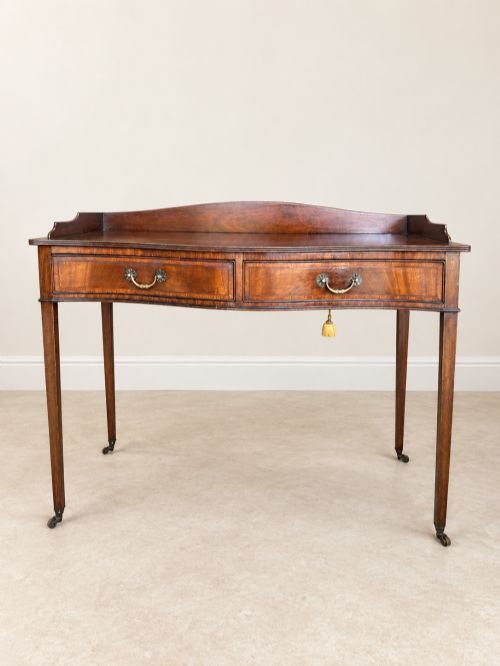
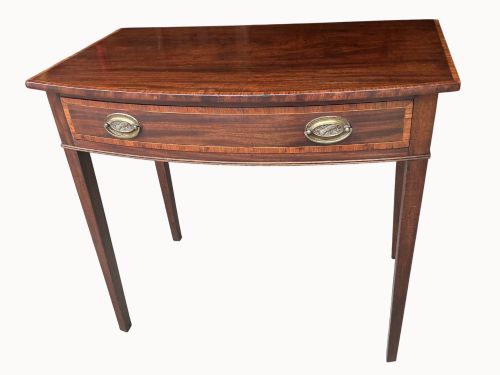
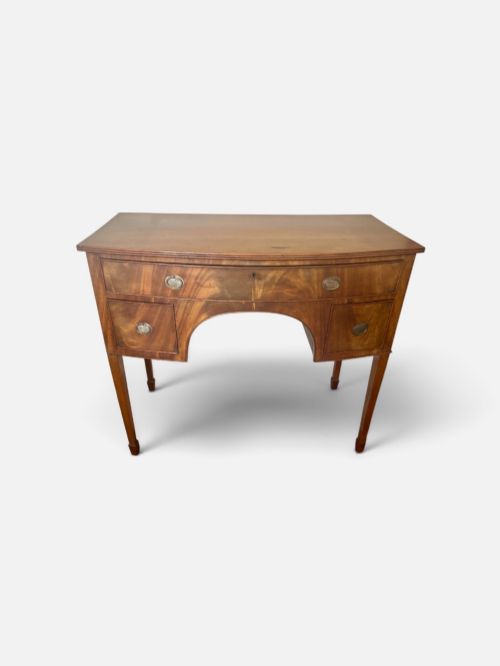
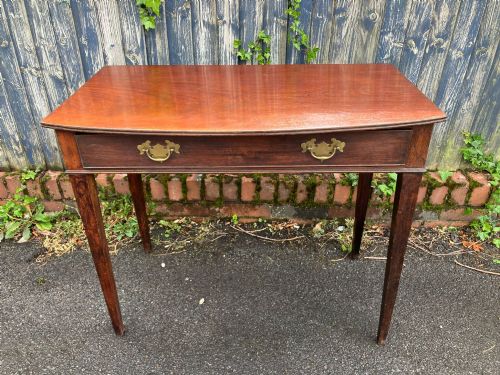
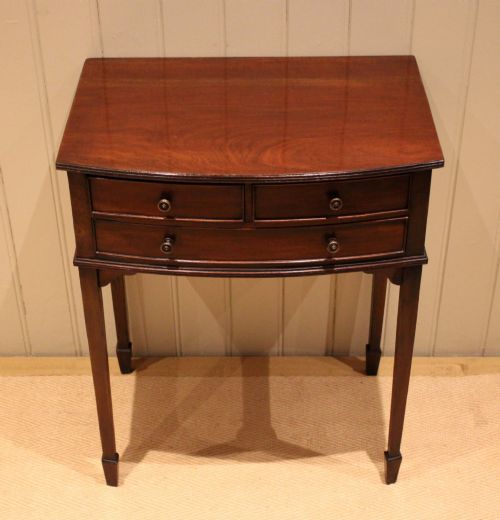
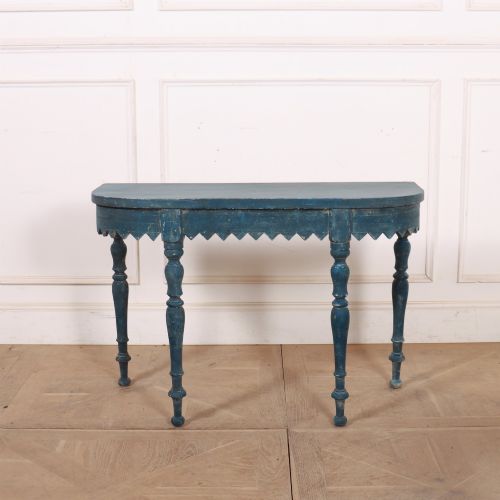

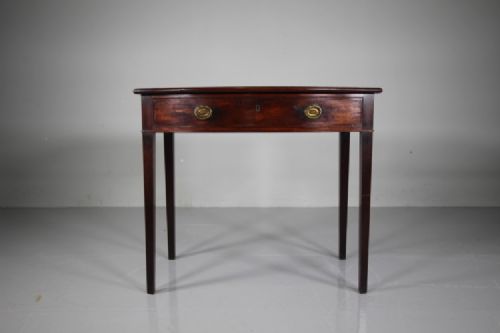


Bow Front Hall Table
A bow front hall table brings a curved, space-saving profile to a narrow passage, combining practical surface area with period elegance.
Bow Front Hall Table
A bow front hall table provides a curved silhouette designed to sit flush against passage walls while softening the geometry of a narrow corridor. These pieces function as surface furniture for everyday items, utilising slender proportions suited to transitional spaces.
The selection ranges widely across eras, spanning Georgian originals, Regency designs, and later revivals from the Victorian and Edwardian periods. Mahogany dominates the available forms, accompanied by occasional walnut, pitch pine, and painted surfaces.
Most examples manifest as side tables, console tables, or lowboys equipped with one, two, or three drawers. The curved front edge defines the typology, distinguishing standard rectangular furniture from these sweeping architectural forms.
Materials and construction methods
Makers relied primarily on solid mahogany and flame mahogany veneers, often applying boxwood stringing or brass drawer pulls for contrast. Oak frequently appears as a secondary wood for drawer linings within Georgian and Regency workshops.
Shaping the characteristic curve required precise carpentry, bending solid timber or laying veneers over curved carcases. Cabinetmakers balanced structural stability with visual lightness, utilising tapering legs and fine joinery to support the protruding front.
Listings feature mahogany predominantly, alongside burr walnut, pitch pine, and painted wood, spanning the Georgian, Regency, Victorian, and Edwardian periods.
Assessing quality and craftsmanship
Quality rests in the precision of the curved drawer fronts and the integrity of the timber selection, such as matched flame mahogany veneer. Superior examples display restrained inlay work, such as boxwood stringing, executed with crisp geometry.
Construction details differentiate standard production from finer cabinetwork, notably hand-cut dovetails in the drawer boxes and the retention of original brass hardware. The handling of secondary timbers like oak inside the drawers points to workshop origin and period standards.
The Bow Front Hall Table Glossary
- Bow front
- A convex curved front profile that projects outward in the centre, softening angular room layouts. This shape appears frequently in side tables and hall furniture.
- Lowboy
- A small table with drawers, typically standing on four tall legs, used historically for various domestic storage tasks. They often share proportions with narrow hall and side tables.
- Flame mahogany
- A distinctive veneer figure resembling flickering flames, prized for its dramatic grain pattern. Cabinetmakers selected this cut for prominent drawer fronts on high-status furniture.
- Console table
- A table designed to stand against a wall, occasionally secured with brackets, functioning as a display surface in hallways or reception rooms.
- Stringing
- Thin inlaid lines of contrasting wood, such as boxwood, used to outline table edges and drawer fronts. This decorative technique defines many Sheraton and Regency pieces.
Bow Front Hall Table: Frequently Asked Questions
Where should a bow front hall table be placed?
These tables fit naturally in narrow corridors, entryways, and landings where floor space is limited. The curved front allows people to pass more easily compared to a sharp rectangular corner.
They also function effectively in dining rooms or bedrooms as serving or dressing surfaces, depending on the specific height and drawer configuration.
How do I identify a Georgian piece?
Georgian tables often feature solid mahogany construction, hand-cut dovetails inside the drawers, and secondary woods like oak. The proportions tend to reflect 18th-century design standards with understated brass hardware.
Later revival pieces from the Edwardian era or the 1920s replicate these traits but frequently use machine-cut elements or different interior lining timbers.
What is the difference between a side table and a console table?
Side tables typically stand independently on four legs and function as versatile surface furniture in various rooms. Console tables were traditionally designed to stand directly against a wall, sometimes utilising wall brackets for stability.
In modern usage, these terms often overlap, particularly when describing antique bow front furniture found in hallways.
How do I care for antique mahogany surfaces?
Maintenance involves dusting with a dry, soft cloth and avoiding direct sunlight to prevent the timber and veneers from fading. Applying appropriate wax feeds the wood and preserves the sheen without building up heavy chemical residue.
Keeping the furniture away from direct heat sources prevents the wood from drying out and stops veneers from lifting off the curved carcase.