
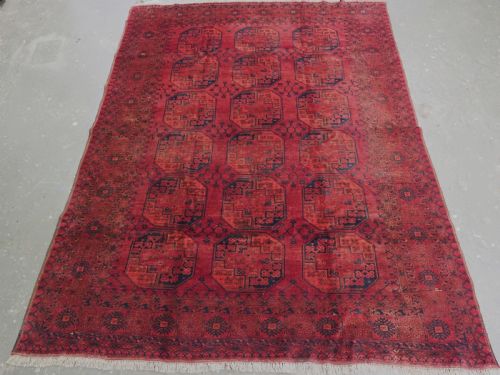
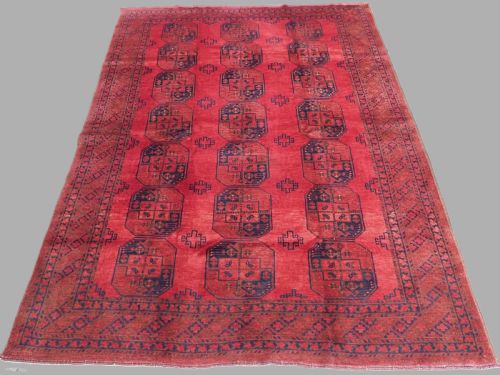
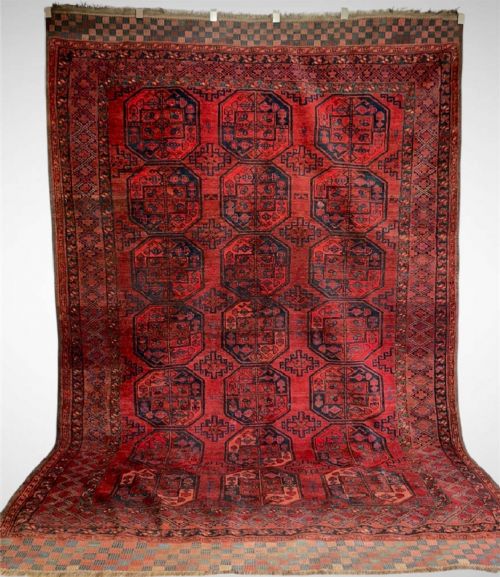


Crimson Afghan Carpet
A crimson afghan carpet brings rich red tones and tribal motifs into a room, offering durability and deep historical character for an interior.
Crimson Afghan Carpet
These floor coverings often display traditional tribal designs such as the gul motif or Ersari Turkmen patterns. Pieces date from around eighteen ninety to nineteen thirty, representing established weaving traditions of the region.
Village weavers and nomadic groups produced these rugs to serve practical domestic functions while incorporating regional design vocabulary. The dominant visual element across the selection remains a warm red or deep crimson ground colour.
Quality factors in weaving
Variations in quality stem from the fineness of the wool and the precision of the knotting technique employed by the weaver. Softer, glossier wool and greater density in the pile separate finer village and main carpets from simpler utilitarian formats.
The depth and nuance of the natural dye palette also determine distinction, with certain pieces exhibiting a richer red ground and superior visual harmony. Structural integrity and the preservation of the original tribal design elements further define the upper tier of these textiles.
Listings span the period from eighteen ninety to nineteen thirty, constructed from wool, cotton, and natural dyes.
The Crimson Afghan Carpet Glossary
- Gul
- A primary medallion motif often found repeating across Central Asian and Turkmen carpets. This octagonal design forms the core geometric structure of many tribal patterns.
- Ersari
- A major Turkmen tribe known for producing large carpets with rich red grounds and traditional guls. Their weaving style is prominent among nineteenth and early twentieth century pieces.
- Prayer Rug
- A smaller format rug featuring a mihrab or niche design used for Islamic prayer. These pieces often incorporate lantern or multi-mihrab motifs.
- Chuval
- A traditional tent bag face woven by Turkmen tribes for domestic storage. They share the technical quality and design vocabulary of larger carpets.
- Kelleh
- A long, narrow format carpet traditionally used in Near Eastern domestic architecture. This shape accommodates specific room proportions differently from square main carpets.
Crimson Afghan Carpet: Frequently Asked Questions
What is a crimson afghan carpet?
A crimson afghan carpet is a hand-woven wool floor covering from Afghanistan, typically featuring traditional tribal designs and natural red dyes.
These pieces date from the late nineteenth century to the early twentieth century and include village carpets, main carpets, and smaller prayer rugs.
How do I identify an Ersari carpet?
An Ersari carpet is identified by its distinct Turkmen tribal motifs, particularly repeating octagonal guls and deep red colour palettes.
They often appear as large format carpets produced by weavers belonging to the Ersari sub-tribe in Central Asia.
Where were these carpets made?
These carpets were made in Afghanistan and surrounding Central Asian regions by village weavers and nomadic tribal groups.
Production relied on local materials such as hand-spun wool and natural dyes utilised within traditional workshop and household settings.
How should I care for a wool rug?
Care for a vintage wool rug involves regular gentle vacuuming without a rotating brush and professional cleaning when necessary.
Placing the carpet in areas with moderate foot traffic helps preserve the pile and the natural lustre of the hand-spun wool.