

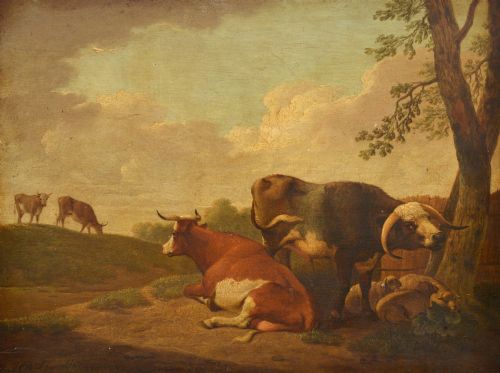


Countryside Livestock Landscape Art
Countryside livestock landscape art brings pasture, farmyard and riverbank scenes into the room through oil paintings and watercolours spanning the eighteenth to early twentieth centuries.
Countryside Livestock Landscape Art
Countryside livestock landscape art captures rural scenes populated by cattle, sheep, horses and poultry set against pastoral backdrops, rivers and farmyards. Buyers searching for this phrase encounter framed works executed primarily during the nineteenth and eighteenth centuries.
The pieces on this page appear mostly as oil paintings on canvas and watercolours on paper. Artists from British and Dutch traditions dominate, ranging from Victorian pastoral realism to romantic interpretations of agrarian life.
How these artworks were produced
Artists applied oil paint to canvas or watercolour to paper, capturing the textures of animal coats, vegetation and atmospheric skies. Many surviving examples retain their period frames constructed from wood, gesso and giltwood with gold leaf finishes.
Techniques varied between the precise brushwork of Dutch romanticism and the looser application seen in British pastoral watercolours. Canvases were stretched over wooden frames, while watercolours were mounted under glass within original or period frames.
Countryside Livestock Landscape Art Retail Price Guide 2026
Typical asking prices for countryside livestock landscape art among the pieces listed under this phrase on Sellingantiques today, from the lower quarter to the upper quarter. They describe what is for sale here now, not the wider market.
Cows, sheep, horses, chickens and calves populate these pastures, often caught mid-munch or watching the painter paint.
What separates works of different standing
Quality rests upon the artist's ability to render animal anatomy convincingly alongside the depth and light of the surrounding landscape. Skilled handling of oil paint or watercolour brings texture to fleece, hide and foliage rather than relying on flat formulas.
The preservation of the original canvas, paint surface and period frame influences the character of each piece. Works by named painters with documented provenance demonstrate greater definition in brushwork and compositional balance.
Hendrik Willem Schweickhardt·William Henry Mander·Frederick Septimus Lewis·James de Rijk·Eugene Verboeckhoven·Basil Bradley·Thomas Sydney Cooper·Arthur Charles Dodd·Claude Cardon·Henry Brittan Willis·William Sidney Cooper·Thomas E Francis·Thomas Baker of Leamington
The Countryside Livestock Landscape Art Glossary
- Oil on Canvas
- A painting medium where pigments suspended in oil are applied to a stretched woven fabric support. This combination allows for rich colour blending and textured brushwork.
- Giltwood
- Timber carved and coated with a thin layer of gold leaf or metallic powder. It provides a decorative and protective border for traditional paintings.
- Watercolour Painting
- Artwork created using water-soluble pigments on paper. This medium produces translucent washes of colour that capture light efficiently.
- Pastoral Realism
- An artistic style depicting rural subjects and agricultural life with a focus on natural appearance. It avoids excessive romantic idealisation in favour of recognizable countryside details.
Countryside Livestock Landscape Art: Frequently Asked Questions
What periods do these paintings date from?
The available selection spans from the eighteenth century through the nineteenth century up to the nineteen-twenties. Pieces reflect distinct stylistic periods including Victorian pastoral and Dutch romanticism.
Dates are supported by artist lifespans and framing styles recorded in the inventory listings.
How should I hang a heavy oil painting?
Large oil paintings with wood and giltwood frames require secure wall fixings suited to the weight of the timber and canvas. Locate wall studs or use appropriate cavity anchors.
Ensure the hanging wire and D-rings on the reverse of the frame are robust enough to support the total weight.
How do I identify a watercolour from an oil painting?
Watercolours are painted on paper under glass, showing translucent washes where the texture of the paper remains visible beneath the pigment. Oil paintings use thick, opaque paint applied to canvas.
Oven-dried oil paint possesses a distinct textural relief on the canvas surface, whereas watercolours present a flat finish.