
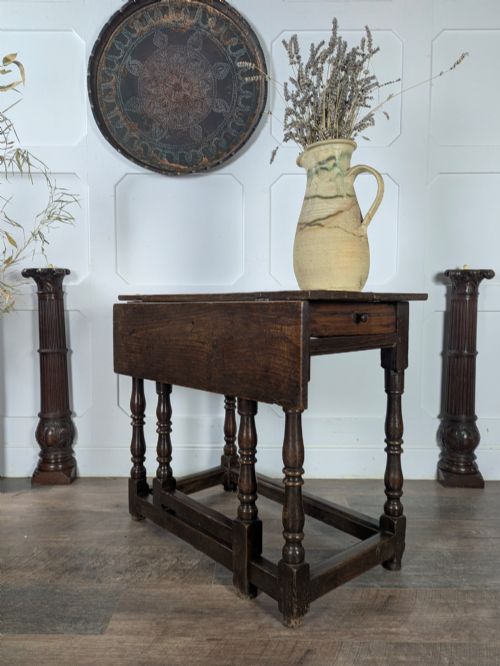
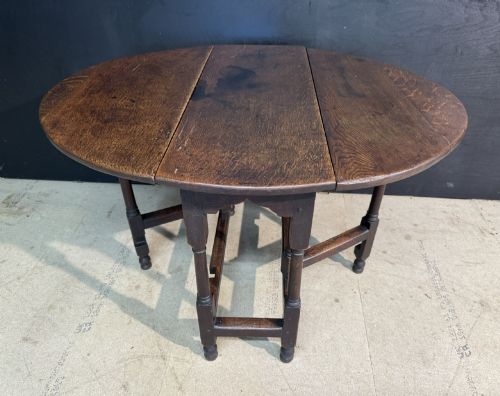


Country Oak Gate Leg Table
A country oak gate leg table provides a sturdy drop-leaf surface with folding supports, built for flexible daily dining.
Country Oak Gate Leg Table
A country oak gate leg table combines a central fixed top with hinged drop leaves supported by pivoting legs that swing outward like a gate. These practical pieces served for dining, working, and general household tasks across centuries of domestic life.
The selections span from robust seventeenth-century examples featuring baluster posts to eighteenth-century Georgian variants and later revival pieces. Forms range from compact occasional tables to large dining versions capable of seating up to ten people.
Makers utilised solid oak alongside secondary timbers such as fruitwood and elm, constructing sturdy frames joined with wooden pegs. Their enduring appeal lies in the ability to fold flat against a wall when floor space is required.
How They Were Made
Joiners built these tables primarily from solid timber planks, selecting hardwearing oak for its strength and grain texture. Secondary woods like fruitwood and elm occasionally appear in structural framing or secondary components.
Construction relied heavily on traditional pegged mortise and tenon joints to secure the legs and rails. Hinges and pivot mechanisms required precise alignment so the moving gate legs could support the heavy drop leaves without sagging.
Listings span multiple centuries, ranging from seventeenth-century joined oak examples to twentieth-century revival pieces made in solid timber.
What Varies in Quality
Quality rests in the thickness of the timber planks used for the top and the integrity of the original peg joints. Superior examples display tight, stable joints where the gate swing aligns flush with the fixed frame.
Surface depth and tactile warmth develop over centuries of use, distinguishing patinated antique timber from later replacements. The proportion of the turned legs and the balance of the overall frame dictate visual harmony.
The Country Oak Gate Leg Table Glossary
- Gateleg table
- A drop-leaf table where hinged legs swing out from the centre frame to support the opened leaves. This mechanical design allows the surface area to expand or contract easily.
- Drop leaf
- A hinged flap of wood attached to a fixed central tabletop that can be raised and supported. It forms an extended surface when needed.
- Baluster post
- A turned vertical wooden support shaped like a vase or column. These often form the structural legs of seventeenth-century tables.
- Patina
- The surface sheen and colour acquired by wood over decades of handling, polishing, and ageing. It serves as an indicator of genuine age.
- Plank top
- A table surface constructed from solid wooden boards joined edge to edge. This method provides the robust foundation characteristic of early farmhouse furniture.
Country Oak Gate Leg Table: Frequently Asked Questions
How do I seat guests comfortably around a gate leg table?
Check the clearance beneath the frieze rails where the gate legs pivot to ensure diners have adequate legroom. Positioning the swinging legs evenly distributes weight and prevents tipping when the leaves are fully loaded.
Larger dining variants accommodate up to ten people when fully extended, while smaller occasional versions suit intimate spaces. Folding down one or both leaves adjusts the footprint to match the room size.
What is the difference between seventeenth-century and Georgian gate leg tables?
Seventeenth-century models typically feature heavier turned baluster posts, visible peg joints, and darker timber tones associated with the Jacobean and Charles II periods. Their construction feels exceptionally rugged and utilitarian.
Georgian examples often present sleeker turned legs and finer proportions suited to formal domestic spaces. Eighteenth-century iterations balance the traditional strength of solid oak with refined joinery techniques.
How should I care for an antique oak surface?
Apply natural beeswax periodically to nourish the dry timber and maintain the soft sheen of the patina. Avoid placing the table near direct heat sources or strong sunlight, which can cause the oak planks to warp or split.
Use coasters and felt pads beneath objects to protect the historic wood from moisture and scratches. Regular dusting with a soft, dry cloth preserves the finish without stripping the historical surface.
Can I use a gate leg table in a modern kitchen?
These tables function well as flexible kitchen islands or breakfast dining spots due to their adjustable surface area. Folding the leaves down creates extra floor space when the kitchen is not in use.
Solid oak construction withstands daily household activity while introducing historical character to contemporary interiors. The sturdy drop leaves provide reliable support for food preparation and casual dining.