

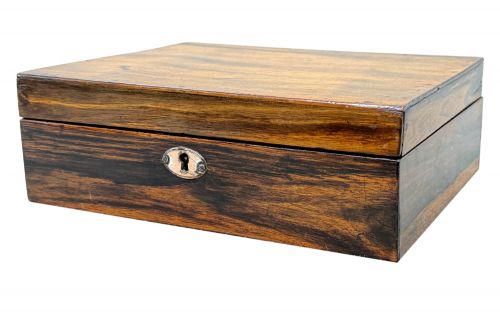


Coromandel Wooden Casket
A coromandel wooden casket brings dense, dark timber and meticulous brass or mother-of-pearl inlay straight to a desk or dressing table.
Coromandel Wooden Casket
A coromandel wooden casket is a sturdy container built for vanity, jewellery, stationery, or sewing, originating largely from the nineteenth century. These boxes arrive in rectangular, dome-top, or combination forms designed to hold precious personal items securely.
Victorian examples dominate the selection, spanning from early periods through the aesthetic movement and the late nineteenth century. Most pieces show the characteristic heavy grain of coromandel timber, frequently enhanced with contrasting brass banding or shimmering mother-of-pearl.
How coromandel wooden caskets were made
Cabinet makers constructed these caskets using dense coromandel wood as the primary carcass, prized for its deep colour and intricate figuring. Carpenters frequently reinforced the corners and edges with solid brass mounts, strapwork, or campaign-style banding.
Surface ornamentation relied on precise inlay techniques, setting mother-of-pearl or pietra dura plaques flush into the timber lid and front panels. Interiors were lined with rich velvet and fitted with compartmentalised wooden trays designed to cradle glass scent bottles or metal tools.
Coromandel Wooden Casket Retail Price Guide 2026
Typical asking prices for coromandel wooden casket among the pieces listed under this phrase on Sellingantiques today, from the lower quarter to the upper quarter. They describe what is for sale here now, not the wider market.
Secret drawers lurk inside several of these caskets, waiting for someone to press the right hidden spring.
What varies in quality in coromandel wooden caskets
The degree of internal fitting dictates the utility and complexity of the piece, ranging from basic empty chambers to fully fitted vanity interiors with original trays and glass bottles. Complete sets of matching components indicate a higher tier of original commission.
The precision of the exterior decoration separates standard boxes from exceptional ones, particularly the tightness of the brass banding and the alignment of mother-of-pearl or pietra dura inlays. Richness in the natural grain of the coromandel timber also influences the visual depth of the finished object.
C.G. Hope Hastings
The Coromandel Wooden Casket Glossary
- Coromandel
- A dense, heavily figured exotic hardwood with dark brown and black striping, highly favoured for nineteenth-century luxury boxes. It provides the heavy base material for these caskets.
- Pietra Dura
- An artistic technique involving the inlay of cut and fitted polished coloured stones to create pictorial designs. These hardstone plaques appear set directly into the wooden lids of select caskets.
- Tantalus
- A locking beverage or scent bottle frame that displays the contents while preventing unauthorised access. In these listings, it refers to combination caskets housing secure bottles.
- Aesthetic Movement
- A late nineteenth-century design style emphasising visual beauty over narrative meaning, often reflected in clean lines and disciplined brass mounts. Pieces from this period lean towards restrained geometric elegance.
- Brass Bound
- A method of reinforcing box edges and corners with fitted brass straps fastened by small pins. This technique adds both structural strength and linear contrast to the dark timber.
Coromandel Wooden Casket: Frequently Asked Questions
What is a coromandel wooden casket?
A coromandel wooden casket is a luxury nineteenth-century box built from dense exotic timber and used for storing jewellery, stationery, or sewing gear. These pieces often feature brass mounts and velvet interiors.
They serve as decorative desktop or dressing table accessories that combine practical storage with high-status cabinet making.
How do I date a coromandel box?
Dating relies on stylistic clues like Regency proportions, mid-Victorian brass banding, or later Aesthetic Movement simplicity. Inlay materials and internal lock mechanisms also point to specific decades.
Examining the construction of the interior trays and hinges helps narrow the manufacturing period.
Were these boxes used for travel?
Many coromandel caskets function as vanity or dressing boxes equipped with recessed brass carrying handles for transport. They protected delicate glass scent bottles and personal valuables during carriage journeys.
Heavier stationery boxes remained stationary on large desks while smaller workboxes moved between rooms.
How do I clean coromandel wood?
Maintenance requires gentle dusting with a soft, dry cloth to protect the polished timber and delicate inlay work. Avoid harsh modern polishes or excessive moisture that might damage the velvet linings or loosen brass pins.
Feeding the wood occasionally with appropriate specialist wax preserves the depth of the dark grain.