

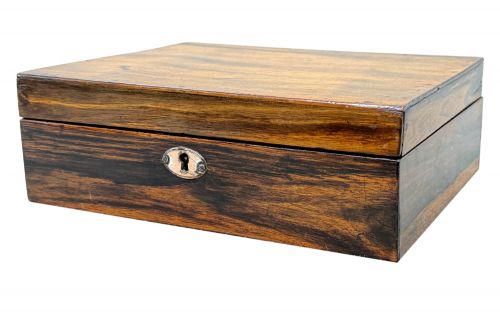


Coromandel Wood Casket
A coromandel wood casket is a dense, highly figured hardwood box prized for its rich grain, housing fitted interiors for writing, sewing, or jewellery.
Coromandel Wood Casket
A coromandel wood casket is a substantial box designed to hold precious items, writing equipment, or personal accessories on a desk or dressing table. You meet these pieces most frequently from the nineteenth century and the Victorian period, spanning forms from simple keepsake boxes to elaborate stationery caskets.
The objects serve specific domestic functions, appearing as jewellery boxes, sewing boxes, vanity cases, and scent bottle caskets. Many examples exhibit distinct styles such as Gothic Revival, Aesthetic Movement, and Regency influences.
Makers shaped coromandel wood into rectangular work boxes, dome-topped stationery cases, and brass-bound writing desks. The wood itself provides a dark, striking ground that distinguishes these containers from ordinary walnut or mahogany boxes.
Materials and construction
Craftsmen built these caskets using solid timber or robust veneers of coromandel wood over a secondary wood carcass, selected for its dark brown colour and dramatic figuring. The exterior surfaces frequently receive brass binding, or flush brass stringing, to reinforce the corners and edges.
Inlaid decoration forms a central part of the construction, utilising mother-of-pearl, ormolu mounts, and occasionally pietra dura panels set directly into the timber. Interiors are lined with velvet, silk, or leather, fitted with compartments, trays, and lift-out sections for bottles and implements.
Coromandel Wood Casket Retail Price Guide 2026
Typical asking prices for coromandel wood casket among the pieces listed under this phrase on Sellingantiques today, from the lower quarter to the upper quarter. They describe what is for sale here now, not the wider market.
Distinctions in quality
The standard of a coromandel wood casket rests on the density and figuring of the grain and the precision of the brass or mother-of-pearl inlay. Superior pieces display seamless joints, robust original hardware, and well-executed decorative mounts rather than crude substitutions.
Internal arrangements differentiate standard boxes from exceptional examples, with complete fitted trays, working locks with original keys, and intact silk or velvet linings holding higher regard. The complexity of the box type, such as a combined scent bottle casket or a fitted vanity case, also elevates the piece.
C.G. Hope Hastings
The Coromandel Wood Casket Glossary
- Coromandel wood
- A dense, heavy tropical hardwood derived from Diospyros species, known for its dark brown colour and contrasting black stripes. It was heavily utilised in high-end nineteenth-century cabinet making.
- Pietra dura
- An artistic technique of inlaying cut and fitted polished coloured stones to create pictorial designs. On caskets, these panels appear as decorative plaques set into the lid.
- Ormolu
- Gilt bronze mounted onto furniture and boxes as decorative feet, handles, or edgings. The technique gives a rich golden contrast against the dark timber.
- Stationery box
- A desk accessory designed to hold paper, envelopes, and letters, often featuring a sloping or dome-topped lid and internal dividers.
- Tantalus
- A locking beverage or scent bottle container that displays the contents while preventing unauthorised access. The mechanism secures the stoppers in place until released.
Coromandel Wood Casket: Frequently Asked Questions
What is coromandel wood?
Coromandel wood is a heavy, durable timber imported from tropical regions, featuring a dark brown or black grain with pale yellow streaks. It provides a striking, decorative surface for nineteenth-century luxury boxes.
Because of its hardness and high cost, cabinet makers reserved the material for high-status writing desks, sewing boxes, and vanity cases.
How do I date a coromandel casket?
Dating relies on stylistic clues, construction methods, and hardware designs characteristic of the nineteenth century. Victorian examples often incorporate brass binding and Gothic Revival or Aesthetic Movement motifs.
Earlier pieces from the Regency period tend to feature simpler geometric brass inlays, while later nineteenth-century caskets frequently include complex fitted compartments and combination locks.
What were these caskets used for?
These boxes served domestic and personal organisational roles for wealthy households in the nineteenth century. Specific interiors housed sewing implements, writing paper, correspondence, jewellery, or glass scent bottles.
Many functioned as portable luxury items for travel or remained as permanent fixtures on drawing room tables and gentleman's desks.
How should I care for coromandel wood?
Maintain coromandel caskets by keeping them away from direct sunlight and sudden changes in temperature, which can cause the timber and veneers to warp or split. Dust gently with a dry, soft cloth and avoid chemical polishes.
Condition the wood occasionally with a suitable wax to preserve the depth of the grain and protect the polished surface.