
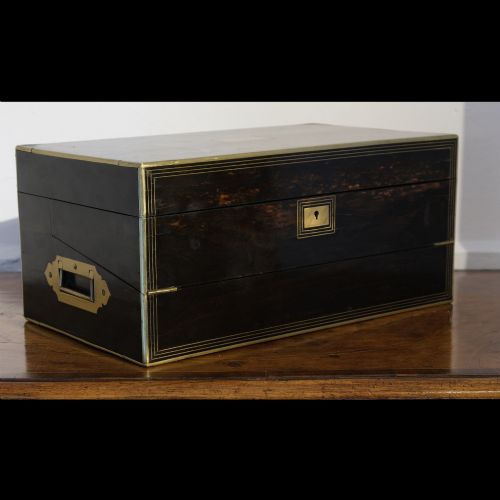


Inlaid Coromandel Box
An inlaid coromandel box brings dense, dark exotic timber and shimmering shell or metal into the Victorian interior as an opulent keeper of valuables.
Inlaid Coromandel Box
An inlaid coromandel box serves primarily as a luxury container for correspondence, jewellery, sewing implements, or toiletries. The form spans writing slopes, vanity cases, card boxes, and tea caddies.
Most examples date from the nineteenth century, particularly the Victorian and Regency periods. Buyers frequently encounter fitted interiors lined with velvet or leather alongside working keys.
The exterior relies on the rich grain of coromandel wood, often contrasted with bright geometric or foliate inlays of mother-of-pearl and brass.
How they were made
Cabinet makers utilised dense coromandel wood as the primary carcass, prized for its dark brown colour and striking black grain. This timber was cut into veneers and applied to a stable secondary wood.
Craftsmen embedded contrasting materials directly into the surface, routing channels for polished brass strings or shaping mother-of-pearl into floral and geometric motifs.
Interiors required precise carpentry to house compartments, trays, and velvet-lined ledges, often incorporating secret drawers and fitted glass inkwells or mirror panels.
Object forms on this page range from cutlery boxes and tea caddies to fully fitted dressing cases and compact stationery boxes.
What varies in quality
The distinction between tiers rests on the crispness of the inlay and the complexity of the internal fitments. Superior pieces feature tightly fitted compartments, hand-engraved brasswork, and high-status maker signatures.
The choice and figuring of the coromandel veneer dictate visual weight, with tightly rippled grain commanding greater presence. Simple hinged carcases with plain interiors sit lower down the scale than fully appointed travelling cases.
H Mitchell·Lund of London·C.G. Hope Hastings
The Inlaid Coromandel Box Glossary
- Coromandel
- A dense, heavy tropical Asian timber with a rich brown body and dark, near-black grain patterns. It was favoured by nineteenth-century cabinet makers for luxury desk accessories and vanity cases.
- Mother-of-pearl
- The iridescent internal layer of mollusc shells, cut into thin plates and shaped for inlay work. It catches the light with shifting tones of pink, green, and silver against dark wood.
- Writing slope
- A box with a hinged, slanted lid that opens to reveal a velvet or leather writing surface and compartments for stationery, pens, and ink.
- Pietra dura
- An artistic technique involving the inlay of cut and fitted polished coloured stones to create pictorial designs. On boxes, small plaques of hardstone are set flush into the wooden lid.
- Brass bound
- The reinforcement of box edges and corners with fitted brass strips to protect the wood and add structural rigidity during travel.
Inlaid Coromandel Box: Frequently Asked Questions
What were coromandel boxes used for?
These luxury containers held private correspondence, writing implements, jewellery, sewing gear, and cosmetics for affluent Victorian and Regency owners.
Many featured specialised interior compartments, lift-out trays, and velvet-lined ledges designed to keep delicate personal items secure at home or during travel.
How do I tell a Regency box from a Victorian one?
Regency examples often lean towards classical restraint with linear brass stringing, whereas Victorian pieces frequently display heavier proportions and elaborate mother-of-pearl flora.
Examining the internal layout, paper linings, and lock hardware helps anchor the piece within the broader nineteenth-century timeline.
Are the keys usually original?
Many surviving boxes retain working keys, though replacements are common given the passage of over a century. A working lock adds utility to the piece but does not alter the underlying date of the cabinet work.
Sellers note whether a functional key is present in the description, which matters for boxes fitted with operational lid and drawer mechanisms.
How should I care for coromandel wood?
Keep the timber away from direct sunlight and extreme humidity changes to prevent the veneer from lifting or splitting. Minimal dusting with a soft, dry cloth preserves the polished surface and the inlaid metal or shell.
Avoid liquid cleaners and wax buildups that can dull the natural contrast between the dark grain and the bright decorative elements.