



Coromandel Document Box
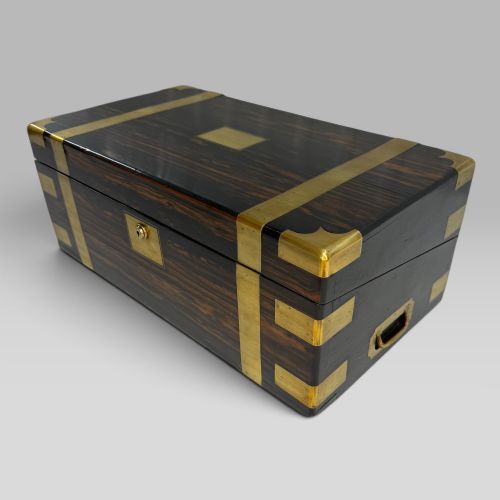
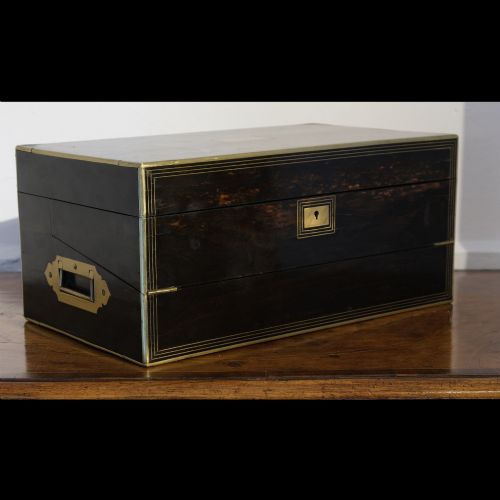
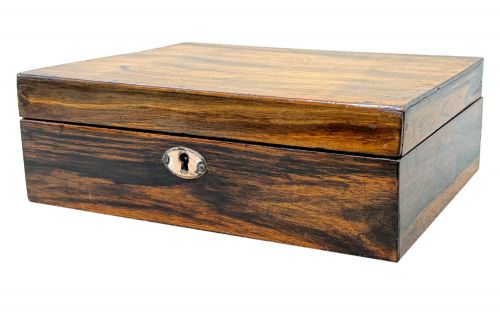
A coromandel document box is a dense, exotic timber chest built to hold letters and papers, prized for its dark grain and brass mountings.
Coromandel Document Box
A coromandel document box is a timber chest designed for correspondence, featuring hinged lids or fall-front doors that open to reveal fitted interiors. When you search for a coromandel document box, you encounter pieces from the nineteenth century, including the Victorian era and the Regency period.
The forms span writing boxes, stationery boxes, stationery cabinets, and writing slopes. Many incorporate brass binding, brass handles, or inlaid details.
Victorian examples dominate the selection, often dated between eighteen fifty and eighteen ninety. These items served a practical purpose on desks in studies and libraries, keeping important papers and letters organised.
Materials and construction
Makers utilised coromandel wood as a primary veneer or solid timber, valued for its rich, dark brown colour and striking contrasting grain. Ebony and Anglo-Indian variants also appear in the record.
Workshops constructed these boxes with internal partitions, drawers, and velvet or leather writing surfaces in slope variants. Joinery was precise to accommodate the dense, heavy nature of the timber.
Coromandel Document Box Retail Price Guide 2026
Typical asking prices for coromandel document box among the pieces listed under this phrase on Sellingantiques today, from the lower quarter to the upper quarter. They describe what is for sale here now, not the wider market.
Several boxes incorporate secret drawers activated by hidden wooden springs, designed to outsmart prying eyes in the Victorian study.
Judging quality in coromandel boxes
Quality rests on the depth and figure of the coromandel grain, alongside the precision of the brass binding and inlay work. The crispness of carved details and the integration of secondary materials like mother-of-pearl elevate a piece.
The sophistication of the internal mechanism, such as hidden drawers, spring-loaded compartments, or fitted stationery dividers, separates standard boxes from finer examples. Maker attribution also distinguishes the piece.
The condition of the timber veneer and the retention of original working locks and keys influence the integrity of the object. Heavy losses to the delicate inlay or splits in the dense wood detract from the form.
Houghton and Gunn·Lund of London·C.G. Hope Hastings
The Coromandel Document Box Glossary
- Coromandel wood
- A dense, heavy tropical timber obtained from southeast Asia, characterised by dark brown and black striations. It was frequently used for luxury nineteenth-century boxes.
- Writing slope
- A box with a sloping lid that opens to form a slanted desk surface for writing letters. It typically includes internal compartments for inkwells, pens, and paper.
- Pietra dura
- An artistic technique of inlaying cut and fitted polished coloured stones to form pictures or geometric designs. It appears on the lids of certain Victorian stationery boxes.
- Escutcheon
- A flat plate of brass surrounding a keyhole, designed to protect the surrounding wood from wear by the key. On these boxes, it forms part of the decorative brass hardware.
- Reeded decoration
- Parallel convex mouldings carved directly into the timber surface. This technique appears on Anglo-Indian ebony boxes.
Coromandel Document Box: Frequently Asked Questions
What is a coromandel document box?
A coromandel document box is a nineteenth-century desk accessory made from dense exotic timber, used for storing letters, papers, and writing materials.
These boxes often feature brass mounts, inlaid mother-of-pearl, or pietra dura panels, reflecting the high status of coromandel wood in Victorian and Regency interiors.
How do I date a coromandel box?
Dating relies on stylistic markers such as Victorian Gothic Revival details, Regency proportions, or inscribed dates and maker plaques. Brass binding styles and lock types also offer chronological clues.
Many pieces in the record cluster around the mid to late nineteenth century, specifically between eighteen fifty and eighteen ninety.
How do I care for coromandel wood?
Coromandel wood benefits from stable room temperatures away from direct sunlight and central heating sources to prevent the dense timber and veneer from splitting. Regular dusting with a soft, dry cloth preserves the polished surface.
Avoid excessive moisture and modern chemical polishes, which can damage the antique polish and the brass or mother-of-pearl inlay.