

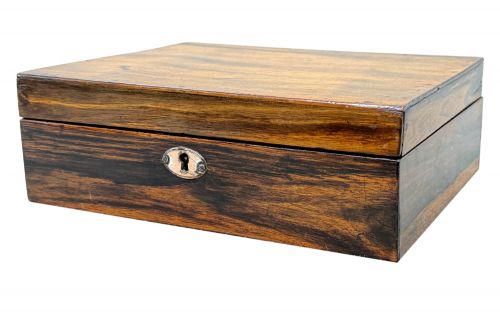


Calamander Wood Box
Calamander wood box examples are striking Victorian containers built from richly grained exotic timber, offering collectors a tactile piece of nineteenth-century desk furniture.
Calamander Wood Box
A calamander wood box encompasses sophisticated Victorian desk accessories, writing slopes, and stationary cabinets designed for nineteenth-century writing desks. These pieces showcase dense, exotic timber characterised by striking dark brown and fawn striping.
The items seen on this page span the mid to late nineteenth century, predominantly taking the form of writing slopes, drop front stationery cabinets, and scent bottle boxes. Victorian craftsmen utilised the heavily figured grain to create visually commanding decorative objects for the home.
Examples often incorporate contrasting materials alongside the timber, including polished brass mounts and intricate stone inlay work. The forms range from compact tabletop scent bottle cases to substantial fitted stationery cabinets.
How they were made
Maker workshops constructed these pieces using dense exotic hardwoods, frequently applying coromandel and calamander veneers over secondary foundational timbers. Artisans selected timber sections with high grain contrast to maximise the decorative impact of the exterior surfaces.
Construction techniques integrated structural brass hardware, such as protective corner mounts, strapwork, and escutcheons, secured directly into the timber. Interiors frequently featured fitted compartments, velvet or leather writing surfaces, and precision lock mechanisms.
Calamander Wood Box Retail Price Guide 2026
Typical asking prices for calamander wood box among the pieces listed under this phrase on Sellingantiques today, from the lower quarter to the upper quarter. They describe what is for sale here now, not the wider market.
Listings on this site feature Victorian Gothic Revival styles alongside mid to late nineteenth-century dates.
What varies in quality
Quality differences rest primarily in the selection and matching of the timber veneer across the exterior surfaces. Finer boxes display continuous, mirror-matched grain patterns that wrap seamlessly around the corners and lid.
The sophistication of the internal fittings and the weight of the brass hardware further distinguish superior pieces from standard production. Precision in the joinery and the survival of original fitted compartments elevate the overall standard of construction.
Houghton and Gunn
The Calamander Wood Box Glossary
- Calamander
- A dense, heavily grained exotic timber from South East Asia, prized in the nineteenth century for luxury cabinet work. Its distinctive dark brown stripes make it easily recognisable.
- Coromandel
- A close relative to calamander, frequently used interchangeably in Victorian cabinet making for rich, striped furniture veneers. This timber forms the basis of many nineteenth-century luxury boxes.
- Writing slope
- A portable desk featuring an angled hinged lid that folds down to reveal a writing surface and internal compartments for stationery. These were essential accessories for correspondence before the widespread use of flat desks.
- Pietra dura
- An inlay technique utilising cut and fitted polished coloured stones to create decorative pictorial designs. This artistic method appears on select Victorian boxes as a focal decorative element.
Calamander Wood Box: Frequently Asked Questions
How do I date a calamander box?
Dating relies on stylistic clues, hardware design, and structural characteristics associated with the Victorian period between 1850 and 1890.
Makers' marks or inscriptions, where present, provide the most precise indication of a box's creation date.
Were these boxes used for writing?
Many examples function specifically as writing slopes, containing internal compartments for inkwells, pens, and paper alongside a hinged writing surface.
Other variants focus on holding letters, envelopes, or glass scent bottles rather than active correspondence.
How do I care for calamander wood?
Calamander timber benefits from stable indoor humidity away from direct sunlight and heat sources to prevent the veneer from drying out.
Occasional light dusting with a dry cloth maintains the polished finish without requiring heavy chemical polishes.