


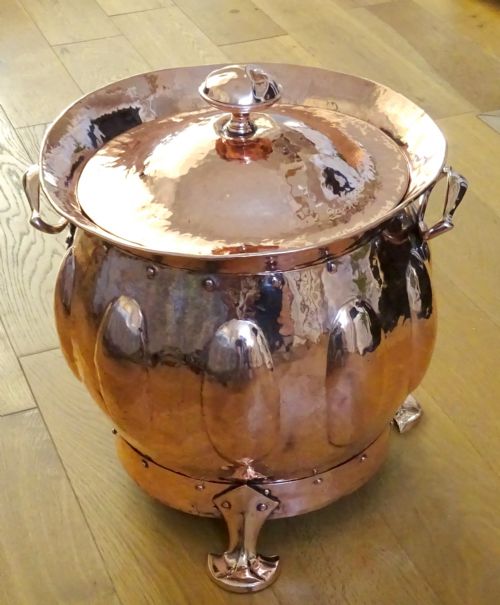

Copper Fireplace Box
A copper fireplace box brings warmth and texture to a hearth, offering a practical way to store fuel while catching the eye.
How they were made
Construction relies heavily on sheet copper combined with structural framing elements in brass, iron, or wrought iron. Wood such as oak often appears in internal linings or supportive frames, while galvanised steel provides durability in utilitarian metal versions.
Metalworking techniques involve hand-beating, riveting, and soldering the copper panels, frequently incorporating embossed or chased decorative motifs such as galleon designs or geometric patterns. Lids, handles, and hinges utilise cast brass or iron to withstand regular lifting and transport.
What varies in quality
Quality reveals itself in the weight of the metal and the integrity of the construction, where thicker gauge copper and robust ironwork separate durable pieces from lighter utilitarian items. Well-executed hand-beating and crisp detailing on decorative panels demonstrate superior craftsmanship compared to plain, mass-produced stampings.
The choice of secondary materials also marks differences in grade, with solid oak frames and cast brass fittings indicating higher workshop standards. Original patination and the survival of matching lids or handles preserve the integrity of the piece.
Listings span from eighteen eighty through nineteen thirty, encompassing Victorian, Edwardian, Arts and Crafts, and Art Nouveau styles.
The Copper Fireplace Box Glossary
- Coal scuttle
- A container with a sloped opening and a handle, designed for carrying coal to a fireplace. Traditional versions often include a smaller shovel stored in a side sleeve.
- Purdonium
- A specific type of Victorian coal box featuring a sloping front flap and a shovel compartment inside. They typically stood on small feet and were designed to sit neatly in a parlour.
- Log bin
- A large container used to store firewood near the hearth. These often feature drop handles and sturdy metal or wood construction to bear the weight of heavy timber.
- Arts and Crafts
- A design movement spanning the late nineteenth and early twentieth centuries that prioritised hand craftsmanship and simple, honest construction. Pieces in this style often display visible rivets and hand-beaten surfaces.
- Art Nouveau
- An international style of art and architecture popular around nineteen hundred, characterised by flowing, organic lines and stylised plant motifs. Copper fireplace boxes from this period often utilise Whiplash curves and embossed naturalistic designs.
Copper Fireplace Box: Frequently Asked Questions
What is a copper fireplace box?
A copper fireplace box is a lidded container used to store coal, logs, or kindling next to a hearth. They combine functional fuel storage with decorative metalwork.
Most examples date from the Victorian and Edwardian periods, utilising copper bodies paired with brass, iron, or wooden elements.
How were they used?
These boxes kept solid fuel close to the fireplace while concealing messy coal or wood from view in the parlour or living room. Household staff or homeowners used them to replenish fires cleanly throughout the day.
Many included hinged lids and sturdy handles to make carrying fuel from an outside store straightforward.
How do I clean copper?
Copper develops a natural dark surface oxidation over time that many collectors prefer to leave undisturbed. If polishing is necessary, use a mild, non-abrasive metal cleaner specifically formulated for copper.
Avoid harsh scouring pads that can scratch the metal surface and remove the historic patina.
How do I date a piece?
Dating relies on stylistic clues, construction methods, and materials typical of specific eras. Victorian examples often feature heavy brass fittings, while Arts and Crafts pieces show hand-beaten textures and riveted construction.
Edwardian and later twentieth-century items may display simpler geometric forms or Art Nouveau motifs.