

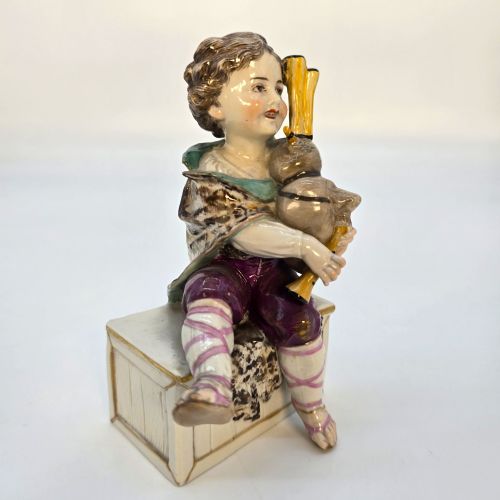


Continental Porcelain Statuettes
Continental porcelain statuettes capture delicate figures and pastoral groups from factories across Europe, prized for their expressive detail and rich ceramic modelling.
Continental Porcelain Statuettes
Continental porcelain statuettes include single figurines, pairs and multi-figure groups depicting ladies, cherubs, children, animals and pastoral characters. These pieces span the eighteenth century, nineteenth century and early twentieth century, originating from German and French centres.
The version most commonly met on this page is the nineteenth-century figure or pair modelled in German or French porcelain, often finished with hand painting and gilding. Many adopt earlier eighteenth-century tastes, referencing Meissen, Chelsea or French models.
Makers range from established factories such as Meissen, Volkstedt Rudolstadt, Carl Thieme Dresden and Royal Dux to French houses like Samson of Paris and Niderviller. Buyers also encounter unlabelled Victorian continental pieces and ceramic bisque figure groups.
How they were made
Makers utilised hard-paste porcelain and ceramic bisque, shaping the figures through skilful moulding and hand-modelling before high-temperature firing. Bisque porcelain remained unglazed to highlight the matte texture of the bare ceramic surface.
Listings feature hard-paste porcelain, ceramic bisque, enamel, gold leaf and gilding across eighteenth-century and nineteenth-century periods.
What varies in quality
Quality rests upon the crispness of the modelling and the precision of the hand painting, where finely articulated facial expressions and detailed drapery distinguish superior work. Earlier eighteenth-century and Marcolini period pieces often display sharper definition in the moulded forms than later commercial reproductions.
The application of enamel and gilding also sets examples apart, with master painters achieving subtle shading and clean lines. Pairs and groups that retain their original matched proportions and harmonious colouring demonstrate higher artistic merit.
Meissen·Volkstedt Rudolstadt·Samson Paris·Niderviller·Carl Thieme Dresden·Eugene Clauss·Royal Dux
The Continental Porcelain Statuettes Glossary
- Bisque porcelain
- Unglazed porcelain fired to a matte, porous finish that resembles white marble. It was widely utilised for nineteenth-century figures and groups.
- Hard-paste porcelain
- A durable ceramic paste composed of kaolin and petuntse, fired at high temperatures. It forms the body of traditional European figures.
- Enamel
- Vitreous coloured decoration applied to the fired porcelain surface and fixed by a second, lower-temperature firing. It provides the vivid hues seen on painted garments.
- Gilding
- The application of gold leaf or powdered gold to highlights, borders and bases. It enhances the decorative effect of porcelain statuettes.
- Rococo revival
- A nineteenth-century decorative style inspired by eighteenth-century forms, characterised by asymmetrical scrolls, naturalistic flowers and playful motifs.
Continental Porcelain Statuettes: Frequently Asked Questions
How do I identify a Meissen statuette?
Look for the characteristic crossed swords mark painted under the glaze, though imitations and revival pieces often emulate these marks.
Examine the quality of the hand painting and the crispness of the porcelain modelling, as genuine eighteenth-century and Marcolini period pieces show superior detail.
What is the difference between glazed and bisque porcelain?
Glazed porcelain possesses a shiny, vitreous coating applied before the final firing, sealing the ceramic body and creating a reflective surface.
Bisque porcelain is left unglazed, resulting in a smooth, matte finish that emphasises sculptural form and fine anatomical detail.
Are these figures English or continental?
These pieces originate from continental European factories in Germany and France, such as Meissen, Volkstedt and Samson of Paris.
While some nineteenth-century continental figures were made in the style of English Chelsea or Chelsea-Derby models, their manufacture occurred abroad.
How should I display porcelain statuettes?
Place them in enclosed cabinets away from direct sunlight and heavy foot traffic to protect delicate painted surfaces and protruding fingers.
Ensure they rest on stable, level shelves where accidental bumps or vibrations cannot cause them to topple.
What periods do these figurines date from?
The listings include eighteenth-century pieces alongside nineteenth-century productions, Victorian items and early twentieth-century examples up to nineteen-ten.
Revival pieces from the mid to late nineteenth century frequently replicate the aesthetic of earlier rococo or neoclassical periods.