

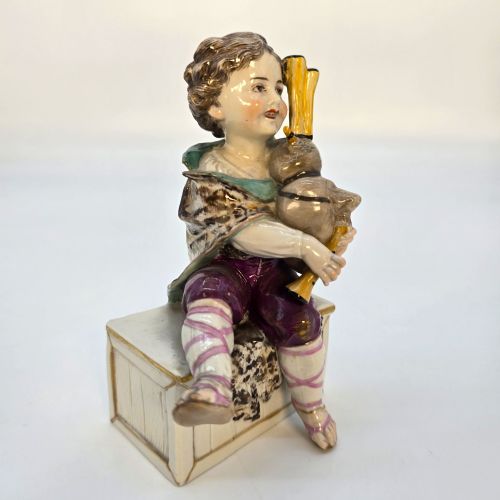


Continental Ceramic Statuettes
Continental ceramic statuettes bring characterful figures, pastoral groups and allegorical scenes into a room through finely modelled porcelain.
Continental Ceramic Statuettes
When you search for continental ceramic statuettes, you encounter porcelain figures, figurines and decorative groups originating from European factories during the eighteenth, nineteenth and early twentieth centuries. These pieces depict human subjects, pairs of figures, cherubs and animals, often arranged in pastoral or allegorical scenes that reflect the tastes of their era.
The versions you are most likely to meet on this page span the Victorian era, the nineteenth century, and periods such as 1880, 1890 and 1900, drawing on earlier styles like Rococo, Rococo Revival, French Empire and Art Nouveau. German and French manufacturers dominate the selection, including pieces modelled in the Chelsea taste or the Meissen style.
Makers represented in the listings range from major European porcelain houses such as Meissen, Volkstedt Rudolstadt, Niderviller and Carl Thieme Dresden to French firms like Samson of Paris, Eugene Clauss and Royal Dux. These objects serve purely decorative roles, bringing miniature narrative scenes and sculptural presence to cabinets and mantelpieces.
Materials and methods of manufacture
Makers shaped these statuettes primarily from hard-paste porcelain and unglazed bisque porcelain, selecting the medium to suit whether a soft matte finish or a bright vitreous body was desired. Bisque porcelain offers a smooth, chalky texture resembling marble, while glazed porcelain accepts detailed hand painting.
Listings feature hard-paste porcelain, bisque porcelain and enamel, spanning the 18th century to 1910.
Judging the quality of figures
Quality rests significantly on the sharpness of the modelling and the crispness of the porcelain form, where deeply defined folds in drapery and delicate facial expressions distinguish superior output. Softer, shallower moulding often indicates secondary production or a later derivative piece.
The precision of the hand painting and the application of enamel and gilding dictate the visual success of a statuette. Skilfully rendered brushwork on eyes, hair and floral motifs elevates a piece, whereas flat or careless application diminishes the charm of the composition.
Meissen·Volkstedt Rudolstadt Factory·Niderviller·Carl Thieme Dresden·Samson of Paris·Eugene Clauss·Royal Dux
The Continental Ceramic Statuettes Glossary
- Bisque Porcelain
- Unglaved porcelain fired to a matte, porous finish that resembles white marble. It captures subtle modelling details cleanly without the reflective sheen of a standard glaze.
- Hard-paste Porcelain
- A dense, durable ceramic body composed of kaolin and petuntse, fired at very high temperatures. It forms the robust foundation for most European figures of the eighteenth and nineteenth centuries.
- Rococo Revival
- A nineteenth-century design movement that revived the elaborate, asymmetrical scrolls, shell motifs and playful curves of the mid-eighteenth century. Statuettes in this style feature lively, flowing compositions.
- Allegorical Figurine
- A sculptural piece representing an abstract idea such as an element, a season or an emotion through human or mythological figures. These often include symbolic attributes like fruit, flowers or animals.
- Marcolini Period
- The phase of Meissen porcelain production lasting from 1774 to 1814, named after Count Camillo Marcolini. Pieces from this era typically display refined neoclassical influences and specific factory marks.
Continental Ceramic Statuettes: Frequently Asked Questions
What are continental ceramic statuettes?
These pieces are small porcelain or ceramic sculptures produced by European factories, depicting human figures, animals and narrative groups.
They range from single allegorical figures to complex multi-figure pastoral groups created for decorative display.
How were these figures used originally?
Wealthy households used these statuettes as table centerpieces for dessert courses or as decorative ornaments displayed on mantelpieces and in cabinets.
They served as conversational art pieces reflecting classical themes, pastoral fantasies or contemporary fashions.
How do I care for antique porcelain figures?
Keep porcelain statuettes out of direct sunlight to prevent the hand-painted enamels and gilding from fading over time.
Dust them gently with a soft dry brush, avoiding harsh cleaning agents that can damage delicate surface decorations.
How can I tell different periods apart?
Examine the style of dress, the modelling techniques and any factory marks stamped or painted on the underside of the base.
Nineteenth-century revival pieces often imitate eighteenth-century models like Meissen or Chelsea, requiring careful study of paste quality and pigment.