
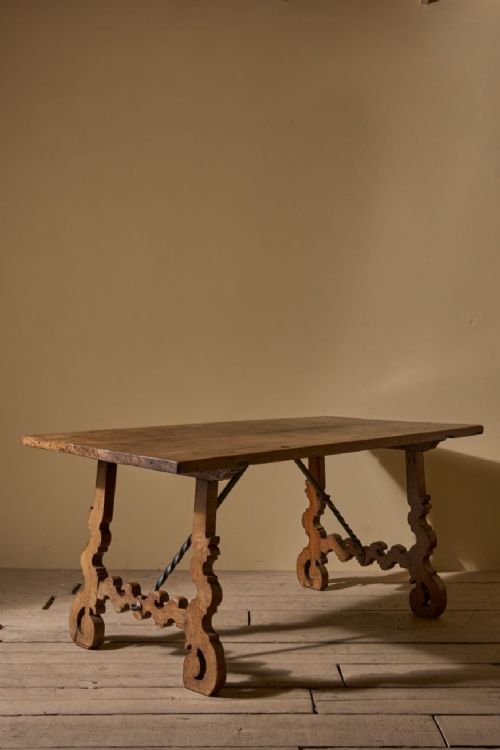
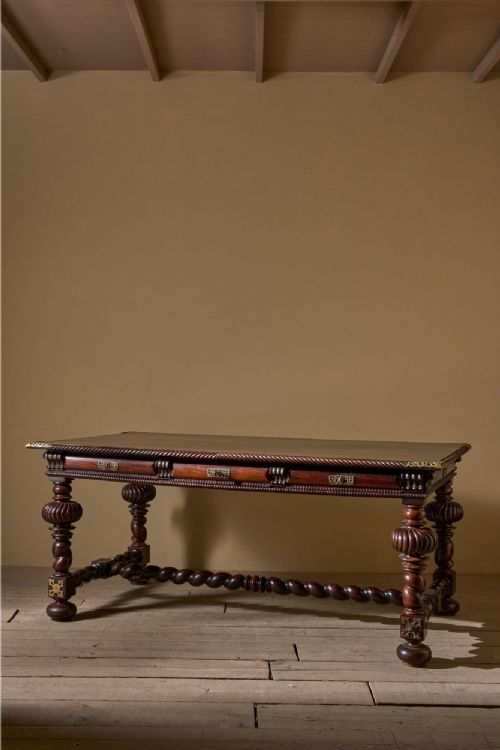
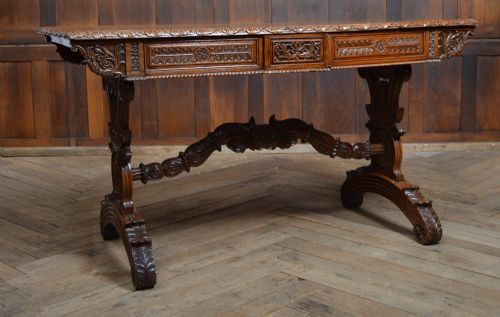


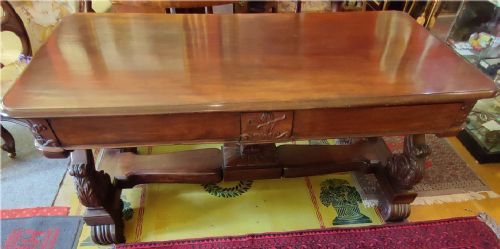


Colonial Library Table
A colonial library table brings centuries of dense walnut, padauk and rosewood into a study, offering a broad surface for reading and writing.
Colonial Library Table
When you search for a colonial library table, you encounter substantial working furniture spanning the eighteenth century, nineteenth century, and later revival periods.
The selections on this page bridge domestic utility and global craftsmanship, featuring forms originating from Spanish, Portuguese, and Anglo-Indian traditions.
You are most likely to meet heavy centre tables, writing desks, and partners desks constructed from durable hardwoods designed for colonial administrative and domestic life.
How they were made
Cabinetmakers utilised dense timbers such as walnut, rosewood, teak, and padauk, often pairing them with fruitwood or brass detailing.
Many examples display intricate hand carving reflecting Spanish Baroque, Portuguese Baroque, and Anglo-Indian regional aesthetics.
Listings feature walnut, rosewood, padauk, and wrought iron across Spanish, Portuguese, and Anglo-Indian styles.
What varies in quality
The distinction between standard workshop output and superior examples lies in the depth and precision of the carved ornamentation across the aprons and legs.
The choice of primary timber also dictates the character of the piece, with richly figured rosewood and walnut sitting at the upper end of the material scale.
Chandy Charan And Co·Currie And Co
The Colonial Library Table Glossary
- Partners desk
- A large double-sided desk designed for two people to work opposite one another, frequently fitted with drawers on both sides.
- Centre table
- A freestanding table finished on all sides so it can occupy the middle of a room rather than sit against a wall.
- Padauk
- A heavy tropical hardwood known for its deep colour and durability, commonly utilised in Anglo-Indian furniture.
- Baroque
- An elaborate artistic style characterised by dramatic ornamentation, visible in seventeenth and eighteenth-century Spanish and Portuguese pieces.
Colonial Library Table: Frequently Asked Questions
What is a colonial library table?
A colonial library table is a heavy wooden writing or centre table produced during the eighteenth, nineteenth, or early twentieth centuries within Spanish, Portuguese, or British colonial spheres.
These pieces were built from dense timbers like rosewood, walnut, and padauk to serve as durable writing and study surfaces.
How do I date these tables?
Dating relies on identifying the prevailing style, such as Spanish Baroque, Regency, or Victorian, combined with the characteristics of the timber and construction methods.
Makers' marks or specific regional carving techniques can also narrow down the period of production.
Where were these tables made?
They were produced across global territories influenced by European powers, including British India, Spain, and Portugal.
Local cabinetmakers in these regions adapted European forms using native tropical hardwoods.
How do I care for a hardwood table?
Protect antique hardwoods from direct sunlight and sudden temperature shifts to prevent the timber from drying out or splitting.
Dust regularly with a soft cloth and avoid chemical polishes that can damage historic finishes.