



Cobalt Blue Majolica
Cobalt blue majolica brings rich, deep mineral colour and bold relief modelling to Victorian and nineteenth-century interiors.
Cobalt Blue Majolica
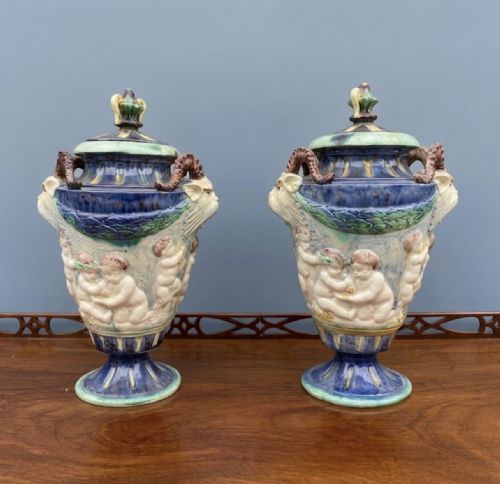
Cobalt blue majolica encompasses a range of nineteenth-century earthenware and tin-glazed vessels finished with vibrant coloured lead glazes. Buyers searching for cobalt blue majolica encounter substantial decorative objects including large jardinieres, cheese domes, apothecary jars, and decorative urns.
The pieces appearing on this page span the Victorian era, c1880, and include earlier examples such as eighteenth-century Italian Savona pieces. Forms range from classical urns and French faience centrepiece dishes to English sardine boxes and heavy majolica cheese dishes.
Stylistic influences draw heavily from Renaissance Revival, Italian Baroque, and French Neoclassical traditions. The shared characteristic across these diverse functional and decorative forms is the striking use of rich cobalt blue glaze.
Materials and manufacture
Makers shaped these pieces from earthenware bodies, applying tin glazes or specialised majolica glazes directly to the clay. The metallic oxides interact with the glaze during firing to produce the characteristic deep blue coloration seen across the wares.
Surface decoration frequently involves hand-painted details beneath or over the glaze, occasionally combined with mounted elements such as ormolu. Certain French pieces incorporate faience techniques, while others utilise moulded relief work to accentuate the sculptural qualities of the vessels.
Cobalt Blue Majolica Retail Price Guide 2026
Typical asking prices for cobalt blue majolica among the pieces listed under this phrase on Sellingantiques today, from the lower quarter to the upper quarter. They describe what is for sale here now, not the wider market.
Crab tureens and sardine boxes prove that Victorian diners enjoyed serving seafood out of ceramic replicas of the fish themselves.
Judging quality in cobalt blue majolica
Quality rests in the crispness of the moulded relief and the depth and evenness of the glaze application. Superior examples display sharply defined ornamentation where the cobalt blue pools richly in the recesses without obscuring the underlying detail.
The ambition of the form dictates distinction, separating standard utilitarian wares from monumental jardinieres, classical urns, and elaborately modelled tureens. Maker attribution also elevates certain pieces, particularly recognised works from factories like Minton and Thomas Forester and Sons.
Minton·Thomas Forester and Sons·George Jones
The Cobalt Blue Majolica Glossary
- Majolica
- A type of pottery glazed with an opaque tin-lead glaze and painted with metallic oxide colours. It is known for its bright palette and heavy, sculptural form.
- Jardiniere
- An ornamental pot or stand for holding flowers or plants. These large vessels often form the decorative centrepiece of a room.
- Tureen
- A deep covered bowl used for serving soup, stew, or other foods. In majolica, they frequently take whimsical animal or naturalistic shapes.
- Apothecary jar
- A vessel used by pharmacists to store medicines and drugs. Early examples often feature detailed hand-painted labelling and rich cobalt glazes.
- Tin glaze
- A lead glaze made opaque by the addition of tin oxide. This surface provides a smooth white ground for subsequent painted decoration.
Cobalt Blue Majolica: Frequently Asked Questions
What is majolica pottery?
Majolica pottery consists of earthenware bodies finished with colourful metallic glazes fired over a tin or lead base. The technique creates bright, durable surfaces with high gloss.
Potters used this method extensively during the Victorian period to create heavily moulded decorative and functional household items.
How were cheese domes used?
Cheese domes and matching dishes served to keep large cheeses fresh on the Victorian dining table. The heavy ceramic cover trapped moisture while protecting the food from insects.
These pieces often featured elaborate naturalistic or classical decoration, making them ornamental as well as practical.
How do I date these pieces?
Dating relies on stylistic clues, factory marks stamped into the clay, and the specific type of glaze and body used. Nineteenth-century pieces often display registration diamonds or maker initials.
Earlier examples from the eighteenth century show distinct throwing techniques and different formulations of tin glaze compared to Victorian production.
Where were these items made?
Production centres for these ceramics spanned England, France, and Italy. Major factories in Stoke-on-Trent produced large quantities for the British market.
At the same time, French faience potteries and Italian workshops produced distinct regional styles using similar glazed earthenware techniques.