


Clock and Urn Garniture
A clock and urn garniture brings symmetry to a mantelpiece, pairing a central timepiece with matching flanking vessels.
Clock and Urn Garniture
A clock and urn garniture provides a complete decorative scheme for a mantelpiece, consisting of a central clock accompanied by a matching pair of side pieces. Buyers seeking this arrangement will encounter three-piece sets designed to create visual balance in a room.
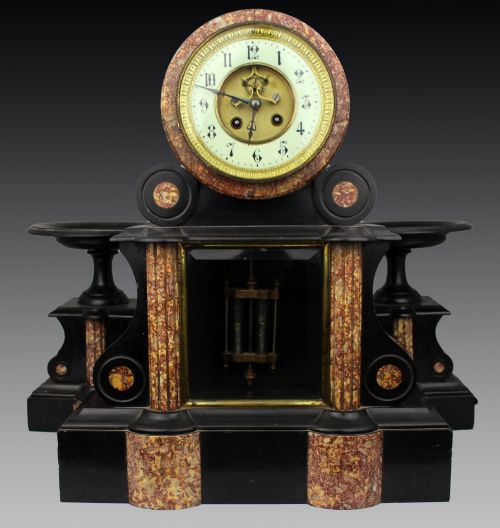
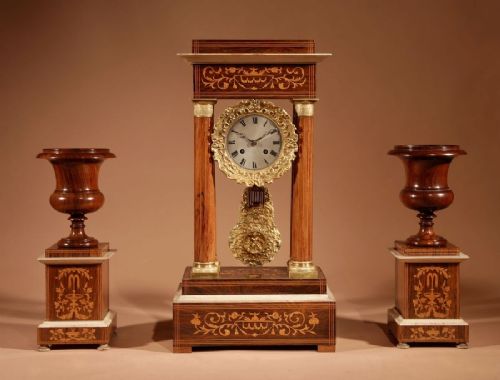
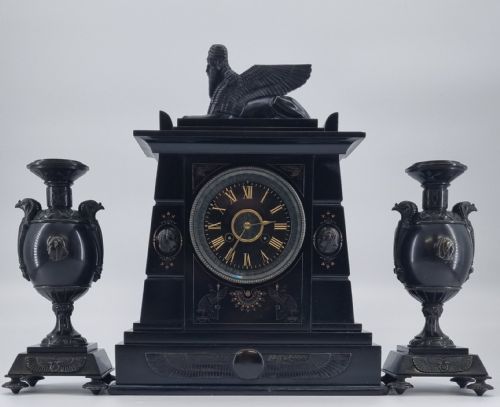
The pieces appearing on this page span the nineteenth century into the early twentieth century, showing strong French origins alongside Victorian examples. Forms range from classical portico designs and Egyptian revival motifs to architectural marble blocks and delicate porcelain sets.
Most compositions comprise a striking clock flanked by matching vases, urns, or ewers constructed to echo the materials and decorative vocabulary of the timekeeper. These matched sets transform a functional timepiece into an integrated sculptural display.
Materials and construction
Makers utilised heavy mineral supports like black slate, Sienna marble, and alabaster to anchor the substantial weight of the clock movements and side urns. These stone bodies often contrast with polished metal mounts and cast decorative elements.
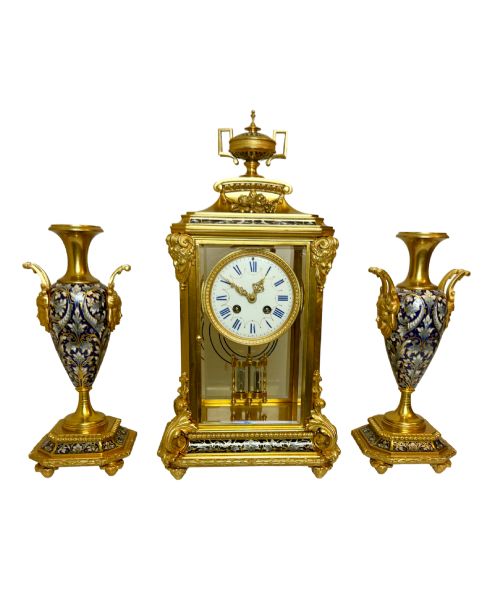
Gilt bronze, ormolu, brass, and gilded toleware provide the bright metallic detailing that defines many of these sets, shaped through casting and chasing techniques. Enamel dials and painted porcelain panels introduce colour and intricate narrative scenes.
Glass domes frequently protect delicate compositions, preserving vulnerable porcelain elements and gilt surfaces from dust and handling over generations.
Materials span heavy black marble and alabaster to delicate porcelain, champleve enamel, and glass protection domes.
Evaluating craftsmanship and detail
The refinement of the cast bronze or ormolu mounts separates standard production from superior examples, with sharper chiselling and deeper gilding indicating higher workshop standards. Model complexity, such as figurative sculpture or champlevé enamel work, also elevates the standing of a set.
The quality of the porcelain components dictates overall distinction, seen in hand-painted details and established factory marks rather than simple transfer printing. Furthermore, the harmonious integration of the stone bodies with their metal fittings reveals the care taken during assembly.
Japy Freres·A D Mougin·Vincenti of Paris·KPM Berlin·Sevres
The Clock and Urn Garniture Glossary
- Garniture
- A matched set of decorative objects designed to be displayed together on a mantelpiece or sideboard, typically comprising a central clock and two flanking urns or vases.
- Ormolu
- Gilt bronze produced by applying a finely ground high-carat gold mercury amalgam to a bronze base, creating a rich golden surface finish common in nineteenth-century decorative arts.
- Portico clock
- A monumental clock style featuring a dial supported by four or more columns resembling a classical temple facade, frequently accompanied by matching side ornaments.
- Champlevé enamel
- A technique where troughs are gouged into a metal surface and filled with vitreous enamel powder before firing, producing colourful geometric or floral patterns.
- Toleware
- Enamelled or lacquered sheet metal items, often hand-painted with floral or decorative motifs to imitate more costly materials.
Clock and Urn Garniture: Frequently Asked Questions
What is a clock and urn garniture?
A clock and urn garniture is a matched three-piece decorative set designed for a mantelpiece or console table. It pairs a central striking clock with two identical flanking urns, vases, or candelabra to create architectural symmetry.
These sets gained immense popularity during the nineteenth century, serving as both reliable timekeepers and grand decorative centerpieces for formal rooms.
How do you style a clock and urn garniture?
These sets work best placed centrally on a mantelpiece, chest of drawers, or sideboard where their symmetry can be fully appreciated. The central clock stands between the two matching side pieces, often arranged with the clock in the middle and an urn on either side.
Ensure the surface is level and sturdy enough to support the weight, particularly for heavy marble or slate assemblies.
What materials were used for these sets?
Nineteenth-century makers utilised a wide variety of materials, ranging from heavy black slate and Sienna marble to refined ormolu, gilt bronze, and brass. Many examples incorporate painted porcelain panels, champlevé enamel, or delicate alabaster.
Glass domes were also utilised to protect the most intricate porcelain and gilt sets from dust.
How do you identify French nineteenth century garnitures?
French garnitures from the nineteenth century often bear the stamp of prominent makers such as Japy Freres, A.D. Mougin, or Vincenti on the movement backplate. Stylistic clues include Louis XVI revival details, Rococo curves, and distinctive dial signatures.
The materials, ranging from portico marble architecture to gilt bronze and hand-painted porcelain, reflect the shifting aesthetic periods of the era.