



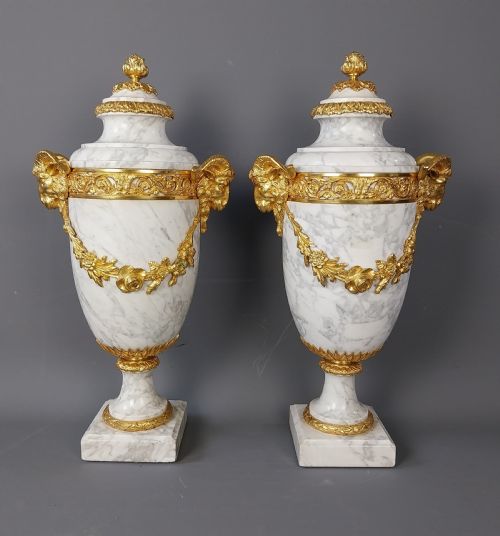


Neoclassical Garniture Urns
Neoclassical garniture urns bring classical proportion and refined metalwork into interiors, offering striking symmetry for a mantelpiece or side table.
Neoclassical Garniture Urns
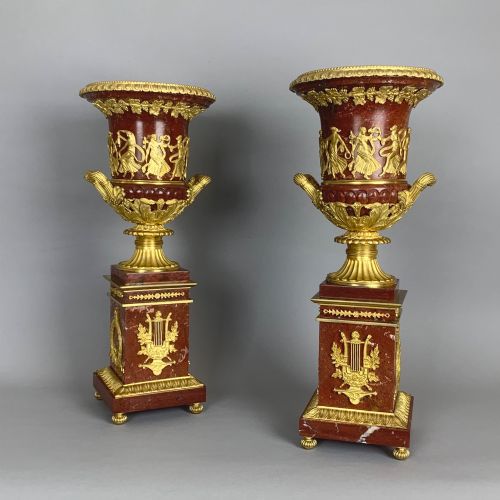
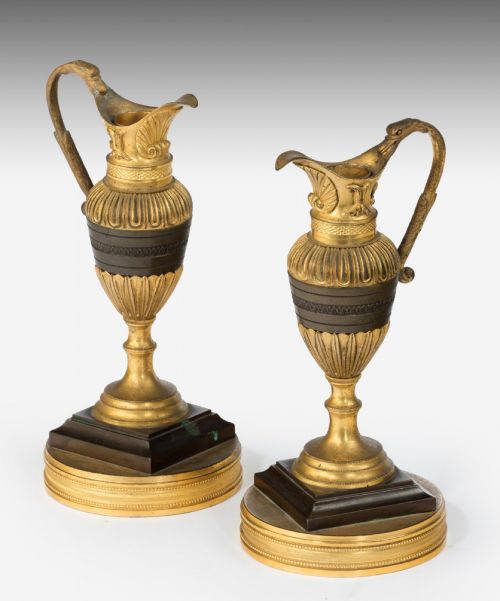
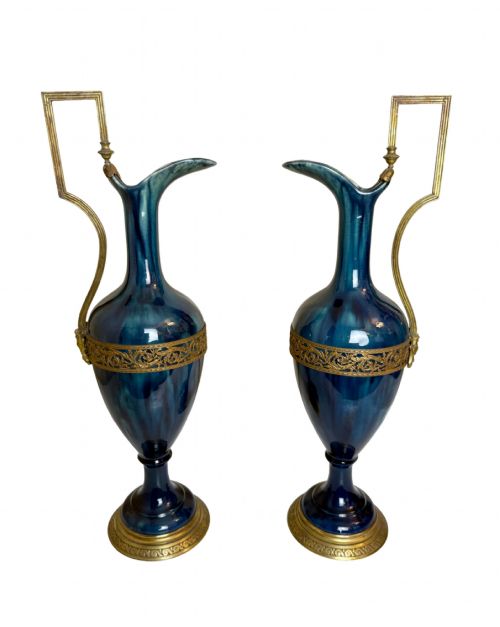
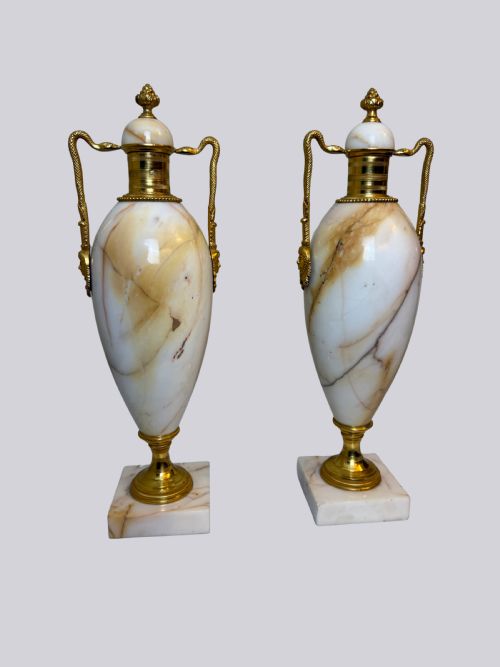
When you search for neoclassical garniture urns, you encounter decorative vessels and multi-piece sets designed to sit symmetrically on mantelpieces and tables. These objects frequently appear as pairs of decorative urns, cassolettes, or as part of a three-piece clock garniture featuring a central timepiece flanked by matching vases.
The pieces on this page originate predominantly from the nineteenth century, spanning Victorian productions and continental European workshops. You find French Empire style compositions alongside Italian Grand Tour souvenirs and Vienna porcelain examples, reflecting diverse interpretations of classical antiquity during the Victorian era.
How they were made
Maker's workshops combined cast metals like bronze, ormolu, and gilded brass with carved stones including white marble, sienna marble, alabaster, onyx, and porphyry. These rigid mineral bases provide weight and contrast to the lustrous metallic mounts and handles applied by artisans.
Ceramic elements such as porcelain and enamel introduce colour and painted detail, while auxiliary components utilise glass, tole flowers, and silver plating. The assembly relies on threaded rods and pins to secure heavy stone plinths to metal collars and finials.
Some nineteenth-century urns secretly hide painted toleware flowers sprouting from their stone interiors.
What varies in quality
The standard of an object rests upon the crispness of the metal chasing and the selection of the stone. Superior examples display sharply defined ormolu mounts with hand-finished detail, paired with unblemished marble or finely turned alabaster that shows consistent natural veining.
Proportion and architectural balance dictate the visual success of the garniture. The finest sets maintain harmonious scale between the central clock and its flanking urns, whereas lesser pieces exhibit clumsy joins or unrefined casting in the bronze elements.
The Neoclassical Garniture Urns Glossary
- Garniture
- A set of matching decorative objects, typically a clock paired with two vases or urns, designed for display together on a mantelpiece.
- Ormolu
- Gilded bronze utilised for decorative mounts and handles, created through a process of applying gold amalgam to cast bronze.
- Cassolette
- A decorative vase or urn with a reversible lid that functions either as a closed vessel or an incense burner.
- Grand Tour
- A traditional trip through Europe undertaken by upper-class travellers who acquired souvenirs such as alabaster and bronze classical vases.
- Porphyry
- A hard igneous rock with large crystals, favoured in classical and nineteenth-century design for its deep purple or reddish colour.
Neoclassical Garniture Urns: Frequently Asked Questions
What is a clock garniture?
A clock garniture is a matched set consisting of a mantel clock accompanied by two side pieces, usually decorative urns or vases. These items were designed to create a balanced, symmetrical arrangement on a fireplace mantel or sideboard.
The matching elements share materials, styles, and decorative motifs, unifying the display across the surface. While the central clock kept time, the flanking urns completed the architectural presentation favoured in nineteenth-century interiors.
How do I style these urns at home?
You can display pairs of urns symmetrically on a mantelpiece, sideboard, or console table to establish a formal focal point. Placing them on either side of a mirror or a central clock echoes their original nineteenth-century placement.
Ensure the surface supports the considerable weight of stone and bronze objects. Keep them away from direct heat sources to protect delicate finishes like ormolu gilding and natural alabaster.
Are these pieces strictly French?
Not all pieces originate from France, although many follow French Empire and Louis XVI styles. The selection includes Italian productions, particularly alabaster and bronze souvenirs associated with the Grand Tour.
You also find Vienna porcelain urns and English Victorian interpretations of classical designs. The shared aesthetic is neoclassical, regardless of the specific European workshop origin.