
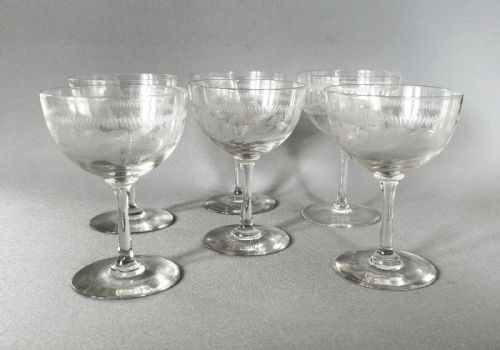


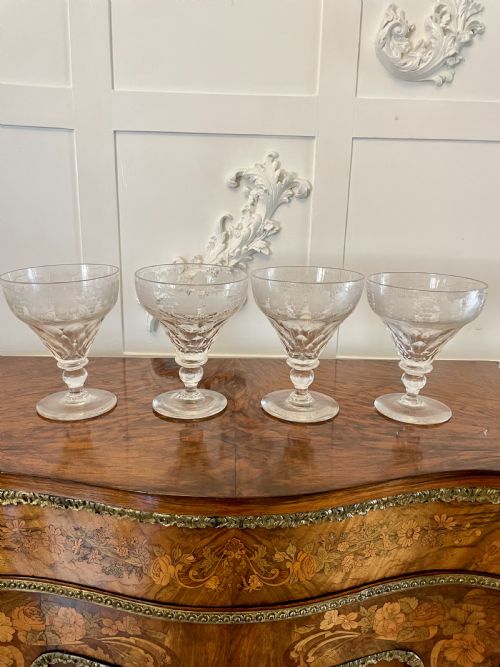


Clear Glass Cocktail Set
A clear glass cocktail set brings sharp lines and brilliant sparkle to a gathering, offering matching vessels designed for serving drinks with period style.
Clear Glass Cocktail Set
A clear glass cocktail set comprises matching drinking vessels, decanters, or jugs gathered together for entertaining. When you search for a clear glass cocktail set, you encounter suites intended for serving champagne, wine, and mixed drinks.
The pieces appearing here span several decades, stretching from Victorian examples to the bold geometry of Art Deco production. You are most likely to meet twentieth-century suites featuring matching sets of coupes, decanters, and jugs.
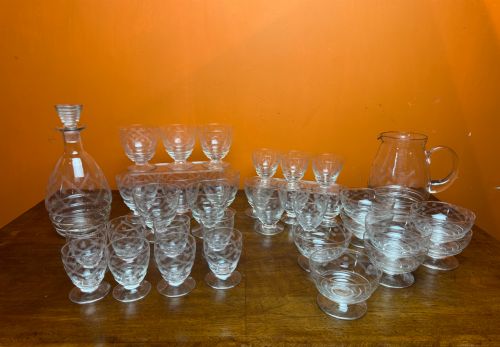
Origins represented in these gatherings include English, French, Bohemian, and Czech manufacture. Forms range from compact groups of four glasses to large suites containing dozens of matching drinking vessels and serving pieces.
How they were made
Makers utilised clear glass, crystal, and crystal glass, shaping them into vessels through blowing and moulding techniques. Artisans then enhanced the plain surfaces by applying wheel-engraved decoration, acid etching, or vibrant enamel work.
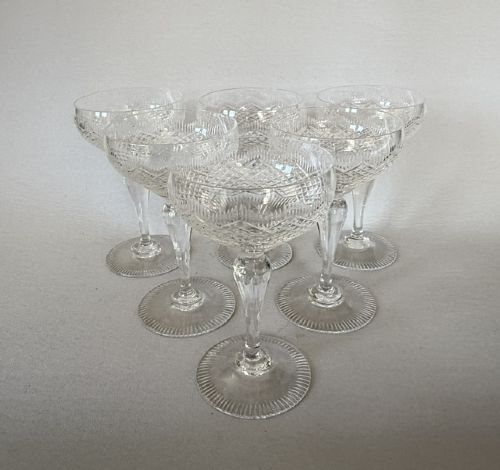
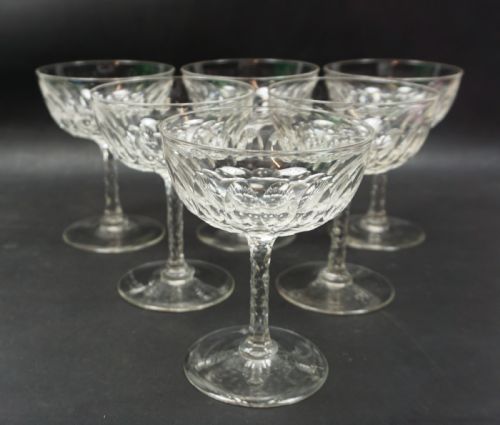
Cut glass examples display sharp facets created by grinding wheels, particularly around the stems and bases of champagne coupes. Silver plating also appears alongside the glass, notably on hardware such as ice bucket mounts and tongs.
Listings feature materials spanning clear glass, crystal, and enamel, alongside decorative techniques including acid etching and wheel cutting.
What varies in quality
Quality depends upon the clarity of the material and the crispness of the applied decoration, whether cut, etched, or enamelled. Heavier crystal suites with precise facet-cut stems demonstrate greater technical skill than lighter, mould-pressed alternatives.
Consistency across a suite dictates desirability, as finding a complete group with matching jugs, decanters, and all original glasses elevates a set. The complexity of surface ornamentation, from simple Greek key borders to detailed pictorial enamel, also separates standard production from finer work.
The Clear Glass Cocktail Set Glossary
- Champagne coupe
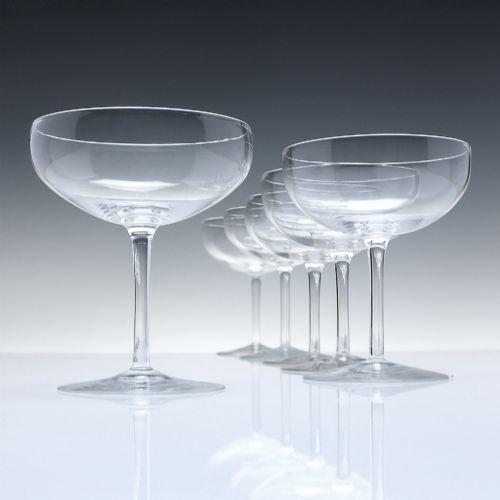
- A shallow, broad-bowled glass designed originally for sparkling wine and widely utilised for cocktails. These bowls sit atop slender stems, sometimes featuring facet cutting.
- Decanter set
- A matched grouping consisting of a serving vessel and a corresponding number of drinking glasses. Such sets were produced for domestic entertaining.
- Etched glass
- Glass decorated by applying acid to eat away exposed areas, leaving a permanent design. This technique creates delicate floral or geometric patterns across the surface.
- Facet cut
- A decorative surface finish formed by grinding flat planes into the glass body. It catches light and adds weight to the stem or base of a drinking vessel.
- Enamel
- Opaque vitreous material fused onto the exterior of glassware to add colour and pattern. It frequently appears in geometric designs on twentieth-century pieces.
Clear Glass Cocktail Set: Frequently Asked Questions
How do I date a cocktail set?
Dating relies upon stylistic indicators such as the heavy geometric motifs of Art Deco production or the delicate etched borders typical of the Edwardian era. Manufacturing techniques and glass weights further help place pieces within specific decades.
Examining the shape of the bowls and the presence of silver-plated mounts provides additional context for determining the period of origin.
Are these sets safe for daily use?
Many vintage drinking vessels remain entirely serviceable for occasional entertaining and careful use. Hand washing is essential to protect delicate enamel work and thin crystal.
Modern dishwashers can damage antique glass surfaces and remove applied decoration over time.
What is the difference between glass and crystal?
Crystal glass contains metallic additives that increase its weight, refractive index, and brilliance compared to standard soda-lime glass. This composition allows artisans to cut deeper facets that reflect more light.
Standard glass tends to be lighter and was more commonly utilised for everyday domestic tableware.
How many pieces usually form a set?
Completions vary widely, ranging from small groups of four wine glasses or champagne bowls up to large suites containing over thirty matching drinking vessels. Decanter sets typically pair a single jug or decanter with six matching glasses.
Partial suites frequently occur as individual glasses have broken over the decades.