


1930s Art Deco Decanter
These 1930s art deco decanter pieces bring geometric form and striking colour to a drinks trolley, combining practical barware with period design.
1930s Art Deco Decanter
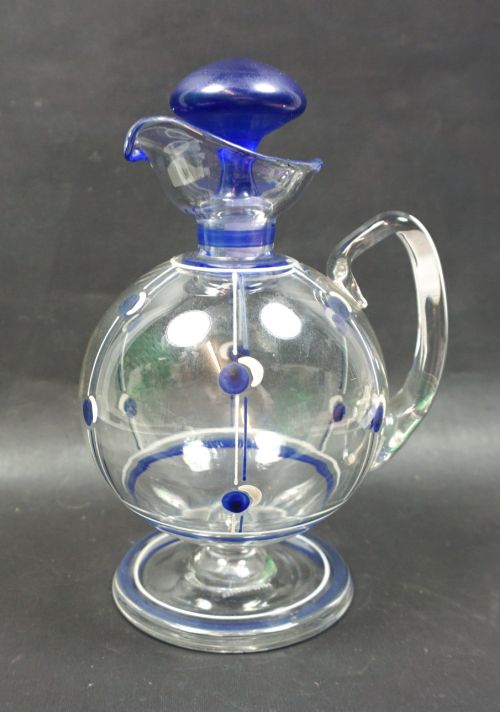
A 1930s art deco decanter search reveals glassware designed for entertaining, often appearing as complete sets with matching glasses and trays. The most common iteration met here is the Czech production originating from Bohemia, frequently featuring hand-enamelled geometric patterns.
Beyond standard liquor vessels, the category encompasses whisky noggins, claret jugs, and cocktail shakers alongside broader barware suites. Pieces emerge from French, English, and Belgian workshops as well as Central European furnaces.
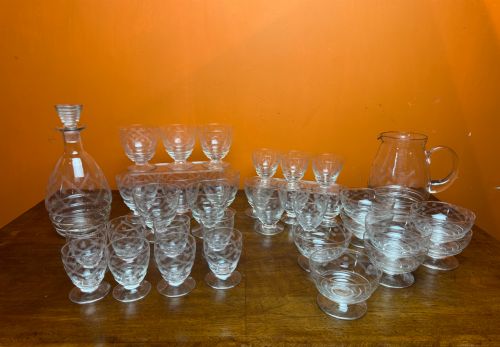
The objects serve as functional drinkware defined by the aesthetic tenets of the period, spanning standalone decanters to comprehensive suites containing thirty-four drinking glasses.
Materials and production methods
Makers utilised lead crystal, cut glass, and plain or black glass as the primary substrate, applying surface decoration through hand enamelling and engraving. Chrome mounts and sterling silver collars provide structural contrast and secure pouring spouts.
Techniques relied on skilled glass cutting and polychrome enamel work to achieve the sharp, linear motifs characteristic of the era. Bohemia and Czechoslovakia emerged as centres for complex enammelled crystal production.
Object forms documented here range from perfume bottles and cocktail shakers to large dining suites and tantalus frames.
Distinctions in quality
Quality rests upon the precision of the glass cutting and the crispness of the hand-enamelled geometric or figurative details. Works bearing attribution to known designers display superior execution in enamel saturation and crystal clarity.
Complete suites retaining all matching glasses and the original tray command greater interest than isolated bottles. The integration of silver or chrome mounts also influences the overall standard of the item.
Karl Palda·Val Saint Lambert·Jacques Adnet·Mosey
The 1930s Art Deco Decanter Glossary
- Decanter set
- A grouping comprising a serving vessel accompanied by a matching set of small glasses or shot glasses. These often sit together upon a fitted glass or metal tray.
- Whisky noggin
- A small single-measure spirit jug, typically fitted with a sterling silver lip and handle. They date frequently to the mid-1930s.
- Tantalus
- A locking wooden or metal frame holding decanters securely while displaying the contents. The modernist versions utilise chrome and glass construction.
- Enamelling
- The application of coloured glass paste fused to the vessel surface by heat. This technique creates the vibrant geometric patterns seen on Bohemian glassware.
- Lead crystal
- Glass containing metal oxide to increase brilliance and weight. It provides the heavy, clear base necessary for deep cutting.
1930s Art Deco Decanter: Frequently Asked Questions
How do I identify a Czech decanter?
Look for characteristic geometric hand-enamelling applied to crystal or amber glass bodies, often accompanied by small shot glasses.
Many originate from Bohemian workshops dating around the nineteen thirties.
Were these sold with matching glasses?
Many listings present complete suites that include six matching glasses alongside the central bottle.
Larger drinking sets contain dozens of glasses designed for spirits or wine.
What metals were used for mounts?
Sterling silver and chrome appear frequently on the necks, handles, and tantalus frames of the glassware.
Silver mounts often carry hallmarks indicating the precise year of assay.
Can I use these for serving drinks?
The vessels function well for serving spirits, wine, and mixed cocktails during gatherings.
Care should be taken with hand-enamelled surfaces during washing to preserve the pigment.