
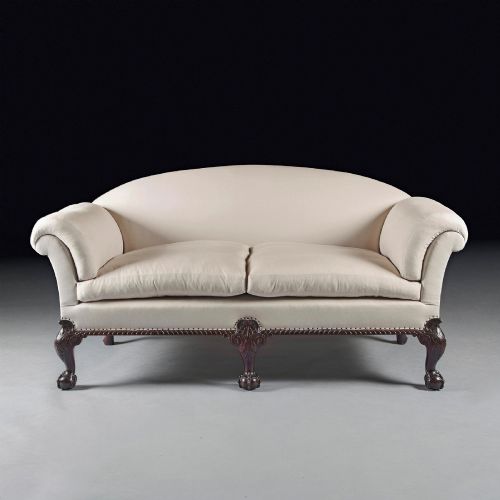


Claw and Ball Foot Sofa
These claw and ball foot sofa pieces combine timber and upholstery for domestic seating, offering period character for daily use.
Claw and Ball Foot Sofa
A claw and ball foot sofa provides upholstered seating raised on carved timber supports depicting a talon gripping a sphere. These pieces appear across several periods, from the eighteenth century to the twentieth century, reflecting shifting tastes in domestic furniture.
The most common examples on this page date to the nineteenth century and the Victorian era, often adopting Chippendale styles or later revivals. Makers utilise forms ranging from two-seat settees to triple-back designs and larger lounge suites.
Buyers encounter variations including mahogany frames, cotton calico, fabric upholstery, and leather finishes. Some pieces link to specific makers like Howard and Sons, whilst others reflect George II style or Aesthetic Movement influences.
How they were made
Makers construct the structural frames of these settees primarily using mahogany, selected for its strength and suitability for detailed carving on the legs and feet. Carvers shape the timber by hand to create the characteristic hawk claw and ball details.
Upholstery techniques involve securing materials such as cotton calico, leather, and various fabrics over the frame to provide deep seating comfort. Additional elements like brass fixings sometimes appear on campaign or related variants.
Some nineteenth-century makers applied elaborate Chinoiserie fabrics to their ball and claw foot settees, ensuring the birds on the feet matched the avian themes overhead.
What varies in quality
The definition and depth of the carved timber feet separate standard production from superior craftsmanship. Sharp, well-defined talons gripping the ball demonstrate greater skill from the maker than soft or shallow carving.
The integrity of the mahogany frame and the quality of the original materials influence the overall standard. Pieces associated with notable makers like Howard and Sons exhibit particular attention to internal construction and upholstery depth.
Howard and Sons
The Claw and Ball Foot Sofa Glossary
- Chippendale
- A style of English furniture design named after Thomas Chippendale, characterised by carved mahogany and classical motifs. This aesthetic heavily influences many nineteenth-century revival settees.
- Mahogany
- A durable tropical hardwood prized for its rich colour and stability under intricate hand carving. It serves as the main structural material for the frames and feet of these sofas.
- Campaign sofa
- A portable form of seating designed for military officers or travel, often featuring specific construction methods. Examples include brass hardware and robust timber frames.
- Aesthetic Movement
- A late nineteenth-century design current that prioritised visual beauty over narrative function. Sofas from this movement incorporate distinctive fabrics and artistic decorative schemes.
Claw and Ball Foot Sofa: Frequently Asked Questions
What is a claw and ball foot sofa?
A claw and ball foot sofa is an upholstered settee raised on timber legs ending in carved feet that represent a bird's talon gripping a sphere. These pieces span multiple centuries and stylistic revivals.
Makers shape the timber framework from mahogany and combine it with various upholstery materials, creating durable seating with distinct period presence.
How do I date a settee?
Dating a settee involves examining the timber species, the style of the frame, and the carving technique on the feet. Eighteenth-century pieces differ in structural joinery from nineteenth-century Chippendale revival versions.
Comparing the upholstery materials and any maker signatures provides additional chronological context for the piece.
Are these sofas comfortable for daily use?
Many examples, particularly deep-seated Victorian and Edwardian versions, are constructed for substantial domestic relaxation. The internal webbing and padding support extended sitting.
Buyers often assess the depth of the seat and the firmness of the upholstery when selecting a settee for a living space.
What styles are available?
The listings feature Chippendale style, George II style, and Aesthetic Movement influences applied to various settee formats. These range from two-seat frames to triple-back settees and complete lounge suites.
Each style interprets the traditional claw and ball foot through the design vocabulary of its respective era.